Will Rare Earth magnets shift from being commoditized and mostly Chinese-made, to a higher-value market, sustaining a moat for leading Western companies? Especially as demand inflects in the AI era? Our answers in this 14-page report are based on a site visit to Europe’s first large-scale Rare Earth magnet plant, and subsequent economic modeling.
On the 17th September 2025, we participated in a site visit to Neo Performance Materials‘ new magnet manufacturing plant in Narva, Eastern Estonia, which has just started up, and is now the only large-scale magnet manufacturing facility in Europe. The key controversy on our minds, is described on page 2.
A theoretical re-cap of Rare Earth magnets covers the global Rare Earth market, why Rare Earths produce such strong magnets, especially for NdFeB Rare Earth magnets with 30-60 MGOe of BHMax magnetic properties, on pages 3-4.
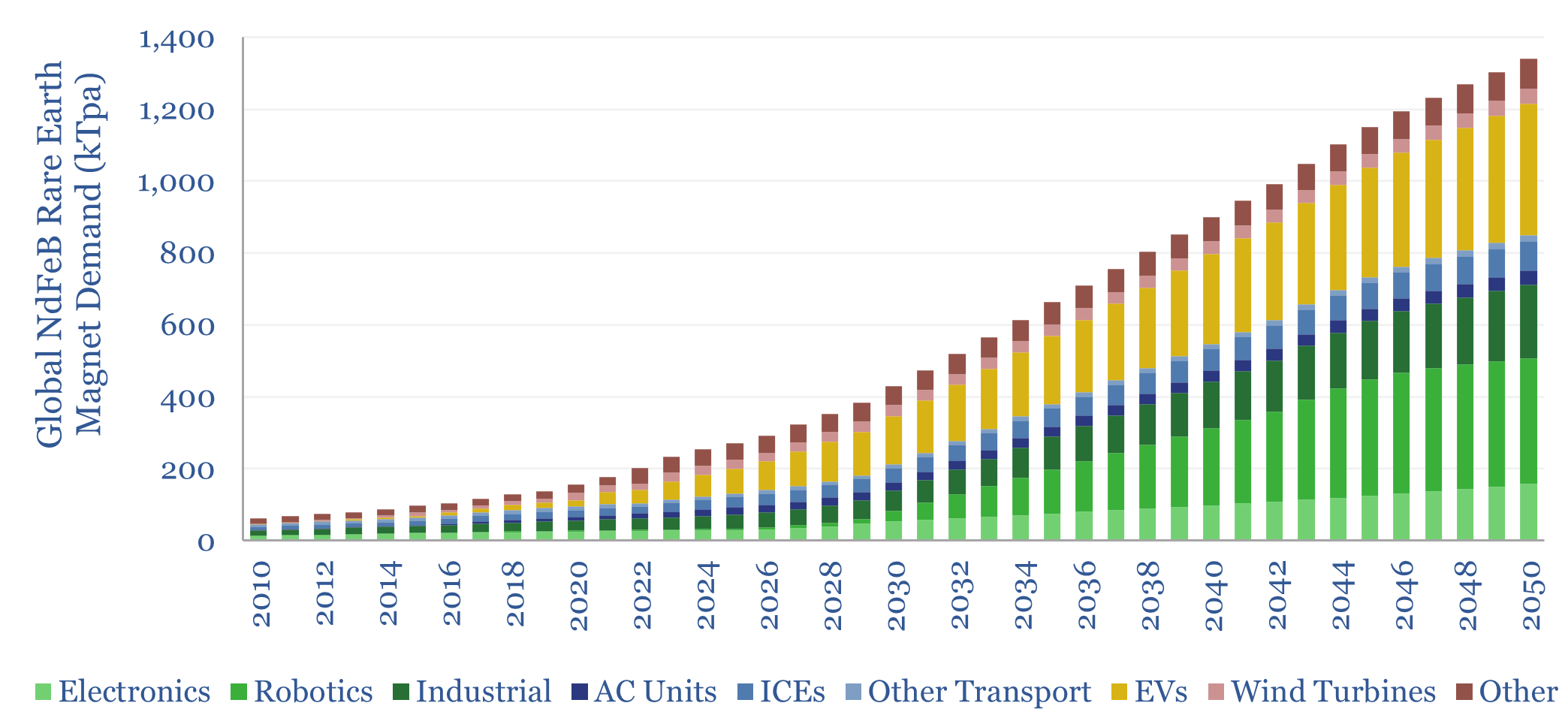
Global demand for NdFeB magnets is seen rising at 7% per year, from 250kTpa in 2024 to 1.3MTpa by 2050, in our Rare Earth magnet demand model, whose demand drivers discussed on page 5.
But Rare Earth magnet manufacturing is more complex than we had previously realized before our site visit. Twelve separate stages are described on pages 6-7.
We also modeled the costs of Rare Earth magnet manufacturing, based on public market disclosures, and insights from our site visit, finding $60/kg pricing can unlock double-digit IRRs, on pages 8-10.
What surprised us most is the economic importance of integration and operator optimizations across the magnet manufacturing processes, as discussed on pages 11-12.
We have screened leading companies in magnet manufacturing, and note quite different experience levels across the group. The note concludes by considering what characteristics will help operators to maximize value, on pages 13-14.