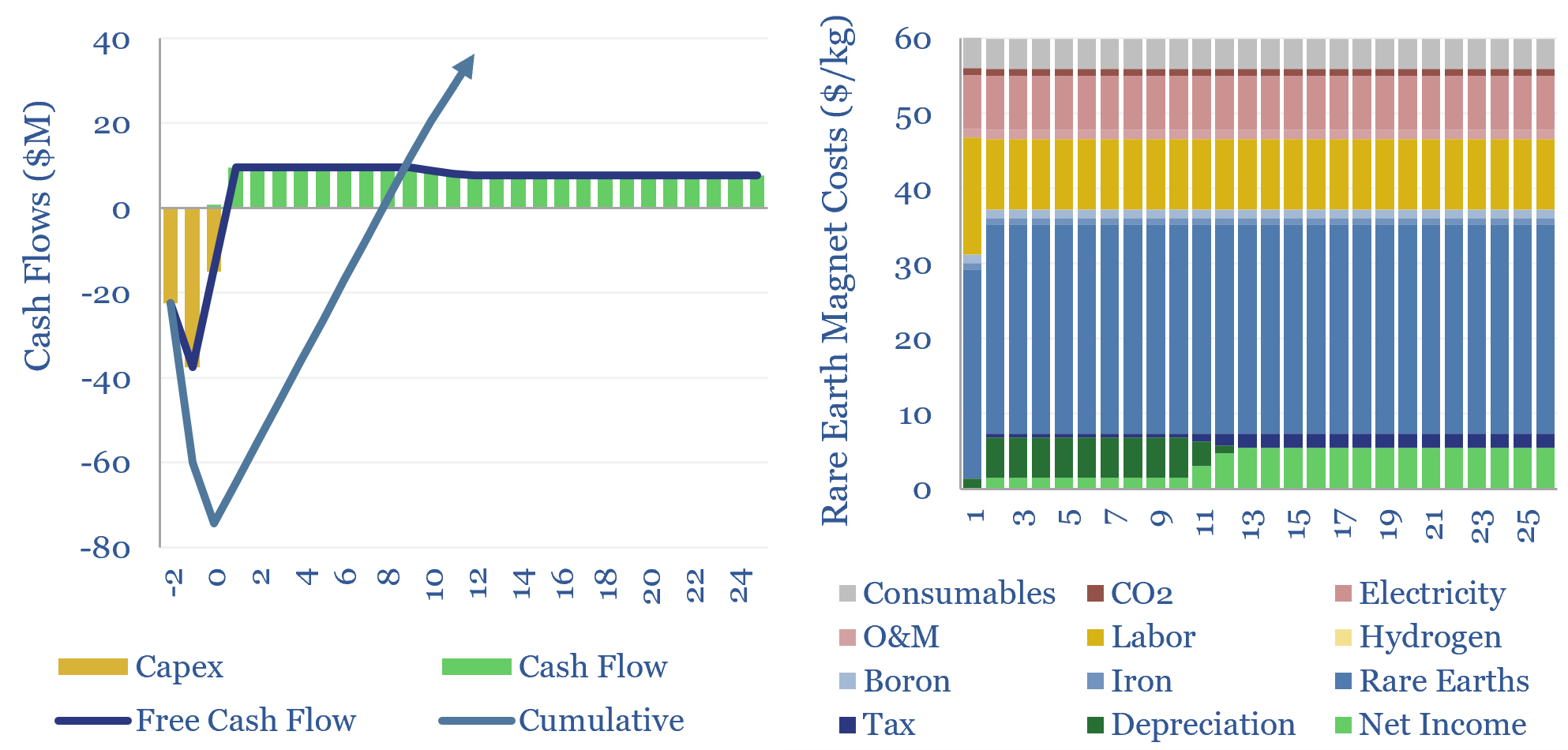
The economics of Rare Earth magnet manufacturing are captured in this data-file. A $60/kg magnet price unlocks a 10% IRR at a new facility converting Rare Earths, steel and ferroboron into sintered NdFeB magnet products, repaying capex and cover other Rare Earth magnet manufacturing costs.
Rare Earth Magnets are produced by melting input materials in a vacuum induction furnace, strip casting the product, milling it into a powder, alignment-pressing the powder, sintering, then shaping, cutting and coating precisely engineered products.
Over 90% of this value chain is currently controlled by Chinese companies, but there is a growing push to re-shore magnet manufacturing in Western supply chains.
Hence what kind of economics would be needed to generate double-digit returns at new Rare Earth magnet manufacturing production facilities? This data-file provides our own cost breakdown, based on technical papers, other TSE economic models, and a site visit to Neo Performance Material’s Narva manufacturing facility.
Capex costs at recent Rare Earth magnet manufacturing projects average $55,000/Tpa, based on disclosures from public companies, which are tabulated below.

Other production costs captured in our data-file include Rare Earths, steel, ferroboron, hydrogen, inert gases, labor, O&M, electricity, and other consumables such as phosphoric acid, nickel, copper and epoxy coating materials.
A $60/kg sales price can unlock 10% IRRs at a typical Rare Earth magnet manufacturing facility, rising to 20% IRRs at $70/kg, but only just covering cash costs at $50/kg. Maximizing product quality and sales price is therefore important.
Other surprisingly important economic variables include integration (to re-capture the value of off-cuts from the shaping process) and the ability to thrift out particularly high-priced Heavy Rare Earths. Please download the data-file to stress test the economics.
Our other Rare Earth data-files cover Rare Earth materials, Rare Earth production economics, Rare Earth magnet demand, a screen of Rare Earth producers, and a screen of magnet manufacturers.