-
Oil markets: restoring the balance?
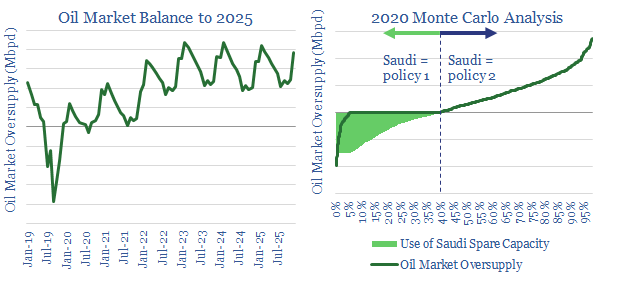
OPEC will most likely need to cut production again to stabilise 2020 oil markets, as shown by our newly updated oil market models. But over-supply still looms in 2023-25. Three resolutions could remove the overhang, within the oil markets’ balance of probabilities. Our updated oil market outlook is explore in this short, 4-page note.
-
Shipping in batteries: the economics?
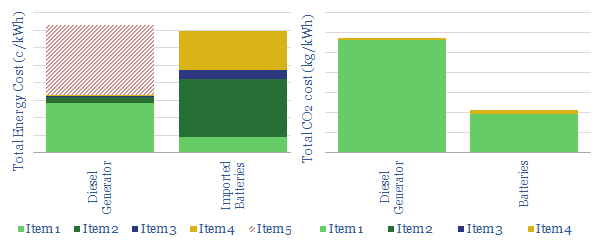
What if it were possible to displace diesel from high-cost, high-carbon island grids, by charging up large batteries with gas- and renewable power, then shipping the batteries? We model the economics to be cost-competitive, while CO2 emissions can be halved. Futher battery cost deflation will also help.
-
Global hydrogen: market breakdown?
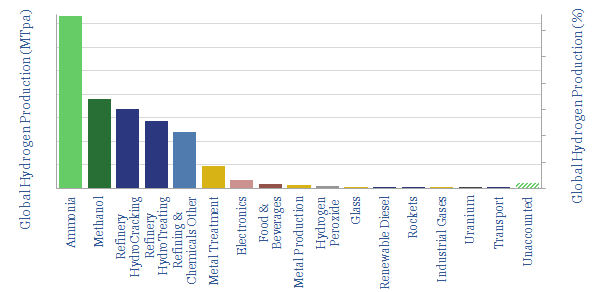
This data-file is a global hydrogen market breakdown, disaggregating the 110MTpa market (mainly ammonia, methanol and refining), how it is met via different production technologies, and our estimates of those technologies’ costs (in $/kg) and CO2 intensities (in kg/kg or tons/ton).
-
Guyana: carbon credentials & capital costs?
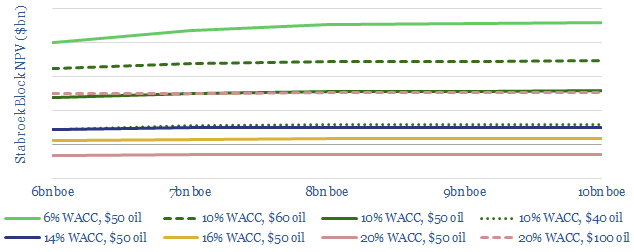
Commercialising Guyana’s new oil resources could entail 30-35kg of CO2 per bbl, which is c50% below the oil industry average. Prioritising such low carbon barrels will matter increasingly to investors, as they can reduce total oil industry CO2 by 25%. Hence, they should attract a lower WACC. In Guyana’s case, the upshot could add $8-15bn…
-
Guyana: Economic Model
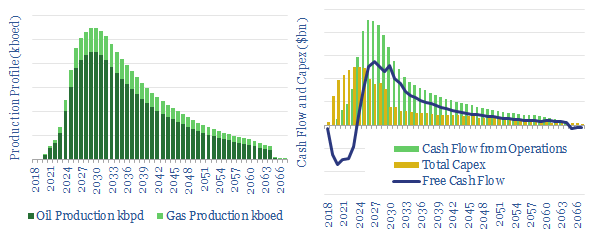
We have modeled the economics for the full development of Exxon, Hess and CNOOC-Nexen’s Stabroek block in Guyana, FPSO by FPSO. The data-file includes the field’s ultimate value, resource volumes, production volumes, cash flows, capex and per-barrel economics. Sensitivities can also modeled as a function of oil prices, WACCs and resources.
-
Global Flaring Intensity by Country
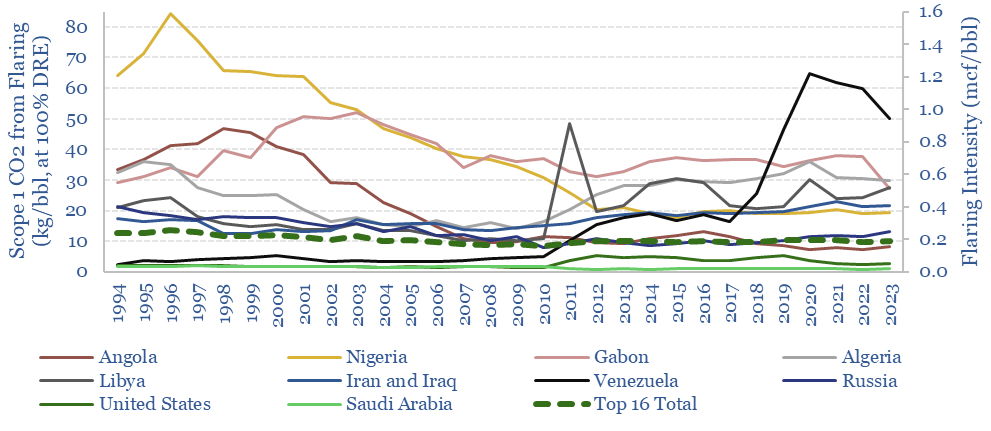
This data-file tabulates global flaring intensity in 16 countries: in absolute terms (bcm per year), per barrel of oil production (mcf/bbl) and as a contribution to CO2 emissions (kg/boe). 2021 saw 144bcm of global flaring, averaging 0.2 mcf/bbl and 10 kg/boe of direct emissions. Lower decile countries flared 0.7 mcf/bbl, which is over 40 kg/boe.
-
The Ascent of Small Scale LNG?
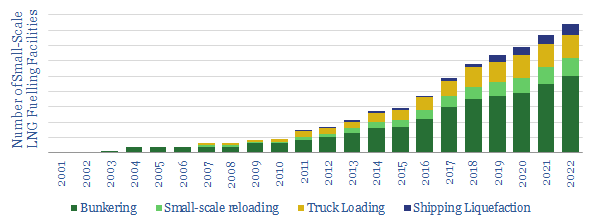
Large LNG projects make large headlines. But we are excited by the ascent of small-scale LNG facilities. At less than 1MTpa each, these facilities can be harder to track, which is the objective of this data-file. We find small LNG liquefaction capacity is set to double, to 25MTpa. Liquefaction facilities for shipping will rise 8x…
-
Investing for an Energy Transition
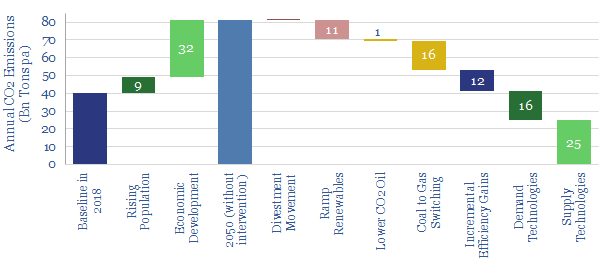
What is the best way for investors to drive decarbonisation? We argue a new ‘venturing’ model is needed, to incubate better technologies. CO2 budgets can also be stretched furthest by re-allocating to gas, lower-carbon oil and lower-carbon industry. But divestment is a grave mistake.
-
Production profiles: renewables vs oil and gas?
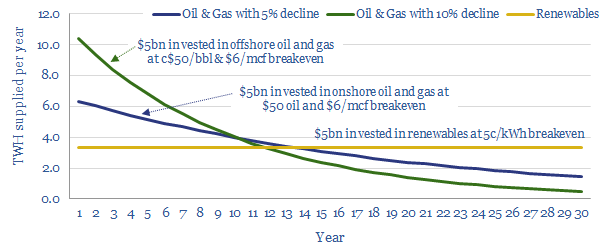
Further deflation of c50-70% is required before the world can truly “re-allocate” capital from fossil fuels to renewables, without causing near-term shortages. This is because fossil fuels’ production profiles are 2-3x more front-end loaded; despite comparable costs, breakevens and resource sizes. It is still necessary to attract adequate capital for both supply sources.
-
Drones & droids: deliver us from e-commerce
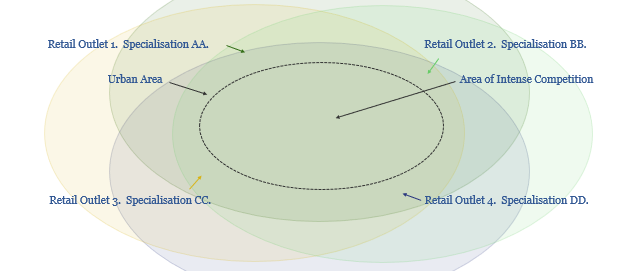
Small, autonomous, electric vehicles are emerging. They are game-changers: rapidly delivering online purchases to customers, creating vast new economic possibilities, but also driving the energy transition. Their ascent could eliminate 500MTpa of CO2, 3.5Mboed of fossil fuels and c$3trn pa of consumer spending across the OECD. The mechanism is a re-shaping of urban consumption habits,…
Content by Category
- Batteries (95)
- Biofuels (44)
- Carbon Intensity (48)
- CCS (64)
- CO2 Removals (9)
- Coal (41)
- Commentary (65)
- Company Diligence (104)
- Data Models (920)
- Decarbonization (162)
- Demand (129)
- Digital (86)
- Downstream (47)
- Economic Model (220)
- Energy Efficiency (76)
- Hydrogen (63)
- Industry Data (308)
- LNG (56)
- Materials (86)
- Metals (88)
- Midstream (45)
- Natural Gas (161)
- Nature (76)
- Nuclear (28)
- Oil (175)
- Patents (39)
- Plastics (44)
- Power Grids (155)
- Renewables (153)
- Screen (136)
- Semiconductors (35)
- Shale (58)
- Solar (72)
- Supply-Demand (53)
- Vehicles (95)
- Video (24)
- Wind (47)
- Written Research (405)