-
Manufacturing utilization rates by industry?
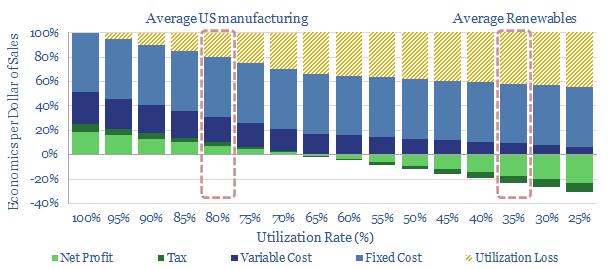
This data-file tabulates the utilization rates of different industries over time, based on a variety of data sources. Manufacturing utilization rates ran at almost 80% prior to the COVID crisis, underpinning 11% of US GDP and 25% of US energy consumption. No manufacturing industry can realistically be profitable running at the c35% utilization rates of…
-
Energy storage: batteries versus supercapacitors?
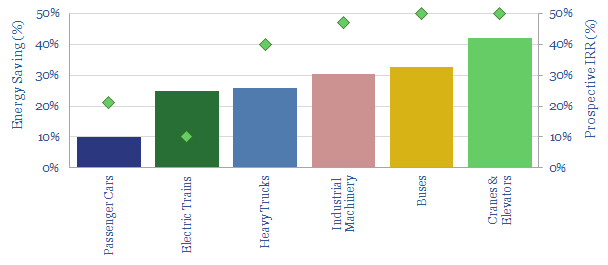
Supercapacitors may eclipse lithium ion batteries in the hybridization of transport and industry. Their energy density is improving. Potential CO2 savings could surpass 1bn tons per year. IRRs of 10-50% can be achieved, even prior to CO2 prices. These are our conclusions after reviewing 2,000 Western patents. We profile the leading companies exposed to the…
-
Criticisms of Carbon Offsets and Reforestation?
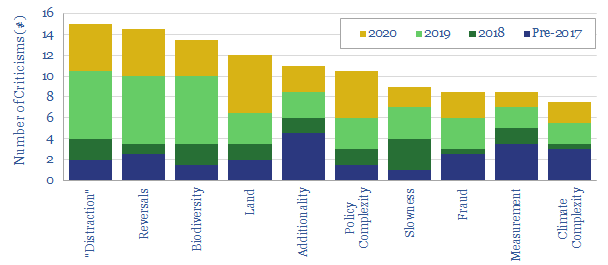
We have collated 100 criticisms into carbon offsets using nature based solutions such as reforestation, sourced from discussions, technical papers and press reports. Ten challenges must be overcome. Most pressingly, CO2 offsets must integrate with decarbonization plans, avoid ‘reversals’ and be well-structured.
-
Energy Transition Technologies?
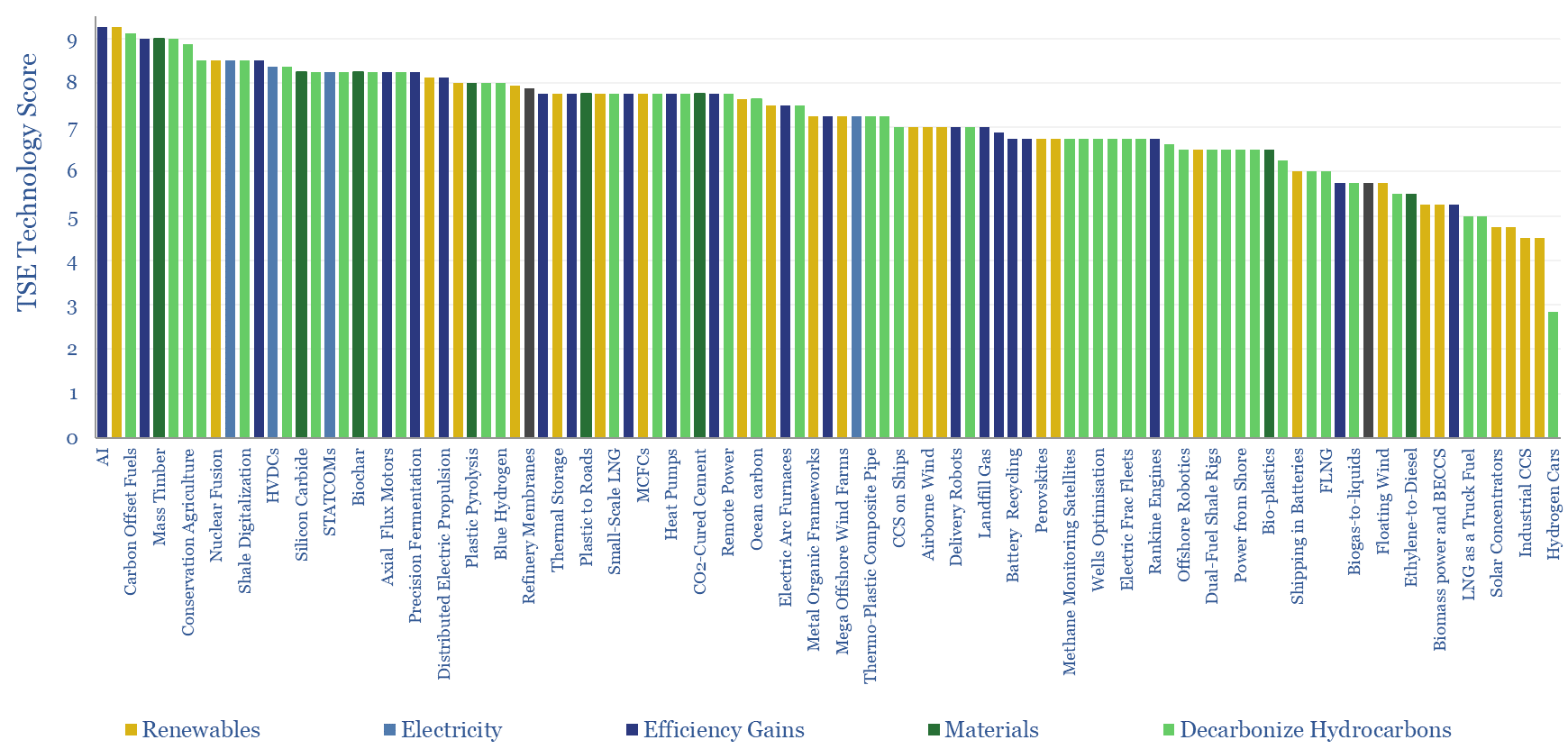
This data-file “scores” the top technologies to transform the global energy industry and the world, as assessed by Thunder Said Energy. Each one is scored based on technical readiness, economic impact and the level of work we have conducted.
-
Desalination by reverse osmosis: the economics?
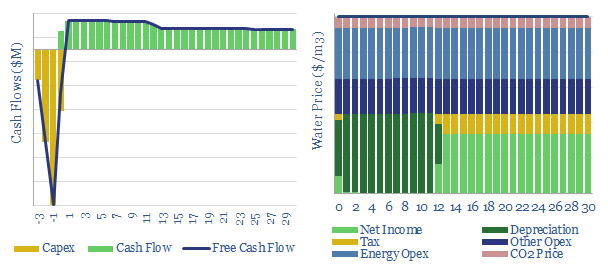
35bn tons of desalinated water are produced each year, absorbing 250 TWH of energy, or 0.4% of total global energy consumption. These numbers will likely rise, due to demographic trends, and due to climate change. Desalination costs average $1.0/m3, use 3.5kWh/m3 of electricity and can demand shift.
-
Super-capacitors: technology leaders?
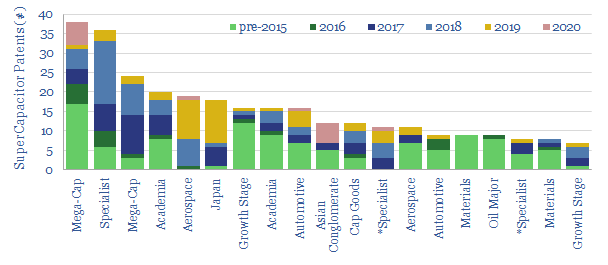
This data-file screens for the ‘top twenty’ technology leaders in super-capacitors, by assessing c2,000 Western patents filed since 2013. The screen comprises capital goods conglomerates, materials companies, an Oil Major with exposure and specialist companies improving SC energy density.
-
3D printing an energy transition?
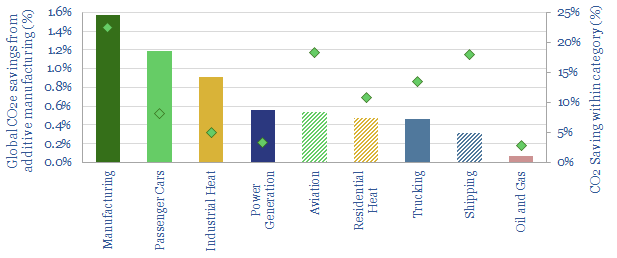
Additive manufacturing (AM) can eliminate 6% of global CO2, across manufacturing, transport, heat and supply chains. We have quantified each opportunity and reviewed 5,500 patents to identify who benefits, among Capital Goods companies, AM Specialists and the Materials sector.
-
Carbon-negative plastics: a breakthrough?
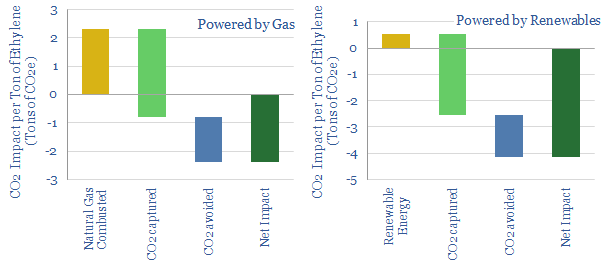
This short note describes a potential, albeit early-stage, breakthrough converting waste CO2 into polyethylene, based on a recent TOTAL patent. We estimate the process could sequester 0.8T of net CO2 per ton of polyethylene. This matters as the world consumes c140MTpa of PE, 30% of the global plastics market, whose cracking and polymerisation emits 1.6T…
-
Efficient frontiers: improvements from a CO2 price within oil and gas?
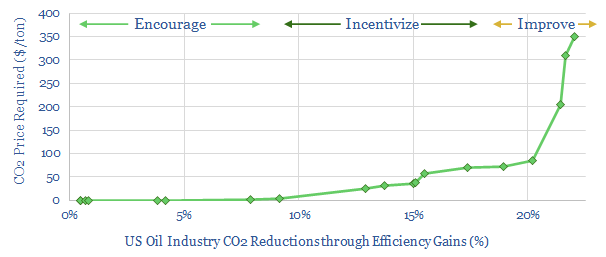
A CO2 price of $40-80/ton could double the pace of industrial efficiency gains in the oil and gas sector, eliminating 15-20% of its CO2 emissions, as outlined in this 14-page note. Cost-curves would steepen in E&P and refining. Technology leaders benefit. Spending would also accelerate, particularly for heat exchangers, compressors, digitization and electrification projects.
-
Energy transition technologies: the pace of progress?
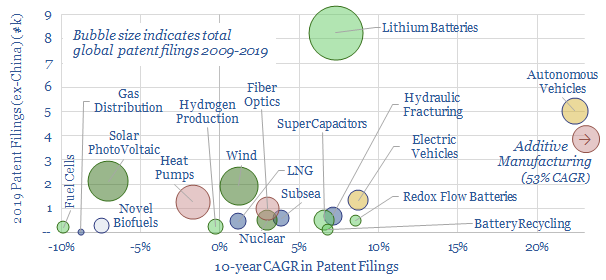
This 3-page note captures over 250,000 patents (ex-China) to assess the pace of progress in different energy transition technologies, yielding insights into lithium ion batteries (high activity), autonomous vehicles and additive manufacturing (fastest acceleration), wind and solar (maturing), fuel cells and biofuels (waning) and other technologies.
Content by Category
- Batteries (96)
- Biofuels (44)
- Carbon Intensity (48)
- CCS (64)
- CO2 Removals (9)
- Coal (41)
- Commentary (65)
- Company Diligence (104)
- Data Models (922)
- Decarbonization (162)
- Demand (129)
- Digital (86)
- Downstream (47)
- Economic Model (221)
- Energy Efficiency (76)
- Hydrogen (63)
- Industry Data (308)
- LNG (56)
- Materials (86)
- Metals (88)
- Midstream (45)
- Natural Gas (161)
- Nature (76)
- Nuclear (28)
- Oil (176)
- Patents (39)
- Plastics (44)
- Power Grids (156)
- Renewables (153)
- Screen (137)
- Semiconductors (35)
- Shale (58)
- Solar (72)
- Supply-Demand (53)
- Vehicles (95)
- Video (24)
- Wind (47)
- Written Research (407)