-
How a CO2 price improves industrial efficiency in oil and gas?
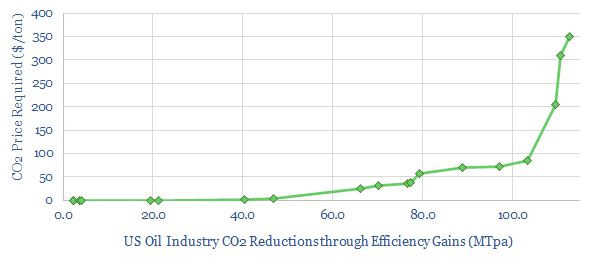
This data-file looks through 20 technologies that can reduce the CO2 intensity of the oil and gas sector. A CO2 price of $40/ton would effectively encourage 10% CO2 reductions that are already economic but have not yet taken place, while an $80/ton CO2 price could incentivize total decarbonization of 20%.
-
Additive manufacturing: costs of 3D-printed products?
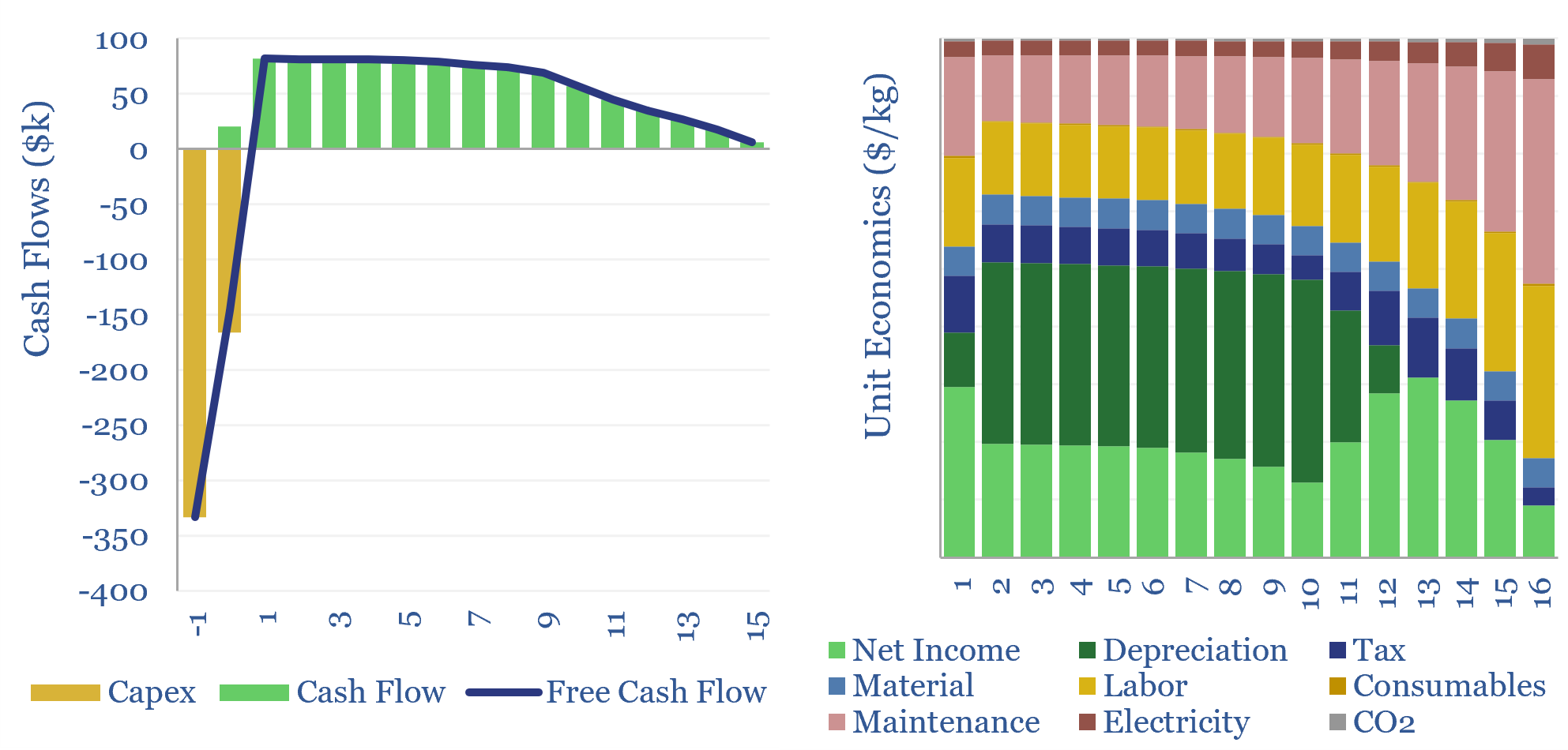
The costs of 3D printed products are estimated between $10-100/kg in this data-file, in order to earn a 10% IRR on constructing and running an additive manufacturing machine, net of labor costs, energy costs, maintenance and materials. Economic costs, energy intensity and CO2 intensity vary as a function of the material and can be stress-tested…
-
Waste heat recovery: heat exchanger costs?
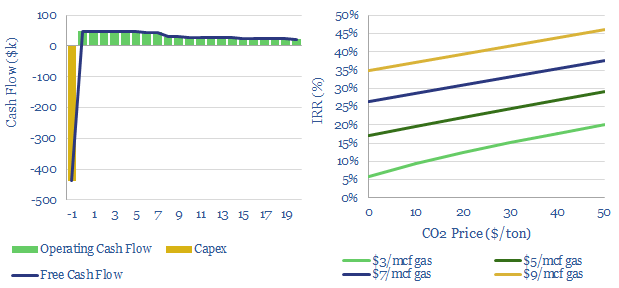
Industrial heat comprises around 20% of global CO2 emissions, but around half of all heat generated may ultimately be wasted. Hence, this model simplifies the economics of using a heat exchanger to recover waste heat. A CO2 price above $50/ton would greatly accelerate waste heat recovery projects.
-
Battery Patents: Lithium Leaders and New Breakthroughs?
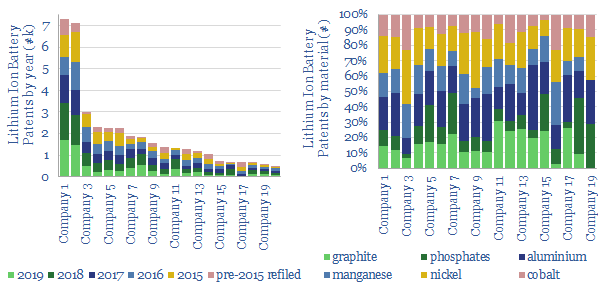
Continued deflation in lithium ion batteries is suggested by a new record of 26,000 patents filed in 2019, hence this data-file identifies the technology leaders. Elsewhere, redox flow batteries patents have doubled since 2014, while interest has been waning in solid state batteries (-57% since 2014) and liquid metal batteries (-67%).
-
Net zero Oil Majors: four cardinal virtues?
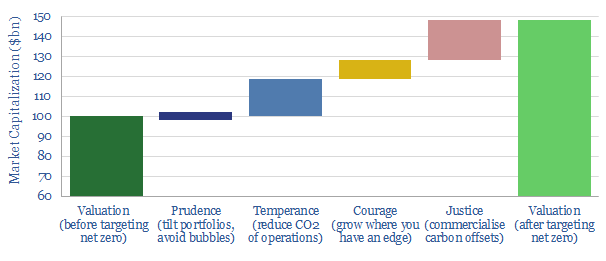
Attaining ‘Net Zero’ can uplift an Energy Major’s valuation by c50%. This means emitting no net CO2, either from the company’s operations or from the use of its products. This 19-page report shows how a Major can best achieve ‘net zero’ by exhibiting four cardinal virtues. Decarbonization is not a threat but an opportunity.
-
Flare gas capture: the economics?
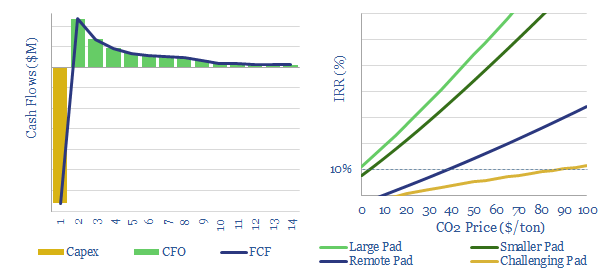
c150bcm of gas was flared globally in 2019. This data-file simplifies the economics of capturing flare gas. Generally, double-digit IRRs are achievable at large new shale pads. But costs are more challenging at smaller sites, remote pads or for contaminated gas. Carbon prices would dramatically improve economics. A $100/ton CO2 price could potentially eliminate US…
-
Energy infrastructure: labor intensity?
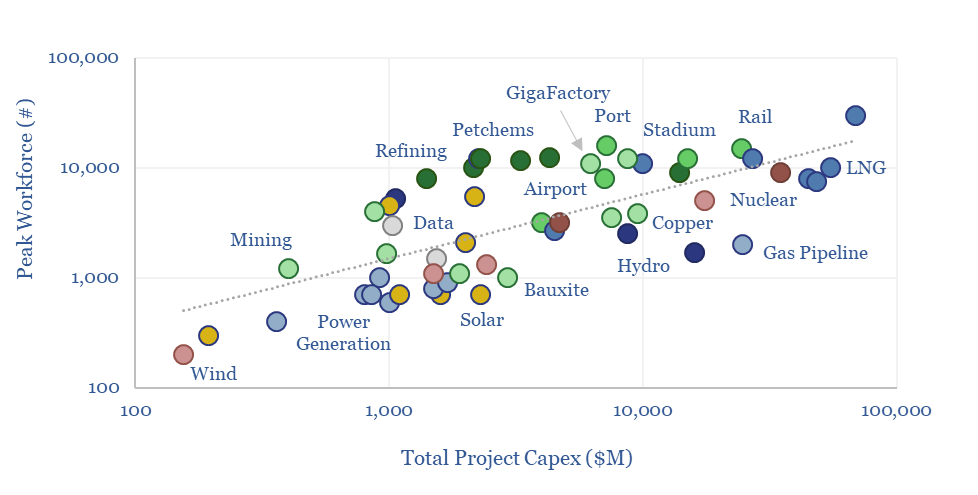
How many jobs are created by different types of energy? This data-file aggregates the labor intensity of different energy sources, which average 50-150 workers per TWH, on an ongoing basis. Another rough rule of thumb is that each $1bn of capex requires 1,000 peak constructon workers, although some project categories are materially more labor intensive…
-
Can carbon-neutral fuels re-shape the oil industry?
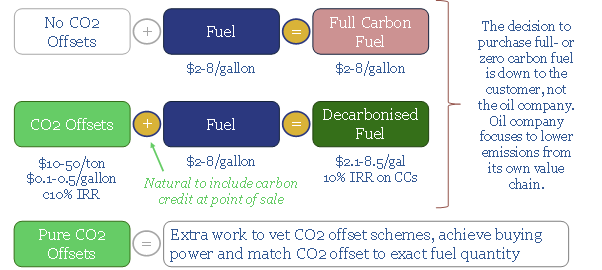
Fuel retailers have a game-changing opportunity seeding new forests. They could offset c15bn tons of CO2 per annum, enough to accommodate 85Mbpd of oil and 400TCF of annual gas use in a fully decarbonized energy system. The cost is competitive, well below c$50/ton. It is natural to sell carbon credits alongside fuels and earn a…
-
Autonomous vehicles: where’s the IP?
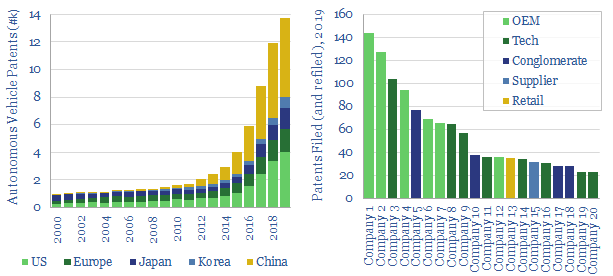
We screen 37,000 patents into autonomous vehicles, which will likely increase total road travel by c10%. The pace of activity has been rising at a rapid, 37% CAGR. Our data-file notes the most active companies, including tech firms (Denso, MobilEye, TuSimple, Uber, Waymo, Zoox) and auto companies (Ford, GM, Honda, Toyota, Volvo et al).
-
Coal-to-gas switching: what CO2 abatement cost?
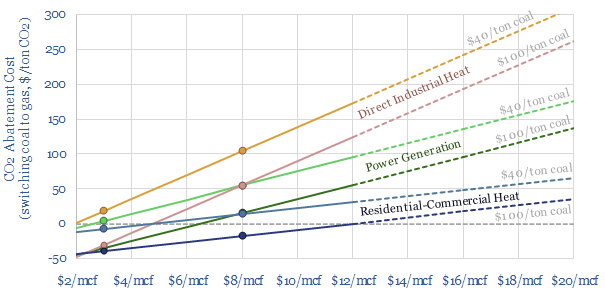
Coal-to-gas switching halves the CO2 emissions per unit of primary energy. This data-file estimates the CO2 abatement costs. Gas is often more expensive than coal. But as a rule of thumb, a $30-60/ton CO2 price makes $6-8/mcf gas competitive with $60-80/ton coal. CO2 abatement costs are materially lower in the US and after reflecting efficiency.…
Content by Category
- Batteries (96)
- Biofuels (44)
- Carbon Intensity (48)
- CCS (64)
- CO2 Removals (9)
- Coal (41)
- Commentary (65)
- Company Diligence (104)
- Data Models (922)
- Decarbonization (162)
- Demand (129)
- Digital (86)
- Downstream (47)
- Economic Model (221)
- Energy Efficiency (76)
- Hydrogen (63)
- Industry Data (308)
- LNG (56)
- Materials (86)
- Metals (88)
- Midstream (45)
- Natural Gas (161)
- Nature (76)
- Nuclear (28)
- Oil (176)
- Patents (39)
- Plastics (44)
- Power Grids (156)
- Renewables (153)
- Screen (137)
- Semiconductors (35)
- Shale (58)
- Solar (72)
- Supply-Demand (53)
- Vehicles (95)
- Video (24)
- Wind (47)
- Written Research (407)