-
Patent Leaders in Energy
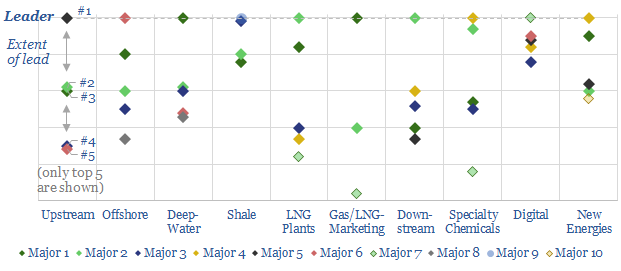
Technology leadership is crucial in energy. But it is difficult to discern. Hence, we reviewed 3,000 patents across the 25 largest companies. This note ranks the industry’s “Top 10 technology-leaders”: in upstream, offshore, deep-water, shale, LNG, gas-marketing, downstream, chemicals, digital and renewables. In each case, we profile the leading company, its edge and the proximity…
-
US Shale: No Country for Old Completion Designs
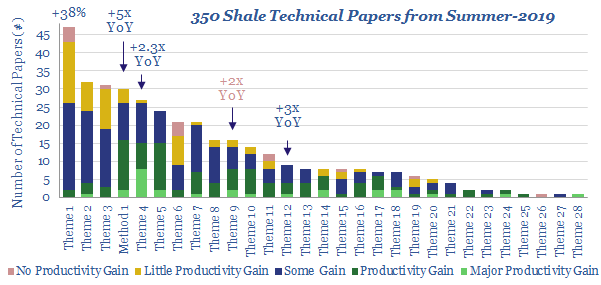
2019 has evoked resource fears in shale, after some E&Ps posted disappointing results, and implied productivity data fell 20% YoY, according to the EIA’s data. We find the data-issues are benign. They reflect changes to completion design, as a bottlenecked industry increased its use of cube development and flowback control.
-
US Shale Gas to Liquids?
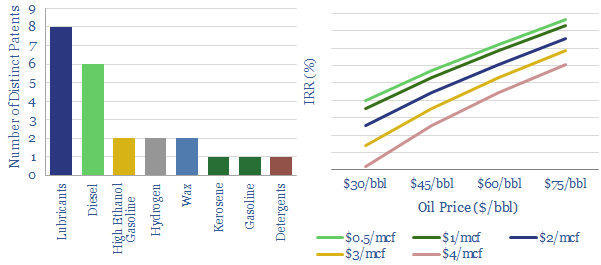
Shell filed 42 distinct new patents around GTL in 2018. This data-file reviews them, showing how the broad array of GTL products confers defensiveness and downstream portfolio benefits. Hence, we have modeled the economics of “replicating” Pearl GTL in Texas. Our base case is a 11% IRR taking in 1.6bcfd of stranded gas from the…
-
The cutting edge of shale technology?
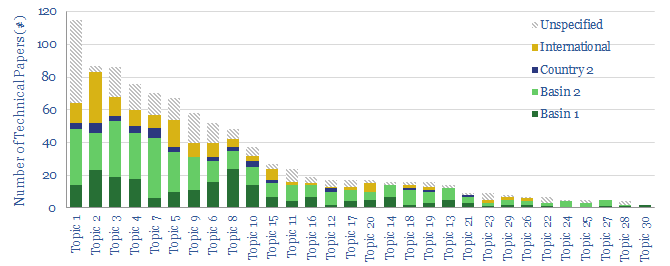
This data-file reviews 950 technical papers from the shale industry in 2018-2020, to identify the cutting edge of shale technology. The trends show an incredible uptick in completion design, frac fluids, EOR and machine learning. Each paper is summarized and categorized. The file also shows which companies and services have a technology edge.
-
Explaining US gasoline?
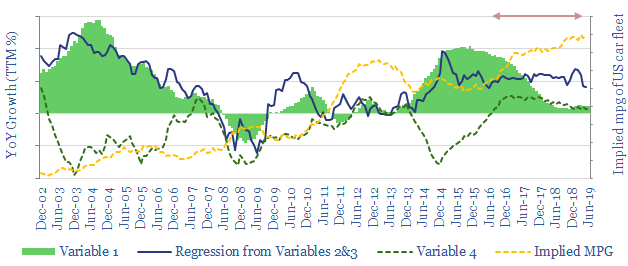
Gasoline demand is stalling in summer-2019, down -0.4% YoY vs a prior 15-year trend for 0.4% pa growth. The cause is urban Vehicle Miles Driven, which has slowed 1.4pp, defying historical correlations with GDP and gasoline prices. Possible structural explanations are explored. The full data-file contains monthly data on the drivers of gasoline, going back…
-
CO2-EOR in Shale: the economics
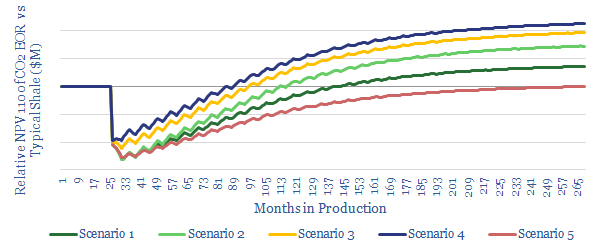
We model the economics for CO2-EOR in shales, after interest in this topic spiked 2.3x YoY in the 2019 technical literature. We see 15% IRRs in our base case, creating $1.6M of incremental value per well, uplifting type curves by 1.75x. Greater upside is readily possible. Most exciting is the prospect for Permian EOR to…
-
Mero Revolutions: countering CO2 in pre-salt Brazil?
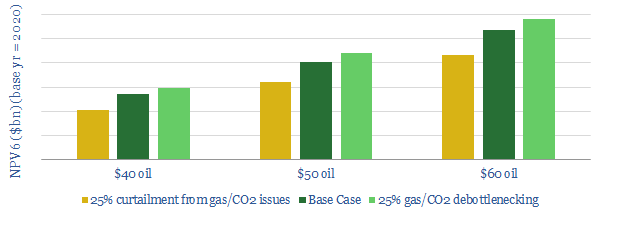
Petrobras, Shell, TOTAL and two Chinese Majors are pushing the boundaries of deep-water technology to develop the Mero oilfield. But the distribution of possible NPV outcomes is very broad, at c$6bn. Challenges remain. The ingenuity required to overcome them should not be under-estimated. Further prizes may be unlocked in the process.
-
Subsea Separation: the elusive history
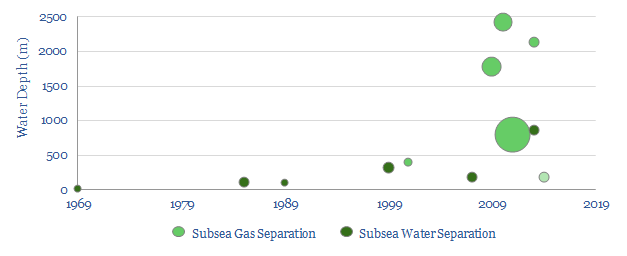
This database covers all 14 subsea separation projects across the history of the oil industry, going back to the “dawn of subsea” in 1969. The technology has been elusive, with just a handful of applications, the largest of which is 2.3MW. This could change, with the pre-salt partners pioneering an unprecedented 6MW facility at Mero.
-
Pre-Salt Brazil: FPSO Tracker
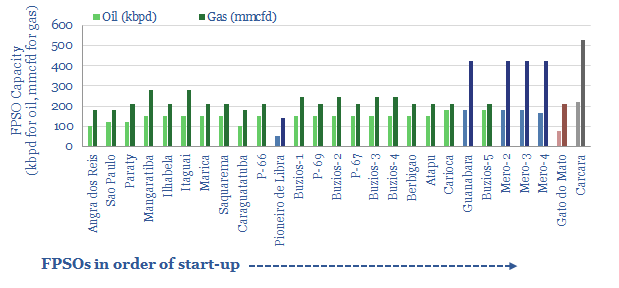
This data-file tracks construction progress of 30 FPSOs being deployed in the Brazilian pre-salt. In each case, we quantify the vessel’s oil and gas handling capacity, development timing and news flow. Pipeline bottlenecks are emerging, and will only be able to export one-third of the pre-salt gas volumes by 2025. The rest must be re-injected.
-
Mero: Economic Model
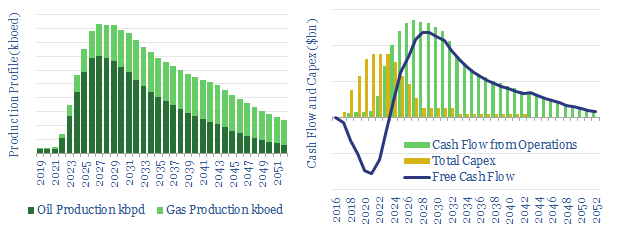
We have modeled the economics of the Mero oilfield (formerly known as Libra), using public disclosures and our own estimates. Our model spans >250 lines of inputs and outputs, so you can flex key assumptions. In particular, we have tested the impact of different gas bottleneck scenarios on the field’s NPV.
Content by Category
- Batteries (96)
- Biofuels (44)
- Carbon Intensity (48)
- CCS (64)
- CO2 Removals (9)
- Coal (41)
- Commentary (65)
- Company Diligence (104)
- Data Models (922)
- Decarbonization (162)
- Demand (129)
- Digital (86)
- Downstream (47)
- Economic Model (221)
- Energy Efficiency (76)
- Hydrogen (63)
- Industry Data (308)
- LNG (56)
- Materials (86)
- Metals (88)
- Midstream (45)
- Natural Gas (161)
- Nature (76)
- Nuclear (28)
- Oil (176)
- Patents (39)
- Plastics (44)
- Power Grids (156)
- Renewables (153)
- Screen (137)
- Semiconductors (35)
- Shale (58)
- Solar (72)
- Supply-Demand (53)
- Vehicles (95)
- Video (24)
- Wind (47)
- Written Research (407)