-
2050 oil markets: opportunities in peak demand?
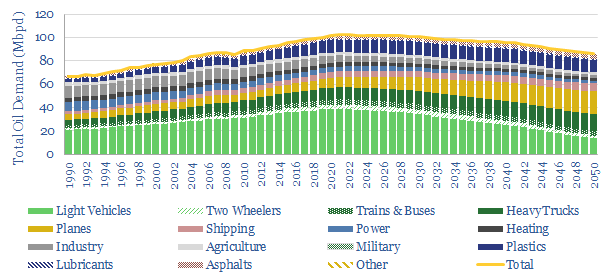
Seven technology themes can save 45Mbpd of long-term oil demand. They make the difference between 2050 oil consumption surpassing 130Mbpd and our own forecasts: for a plateau in the 2020s, then a gradual descent to 87Mbpd in 2050.
-
Do refineries become bio-refineries?
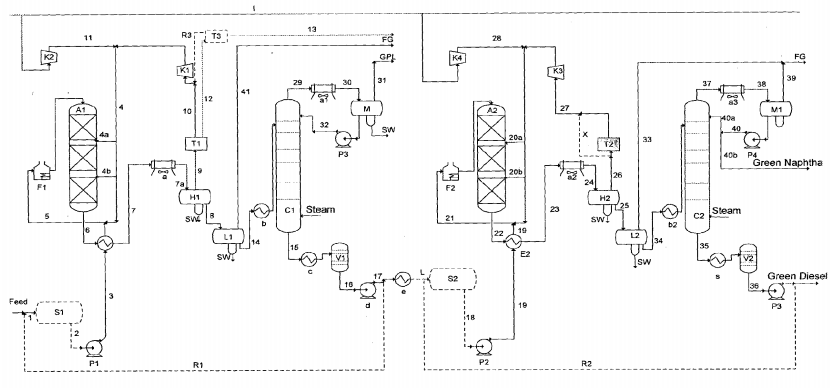
What will happen to oil refineries during the energy transition? On our numbers, liquid oil products will be needed past 2100, long after demand plateaus in the 2020s. Cleaner, more efficient technologies are therefore required in the downstream sector. This note considers whether refineries could increasingly be converted to bio-refineries.
-
Lubricant Leaders: our top five conclusions
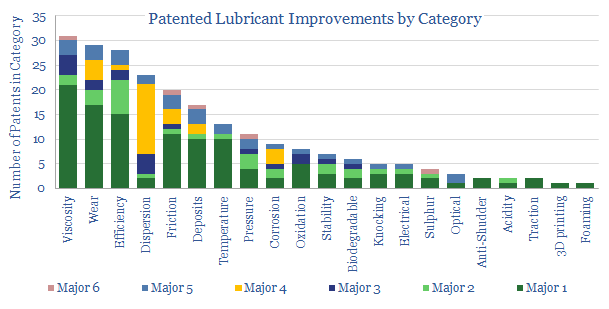
We present our “top five” conclusions on the lubricants industry, after reviewing 240 patents, filed by Oil Majors in 2018. We are most impressed by the intense pace of activity to improve engine efficiencies. Technology will drive margins and market shares, hence three clear market leaders are identified. The relative number of patents into Electric…
-
Drones attack military fuel economy?
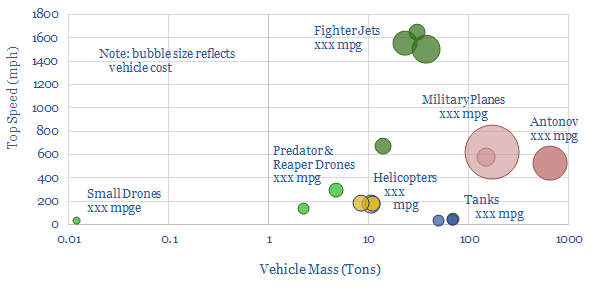
Swarms of drones are emerging as the most devastating military weapon of the 21st century. This was evidenced by the recent attack on Saudi oil infrastructure. But drones’ impact on 0.7Mbpd of global military oil demand could be even more devastating. This data-file quantifies their fuel economy at >1,000 mpge compared to today’s fighter jets,…
-
Container ships versus trucks and trains
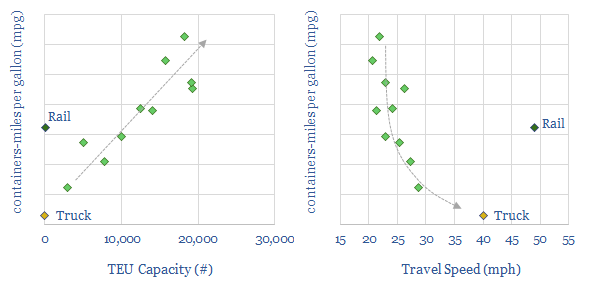
This data-file tabulates the impressive fuel economy of container vessels, as a function of their size and speed. The best examples are 2x more efficient than typical trains and 20x more efficient than typical trucks. Hence, even as the OECD consumes 4kg per person per day of goods shipped from overseas, these container ships account for c0.25%…
-
Make CO2 into valuable products?
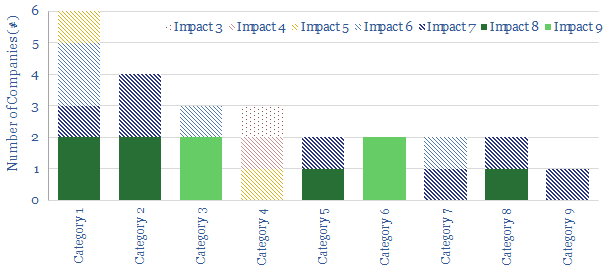
What if CO2 was not a waste product, but a valuable commercial feedstock? We have assessed the top 27 companies at the cutting edge, commercialising CO2 into next-generation plastics, foams, concretes, specialty chemicals and agricultural products. Each company is assessed in detail. 13 are particularly exciting. 21 are start-ups. Aramco, Chevron, Repsol also screen well.
-
Oil industry CO2 per barrel?
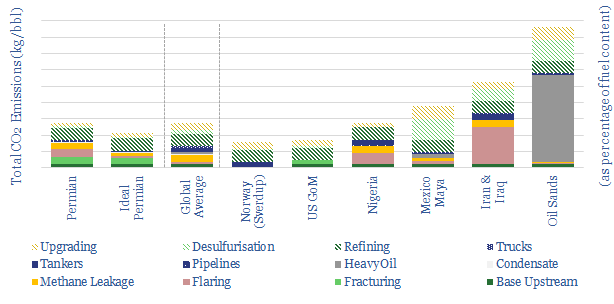
We have constructed a simple model to estimate full-cycle CO2 emissions of an oil resource, as a function of its flaring, methane leakage, gravity, sulphur content, production processes and transportation to market. A c10x energy return on energy investment is estimated. Relative advantages are seen for well-managed resources offshore and in shale; relative disadvantages are…
-
Drone Delivery: the Energy Economics
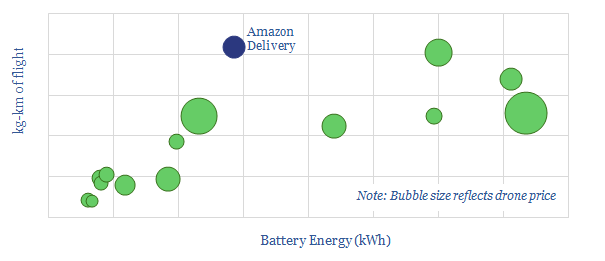
We have tabulated energy economics on 15 commercial drones and run the equations of flight on Amazon’s “Prime Air” solution. We conclude that drone delivery will use 90% less energy, 99% less cost and 90% lower carbon than is typical in current last-mile truck deliveries. Please download the model for all of the numbers.
-
Subsea Robots: the next generation?
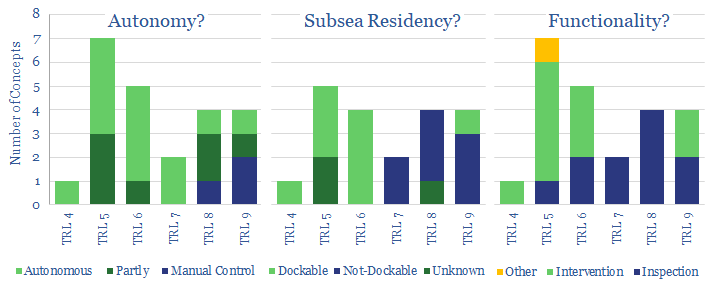
Over 20 next-generation subsea robotics concepts are presented. These electric solutions are increasingly autonomous, they reside subsea and can conduct more thorough inspection/intervention work. Inspection is 2-6x faster, and maintenance costs can be halved, yielding savings of $0.5-1/boe at a typical field. The data-file also summarizes the leading Majors and Service Companies in the space.
-
Long-Term LNG Demand: technology-led?
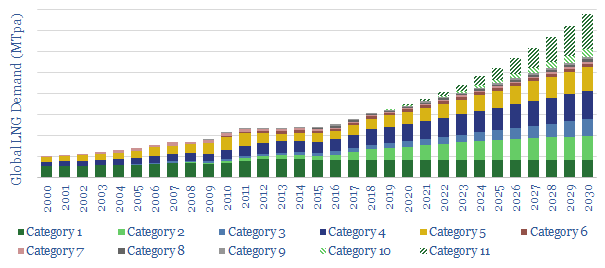
This is a simple model of long-term LNG demand, extrapolating out sensible estimates for the world’s leading LNG-consumers. On top of this, we overlay the upside from two nascent technology areas, which could add 200MTpa of potential upside to the market. Backup workings are included.
Content by Category
- Batteries (96)
- Biofuels (44)
- Carbon Intensity (48)
- CCS (64)
- CO2 Removals (9)
- Coal (41)
- Commentary (65)
- Company Diligence (104)
- Data Models (922)
- Decarbonization (162)
- Demand (129)
- Digital (86)
- Downstream (47)
- Economic Model (221)
- Energy Efficiency (76)
- Hydrogen (63)
- Industry Data (308)
- LNG (56)
- Materials (86)
- Metals (88)
- Midstream (45)
- Natural Gas (161)
- Nature (76)
- Nuclear (28)
- Oil (176)
- Patents (39)
- Plastics (44)
- Power Grids (156)
- Renewables (153)
- Screen (137)
- Semiconductors (35)
- Shale (58)
- Solar (72)
- Supply-Demand (53)
- Vehicles (95)
- Video (24)
- Wind (47)
- Written Research (407)