Biofuels
-
Global biogas production by country?
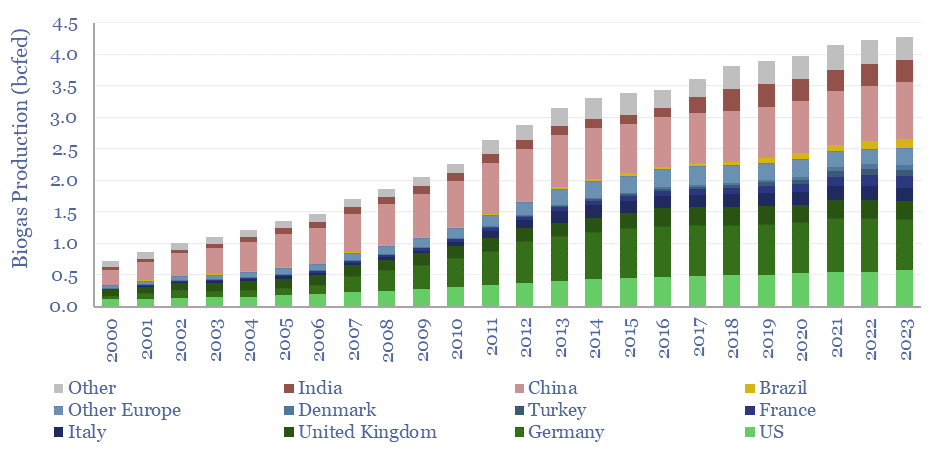
Global biogas production has risen at a 10-year CAGR of 3% to reach 4.3bcfed in 2023, equivalent to 1.1% of global gas consumption. Europe accounts for half of global biogas, helped by $4-40/mcfe subsidies. This data-file aggregates global biogas production by country, plus notes into feedstock sources, uses of biogas and biomethane.
-
Biogas: the economics?
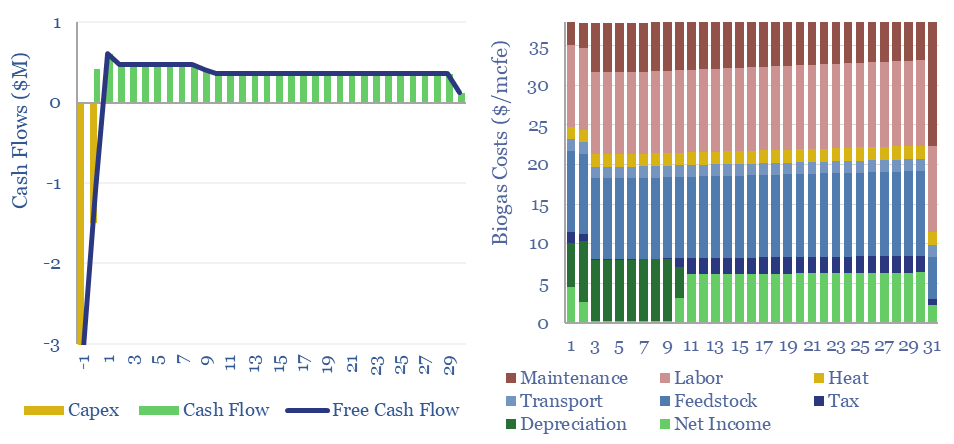
Biogas costs are broken down in this economic model, generating a 10% IRR off $180M/kboed capex, via a mixture of $16/mcfe gas sales, $60/ton waste disposal fees and $50/ton CO2 prices. High gas prices and landfill taxes can make biogas economical in select geographies. Although diseconomies of scale reward smaller projects?
-
Verbio: bio-energy technology review?
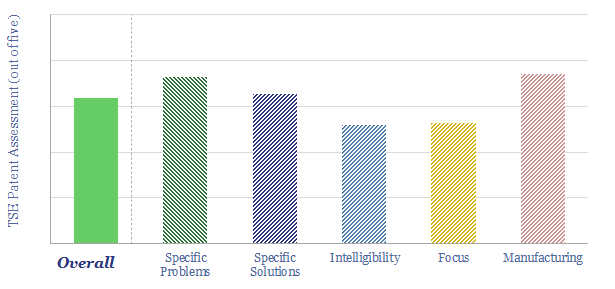
Verbio is a bio-energy company, founded in 2006, listed in Germany, producing bio-diesel, bioethanol, biogas, glycerin and fertilizers. The company has stated “we want to be in a position to convert anything that agriculture can deliver to energy”. Our Verbio technology review is based on its patents. We find some fascinating innovations in cold mash…
-
Energy history: how much wood can be cut in a day?
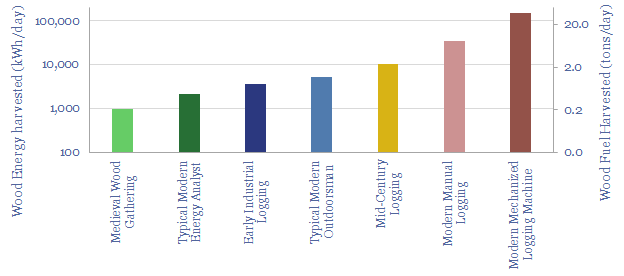
How much wood can be cut in a day? We review 500-years of industrial history. In medieval times, a manorial tenant might have gathered 250kg of fallen branches in a day. A modern feller-buncher is 150x more productive. But a modern energy analyst is little better than a medieval peasant, and harvesting wood as a…
-
Crop production: how much does nitrogen fertilizer increase yields?
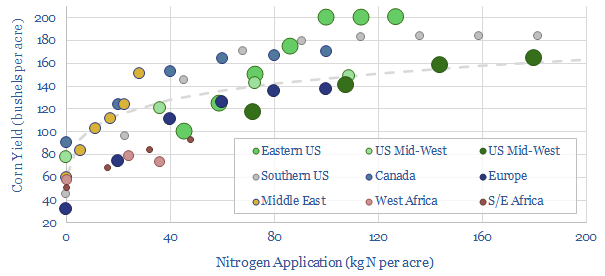
How much does fertilizer increase crop yields? Aggregating all of the global data, a good rule of thumb is that up to 200kg of nitrogen can be applied per acre, increasing corn crop yields from 60 bushels per acre (with no fertilizer) to 160 bushels per acre (at 200 kg/acre). But the relationship is logarithmic,…
-
Crop production: what CO2 intensity?
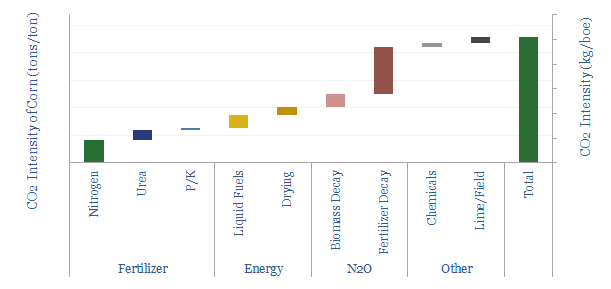
The CO2 intensity of producing corn averages 0.23 tons/ton, or 75kg/boe. 50% is from N2O emissions, a powerful greenhouse gas, from the breakdown of nitrogen fertilizer. Producing 1 kWh of food energy requires 9 kWh of fossil energy.
-
Bio-coke: energy economics?
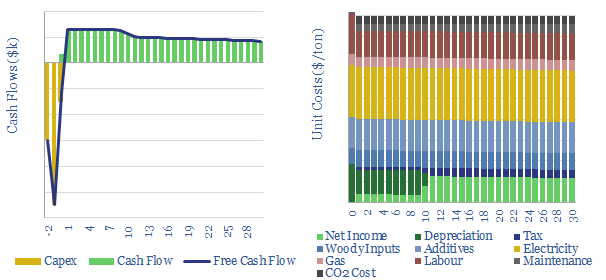
Bio-coke is a substitute for coal-coke in steel-making and other smelting operations. We model it will cost c$450/ton, c50% more than coal-coke, but saves 2 – 2.5 tons/ton of CO2. Abatement costs can be as low as $70/ton. Although not always, and there are comparability issues.
-
World food production: energy breakdown by crop by country?
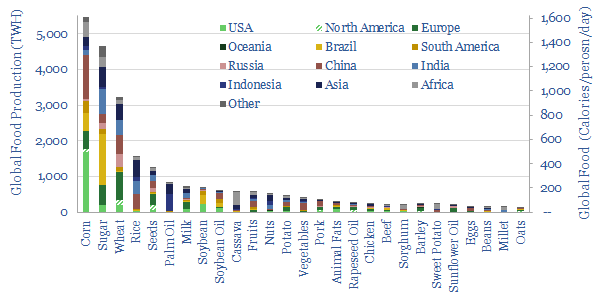
World food production runs at 10 bn tons per year, equivalent to 25,000 TWH of primary energy, or 7,500 calories per person per day. Of this total, 30% is fed to animals, 30% is wasted, 5% is converted to biofuels and 2% is used in consumer products. Humans eat the remaining 2,500 calories per person…
-
Palm oil: what CO2 intensity?
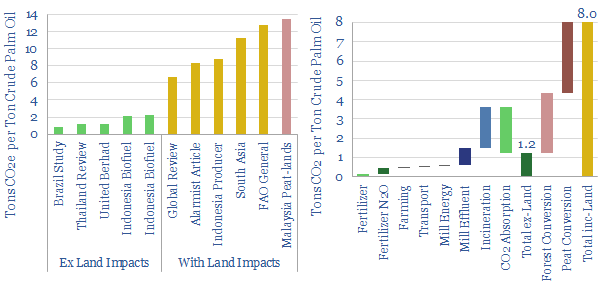
Global palm oil production runs at 80MTpa, for food, HPC and bio-fuels. Carbon intensity is 1.2 tons CO2e per ton of crude palm oil, excluding land use impacts, and 8.0 tons/ton on a global basis including land use impacts. This means once a bio-fuel has more than c35% palm oil in its feedstock, it is…
-
Biofuels: the best of times, the worst of times?
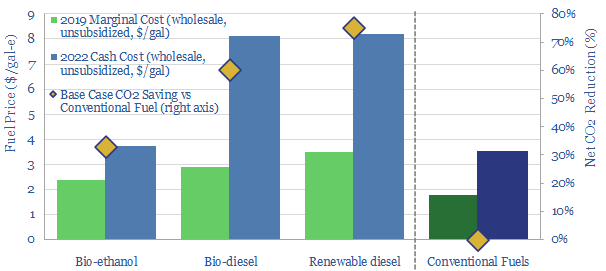
How will food and energy shortages re-shape liquid biofuels? This 11-page note explores four questions. Could the US re-consider its ethanol blending to help world food security? Could rising cash costs of bio-diesel inflate global diesel prices to $6-8/gal? Will renewable diesel expansion be dialed back? What outlook for each biofuel in the energy transition?
Content by Category
- Batteries (95)
- Biofuels (44)
- Carbon Intensity (48)
- CCS (64)
- CO2 Removals (9)
- Coal (41)
- Commentary (65)
- Company Diligence (104)
- Data Models (920)
- Decarbonization (162)
- Demand (129)
- Digital (86)
- Downstream (47)
- Economic Model (220)
- Energy Efficiency (76)
- Hydrogen (63)
- Industry Data (308)
- LNG (56)
- Materials (86)
- Metals (88)
- Midstream (45)
- Natural Gas (161)
- Nature (76)
- Nuclear (28)
- Oil (175)
- Patents (39)
- Plastics (44)
- Power Grids (155)
- Renewables (153)
- Screen (136)
- Semiconductors (35)
- Shale (58)
- Solar (72)
- Supply-Demand (53)
- Vehicles (95)
- Video (24)
- Wind (47)
- Written Research (405)