Natural Gas
-
Turbo-charge gas turbines: the economics?
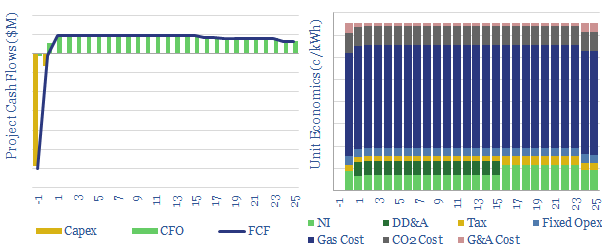
This data-file models the economics of turbo-charging gas turbines, which increases the mass flow of combustion air, to improve their power ratings by c10-20%. IRRs are solid. Turbo-charged gas turbines could thus gain greater share as grids become saturated with renewables
-
Decarbonization in Europe: but is there enough gas?
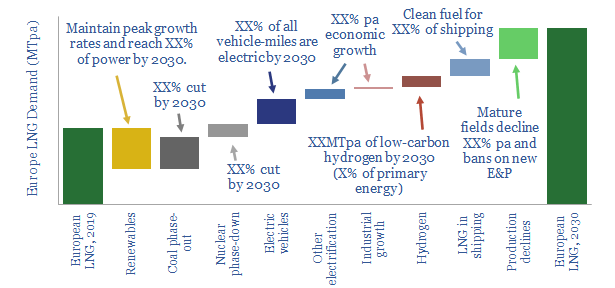
A lack of gas is likely to slow down Europe’s energy transition in the 2020s. This is the conclusion in our new 12-page note, which captures basic EU policy objectives. An incremental 85MTpa of LNG must be sourced by 2030, absorbing one third of new global LNG supplies and stoking shortages.
-
Weatherization of homes: what methods and costs?
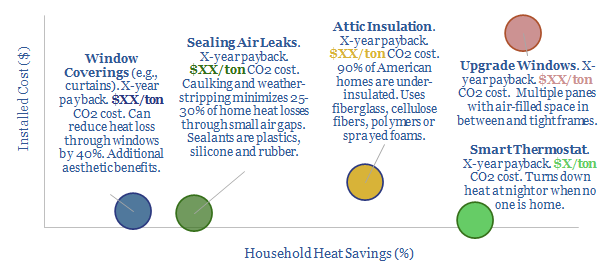
The weatherization of 2M American homes is part of Joe Biden’s proposed energy policy, in order to reduce heating costs and emissions. Hence, this data-file estimates the costs and payoffs of attic insulation, air sealing, window upgrades, window coverings and smart thermostats.
-
Exhaust gas recirculation in gas power: the economics?
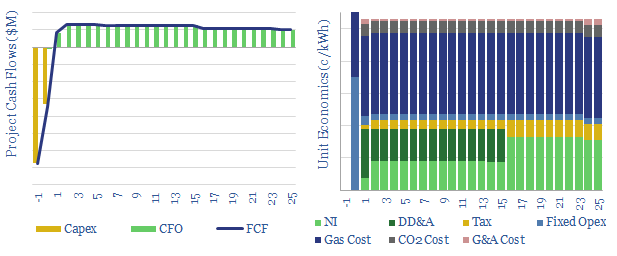
This data-file explores an alternative design for a combined cycle gas turbine, re-circulating exhaust gases after combustion, in order to facilitate CO2 capture. Costs and operating parameters are summarized from recent technical papers. Even with EGR, it will be challenging to decarbonize a gas turbine for less than $100/ton.
-
Deep blue: cracking the code of carbon capture?
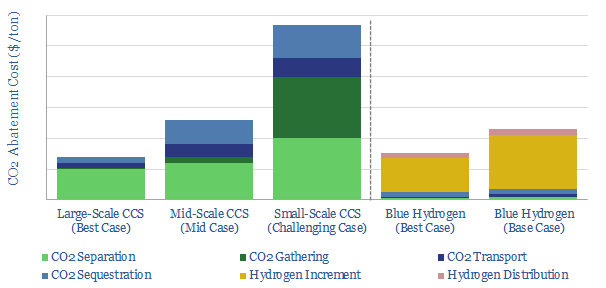
Carbon capture is cursed by colossal costs at small scale. But blue hydrogen may be its saviour. Crucial economies of scale are guaranteed by deploying both technologies together. The combination is a dream scenario for gas producers. This 21-page note outlines the opportunity and costs.
-
A new case for gas: what if renewables get overbuilt?
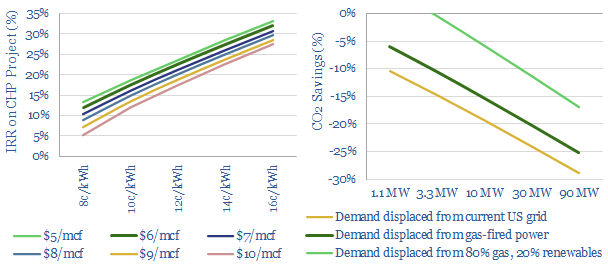
Overbuilding renewables may make power grids more expensive and less reliable. Hence more businesses may choose to generate their own power behind the meter, installing combined heat and power systems fuelled by natural gas. IRRs reach 20-30%. Efficiency is 70-80%. Total CO2 falls by 6-30%. This 17-page note outlines the opportunity.
-
Combined heat and power: the economics?
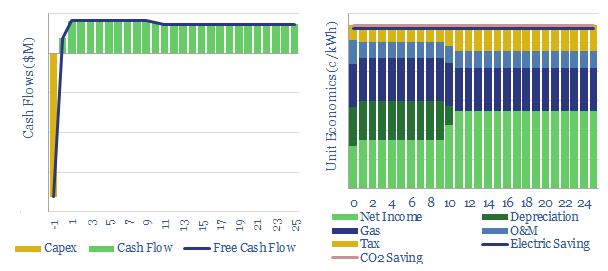
This data-file models the energy economics of a combined heat and power installation, to provide electricity and heating behind the meter, in lieu of purchasing electricity from the grid. Economics are strong, especially for larger units. CO2 emissions can also be reduced by 5-30% due to high efficiency.
-
Great white whales: the end of oil and gas?
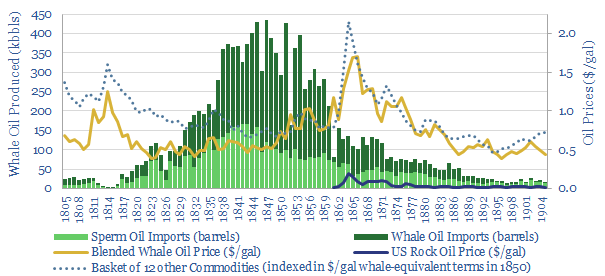
Whale oil was a dominant, albeit barbaric, lighting fuel in the 19th century. But what happened to pricing as the industry was disrupted by kerosene and ultimately by electric lighting? We find whale oil pricing maintained a 25x premium to rock oil and outperformed other commodities as the whale oil market collapsed. As whaling declined,…
-
Fuel cells: performance, efficiency and decline rates?
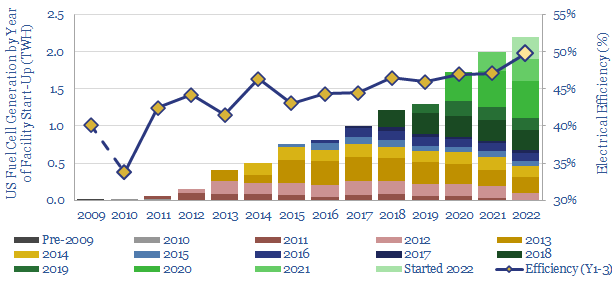
This data-file captures the performance of c160 fuel cell power plants, installed to-date in the US, generating over 2TWH of electricity, looking facility-by-facility, year-by-year. How has the performance, efficiency and longevity of US fuel cell power plants been trending over time?
-
Gas pipelines, CO2 pipelines, hydrogen pipelines?
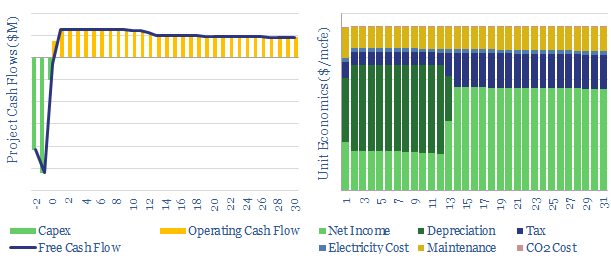
This model captures the energy economics of a pipeline carrying natural gas, CO2 or hydrogen. It computes the required throughput tariff (in $/mcf or $/kg) to earn a 10% IRR. Hydrogen tariffs must be 2x new gas pipelines and 10x pre-existing gas pipelines. CO2 disposal is more economic at scale.
Content by Category
- Batteries (95)
- Biofuels (44)
- Carbon Intensity (48)
- CCS (64)
- CO2 Removals (9)
- Coal (41)
- Commentary (65)
- Company Diligence (104)
- Data Models (920)
- Decarbonization (162)
- Demand (129)
- Digital (86)
- Downstream (47)
- Economic Model (220)
- Energy Efficiency (76)
- Hydrogen (63)
- Industry Data (308)
- LNG (56)
- Materials (86)
- Metals (88)
- Midstream (45)
- Natural Gas (161)
- Nature (76)
- Nuclear (28)
- Oil (175)
- Patents (39)
- Plastics (44)
- Power Grids (155)
- Renewables (153)
- Screen (136)
- Semiconductors (35)
- Shale (58)
- Solar (72)
- Supply-Demand (53)
- Vehicles (95)
- Video (24)
- Wind (47)
- Written Research (405)