
Deep Fission is designing a next-generation nuclear reactor, placing small modular reactors in 1-mile-deep boreholes, which provide exceptional containment, and may eliminate up to 80% of the surface costs of large nuclear plants. We find strong inherent safety features and can de-risk c50% lower costs than large fission reactors via the Deep Fission technology.
Deep Fission is a next-generation nuclear company, headquartered in California, founded in 2023, expanding on the founders’ pre-existing venture called Deep Isolation, which seeks to dispose of spent nuclear fuel in deep boreholes.
Excellent containment properties of deep boreholes sparked the idea of siting small modular nuclear reactors at similar depths: a kind of hybrid between nuclear SMRs, deep geothermal and drilling technology from the hydrocarbon industry.
Deep Fission is thus aiming to place small, 15MWe pressurized water nuclear reactors, with standard LEU fuel, “one mile underground”, benefitting from the natural containment of 10bn tons of rock in the 45-degree cone around the wellbore, and thereby eliminating up to 80% of surface construction costs.
The steam from multiple reactors in multiple boreholes could be combined to yield a 150MW plant over 1-acre, or a 1.5GW plant over 3-acres, which would be a favorable land intensity factor.
In this data-file, we first summarize Deep Fission technology, based on its patents and white papers (please see the White Papers, Patents and Images tabs).
Safety features of the Deep Fission concept include the “exceptional” isolation of radionuclides from deep boreholes. Other inherent safety features are noted in the data-file, based on the White Papers and patents.
Economics of deep fission could be brought down into the range of $3,000-4,000/kW, or lower, we think, based on adapting our nuclear economic models, drilling and completion models, and other power plant models to our understanding of the Deep Fission concept (illustrative chart below).
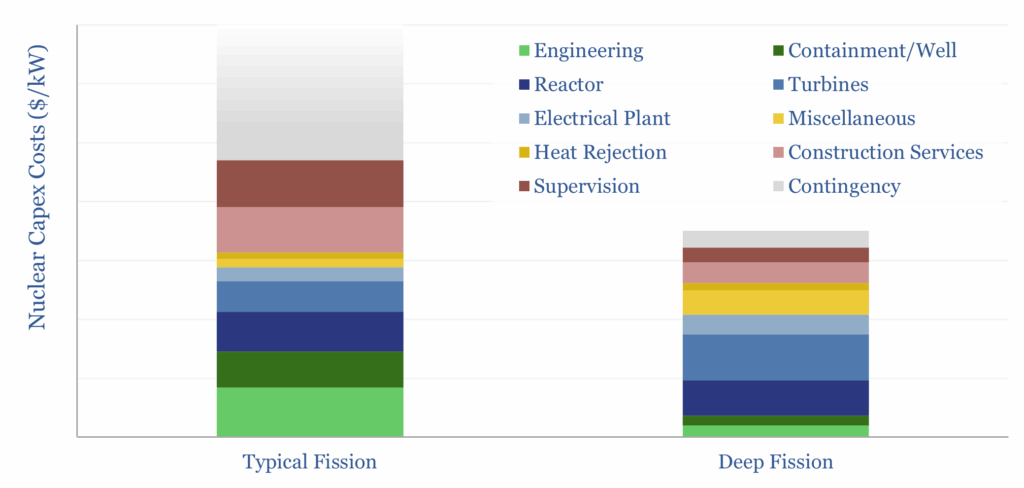
What helps economics is eliminating the surface facilities, the low relative costs of drilling technology compared with constructing containment structures, and a truly modular approach to the reactor design.
The technical readiness and technology moat of Deep Fission are also assessed, based on its patents. Ensuring a technology “moat” may require further patent filings in our view.
Nevertheless, the concept of deep nuclear, at LCOEs of 5-10c/kWh will clearly be of interest, across those looking for round-the-clock power, for facilities that consume large quantities of steam and/or heat, and for hydrocarbon producers with large numbers of pre-existing subsurface wells.