
Global electricity demand for electric vehicles will rise from 120TWH in 2025 to 350 TWH in 2030 and 1,600 TWH in 2050, adds c5% upside to recent global electricity demand. This data-file quantifies electricity demand for EVs by region and over time, including data into the real-world fuel economy of EVs.
The key advantage of electric vehicles is their 4x higher efficiencies than ICEs, harnessing 80-90% of input electricity, whereas an ICE vehicle surrenders 50-70% of the energy content of fuels as waste heat, which is exhausted from the tailpipe.
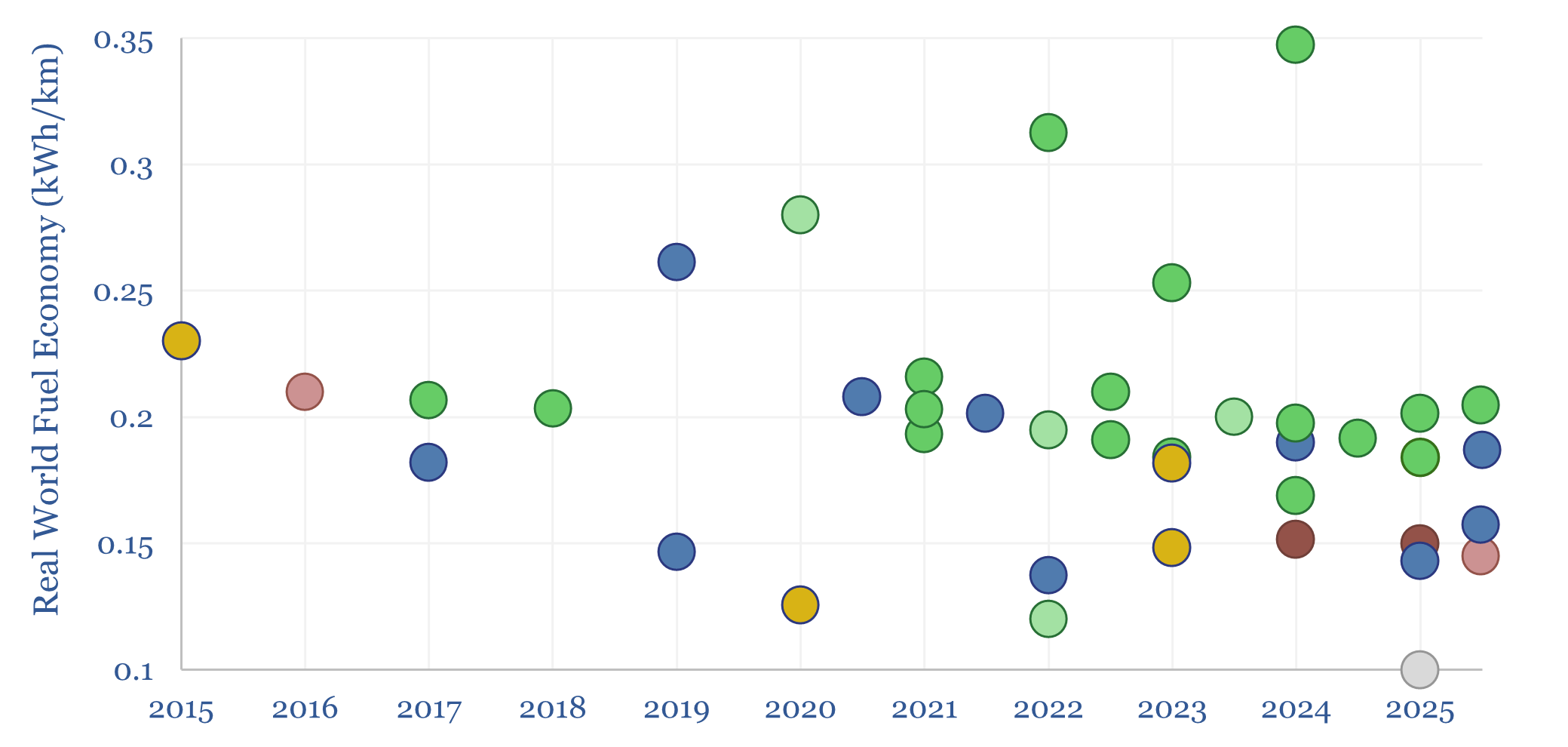
The real-world energy efficiency of electric vehicles is around 0.15-0.2 kWh/km, which equates to 120-160mpge of fuel economy, based on studies and self-reported data tabulated in a tab of this model (chart below). Note real-world energy consumption from EVs can be 20-60% higher than stated by manufacturers or on test-cycles, especially during cold weather.
Global electricity consumption for electric vehicles likely reached 120TWH in 2025 (0.4% of global electricity), and rises to 350 TWH in 2030, 1,000 TWH in 2040 and 1,600 TWH in 2050, based on our numbers, which in turn link to our EV forecast databases.
Without any expansion of the grid, our numbers entail that EVs would add 1.1% upside to today’s global electricity demand by 2030, 3% by 2040 and 5% by 2050. The upside is mostly back-end-loaded, while near-term electricity demand is driven more by data-centers, which could require an additional 1,000 TWH by 2030.
However, we also see global electricity use trebling to 90,000 TWH by 2050 in our roadmap to net zero. If this ramp-up happens, without falling foul of power grid bottlenecks, then EVs will comprise 1% of global electricity demand in 2030, 1.6% in 2040 and 1.8% in 2050.
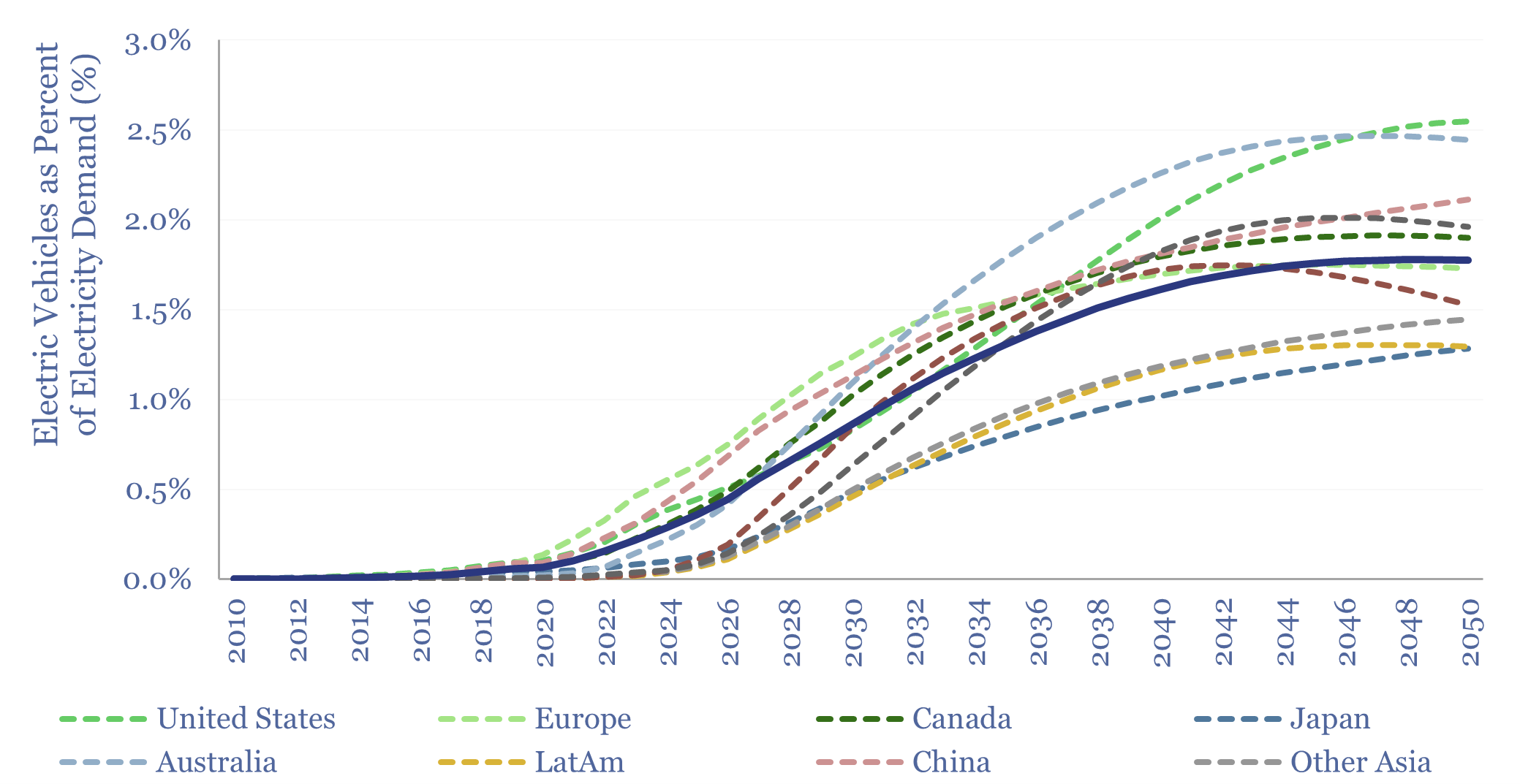
What is remarkable is that we now expect the rise of EVs to stoke electricity demand by about half the level of 2-3 years ago. This is because of slower EV sales growth, lower mileage traveled per EV and high/improving energy efficiency. 50% of US EVs are ‘second cars’ which tend to get driven 15% less than single cars. 20% are third cars (30% less). 10% are fourth+ cars (40-80% less).
Expanding the grid is necessary for meeting electricity demand for electric vehicles, for displacing 20-25Mbpd of possible oil demand by 2050 (14,000 TWH-th of primary energy). Another requirement lies in charging networks. But we see the biggest bottlenecks and opportunities in reconductoring transmission and in urban distribution.