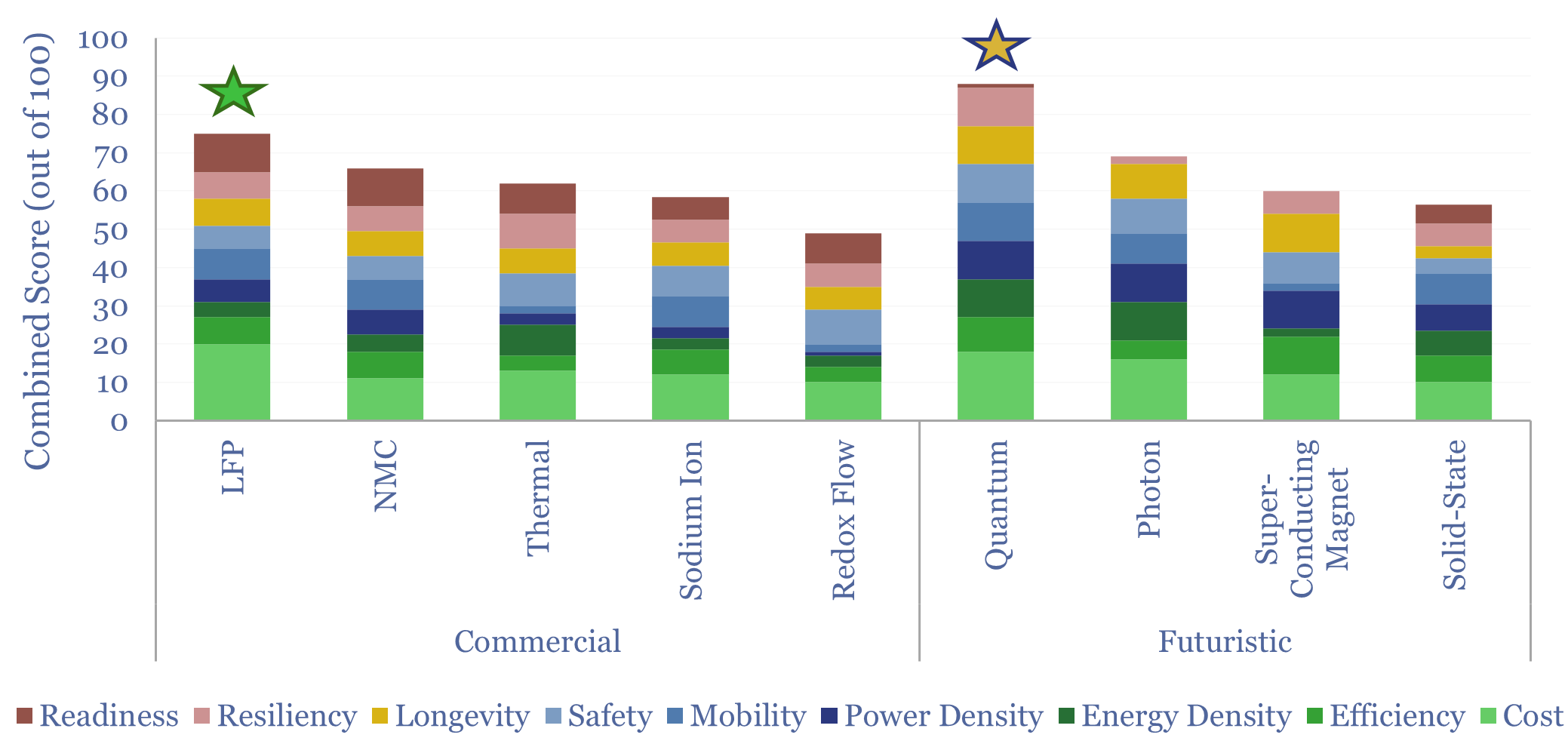
Lithium ion batteries are now so deeply entrenched that we doubt any new electrochemistry can supplant them. So this 23-page report asks where are the opportunities now in batteries? Could any futuristic batteries with quasi-infinite capacity, such as quantum batteries, power interseasonal storage or long-distance aviation?
The world deployed 1,500 GWH of lithium ion batteries in 2024. 70% of all lithium ion batteries are now LFP. These batteries are accelerating to backstop power grids. But they are far from perfect, for the reasons on pages 2-4.
Nevertheless, we argue LFP batteries have now reached the scale where no new electrochemical battery can supplant their dominant market position. Cost structures and physics are explained on pages 5-7.
No electrochemical batteries will ever be economical for interseasonal energy storage, which matters particularly for scaling up solar, for the reasons on pages 8-9.
No electrochemical batteries will ever be energy-dense enough to energize long-distance aviation, for the reasons on page 10.
Hence where are the opportunities for battery innovation? Especially if lithium ion battery value chains become commoditized, and small improvements quickly get copycatted or leapfrogged, per pages 11-12.
Futuristic battery concepts that could store orders-of-magnitude more energy, orders-of-magnitude more economically, with orders-of-magnitude higher energy density are thus the focus in the second half of this report.
A photon battery benefits from bosons’ defiance of the Pauli Exclusion Principle, which means infinite quantities of energy carriers can conceivably be concentrated in a small space. Although there are some key challenges here, described on pages 13-14.
Superconductor magnetic energy storage (SMES) likewise benefits from the boson-like behaviour of Cooper pairs. Superconductors are already used in specialized distribution networks. Issues are on page 15-16.
Quantum batteries stood out as most interesting, for potentially game-changing futuristic batteries. Their charging and discharging would be “super-extensive”, which means that the energy stored per atom actually increases with the number of atoms in the battery?! The principles, and recent research progress, are on pages 17-19.
Thermal energy storage, interestingly, also achieves scaling benefits in a similar vein to quantum batteries. Especially when using large petcoke/graphite blocks as a storage material. Hence we revisited the economics of thermal energy storage, where capex could be 90-99% below lithium batteries, unlocking interseasonal storage possibilities, per pages 20-21.
Futuristic batteries are fascinating to consider. But most are over a decade from commercialization. In the mean time, we argue for 9% pa growth in global lithium demand, whereas we are only able to de-risk 6% pa growth in lithium supplies.