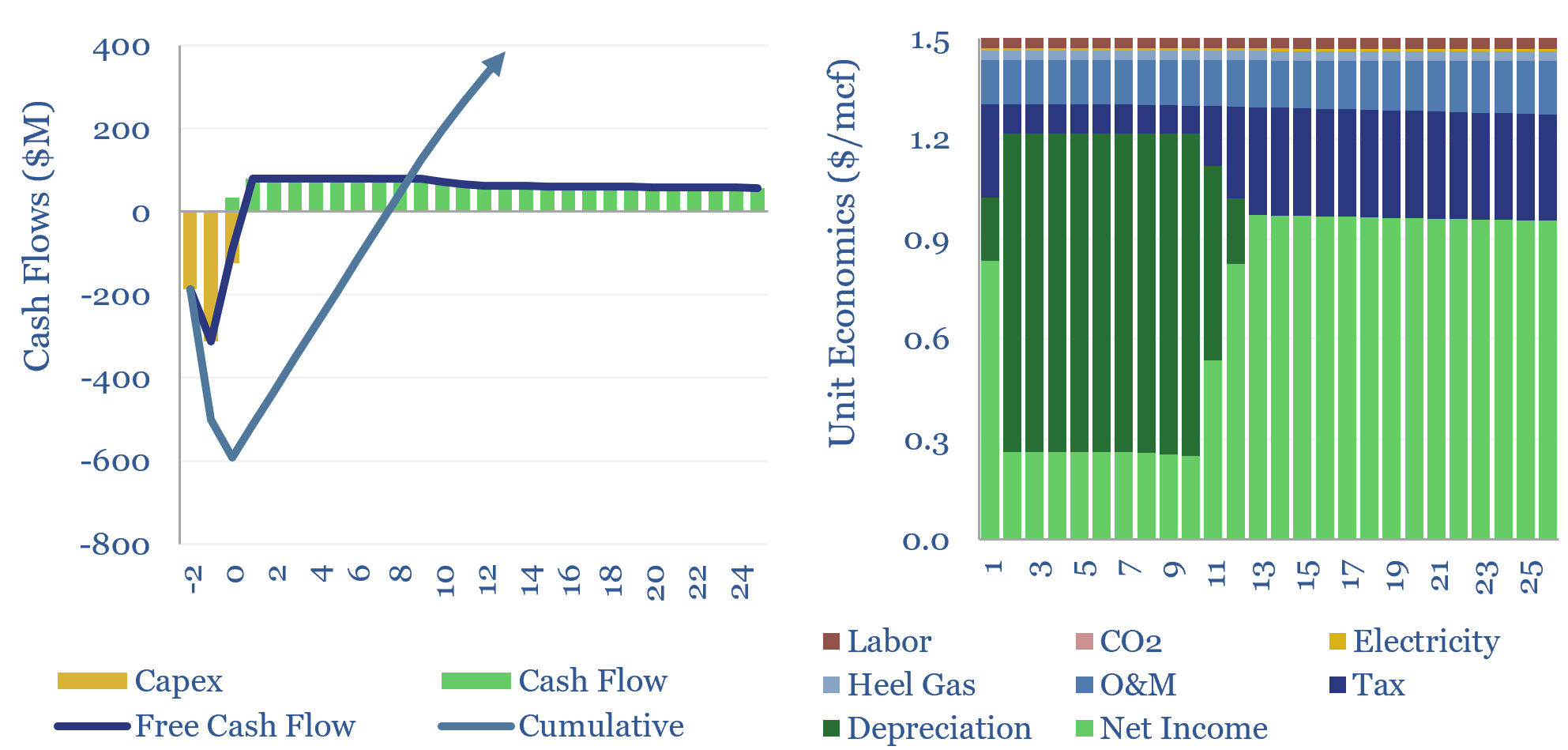
Gas storage economics are captured in this data-file. In our base case, a 30bcf underground storage facility, which cycles 2mcf per year of gas per mcf of gas capacity, requires a storage spread of $1.5/mcf to generate a 10% IRR off $19/mcf of capex. Effectively, this is inter-seasonal energy storage for 0.5c/kWh-th.
The US has 400 underground gas storage facilities with around 4TCF of capacity, equivalent to c45 days of demand in our US energy models. US storage will typically fill to capacity at the start of winter then drain to around 1.5 TCF by spring, per EIA gas storage data. And US gas demand is growing and maturing.
Europe has about 110bcm of gas storage capacity, which is equivalent to 100 days of demand in our European natural gas models. Likewise, European gas will typically fill to capacity at the start of winter, then drain to as little as 20% of capacity by March-April.
So gas storage is the original “inter-seasonal energy storage”. In addition, gas storage will be used to ensure security of supply for gas-fired generation. One example might be at an AI data-center. Another example might be when a large gas peaker plant is being fed directly by upstream production.
Gas storage economics can be stress-tested in this data-file. In our base case, a 30bcf underground storage facility, cycling 2mcf of gas per year per mcf of gas capacity, requires a storage spread of $1.5/mcf for a 10% IRR off $19/mcf of capex.
Gas storage costs are thus very low, as a form of inter-seasonal storage, equating to around 0.5 c/kWh-th when cycling 2 mcf pa per mcf of capacity, and 1c/kWh-th when cycling 1 mcf pa per mcf of capacity.
This is an order of magnitude lower than for lithium ion batteries, flow-batteries, pumped hydro or green hydrogen value chains, which would require storage spreads in the hundreds-thousands of cents per kWh, to amortize capex over just 1 charge-discharge cycle per year.
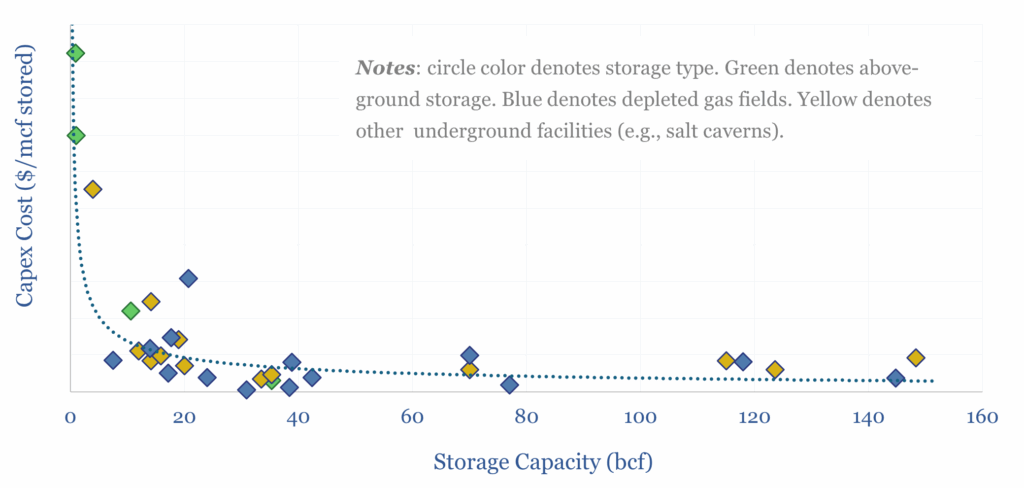
The capex costs of gas storage are built up from first principles in the data-file, decaying as a function of storage capacity. Generally depleted gas fields are most economical, followed by other underground storage, while above-ground storage (e.g., in storage tanks) tends to be lower-capacity and more expensive.
Please download the data-file to stress-test gas storage economics: especially how required storage spreads vary as a function of utilization rates (mcf per year per mcf of capacity) and capex costs (in $/mcf).