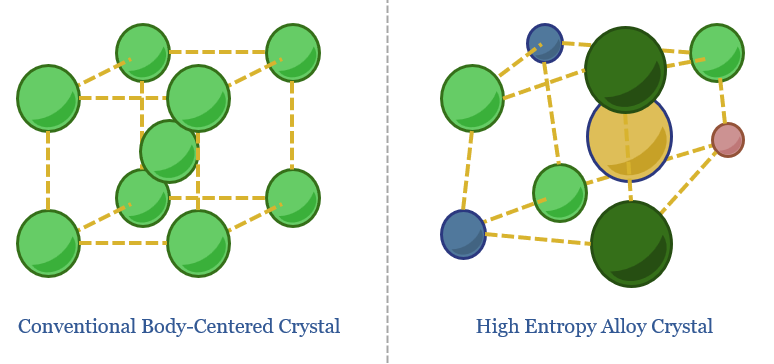
High Entropy Alloys are an emerging class of materials, composed of five or more elements, forming fascinating/novel lattice structures. This 18-page report reviews 100 recent HEA patents, and predicts generative AI will unlock transformational catalysts and materials in the next decade.
Some of the most game-changing materials in energy and industrials have been complex combinations of elements — LFP in batteries, NdFeB in magnetics, YBCO in high-temperature superconductors.
Historically, most materials were discovered due to their obviousness or via happy accidents. But is this changing in the AI era, and will this unlock more complex combinations? Evidence is on pages 2-3.
High Entropy Alloys (HEAs) are the class of materials, composed of five+ metallic elements, in similar proportions, which thus have interesting properties. Their history and structures are described on page 4.
There are trillions of possible HEAs in state space, as shown via the combinatorial mathematics on page 5. Many examples show extreme hardness and stability.
How are High Entropy Alloys being developed and commercialized? To answer this question, we reviewed 100 patents (over 2,000 pages) from the past decade, as noted on page 6-7.
The most interesting examples, from reviewing these HEA patents include extremely strong machine tools, high-temperature materials, nuclear materials, novel catalysts and in new energies, per pages 8-11.
In our view, we are in the early innings of using AI/ML to commercialize world-changing HEAs, and the most promising applications are in novel catalysts, thermoelectrics, superconductors, new magnets that do not require Rare Earths, and semiconductors, per pages 12-14.
Synthesis pathways for High Entropy Materials are briefly covered on page 15.
Leading companies in high entropy alloys, and their recent patent filings, are laid out on pages 16-18.