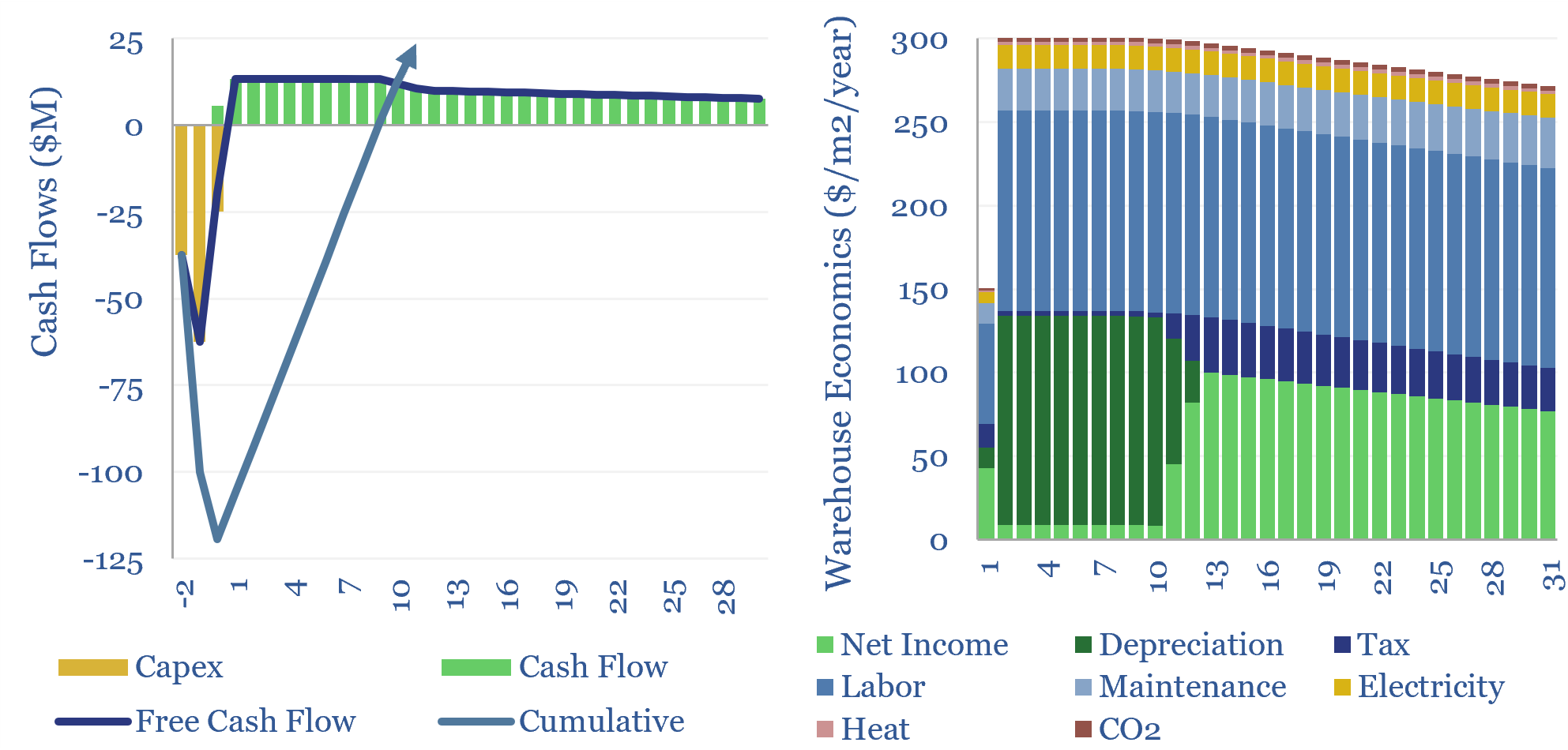
This data-file captures the economics of warehouses. A typical warehousing facility needs to charge $350 per m2 per year of storage, to earn an 8% unlevered return, on $1,250/m2 of construction capex, net of labor, electricity, heating and maintenance costs.
The global warehousing industry is worth $1trn pa, as every product needs to be stored at some point, perhaps several points, between its production and use. There are around 180,000 warehouses globally. The largest warehouse in the world is part of Boeing’s 400,000 m2 Everett Factory, in Washington, USA.
Hence this data-file captures the economics of warehousing. A typical warehousing facility needs to charge $350 per m2 per year of storage, to earn an 8% unlevered return, on $1,250/m2 of construction capex, net of labor, electricity, heating and maintenance costs.
This means, for example, that storing solar modules for a year, between their production and their deployment, will comprise around $50/kW of the total installed costs for a solar project. This also explains why solar module manufacturers may sometimes sell near to cost, in times of oversupply.
The economics of warehouses can be flexed in the data-file. Warehousing costs vary widely based on capex costs and labor costs, which are thus tabulated across 100 case studies and examples in the Examples_CaseStudies tab.
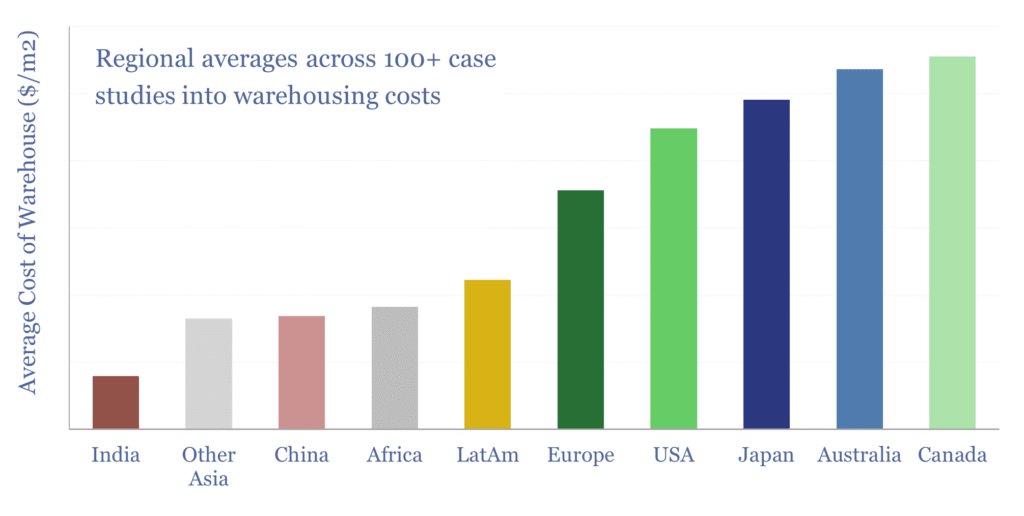
Fascinatingly, capex costs tend to be around 3x higher in the developed world compared to the emerging world. Within each geography, cold-storage facilities, climate-controlled and more complex logistics facilities can also be an order of magnitude more expensive than simpler industrial facilities.
If we think about our model for the construction costs of a data-center, really a data center is a warehouse full of server racks and GPUs. At $2,000/m2 of capex, this means that $1,000/kW of data center costs are likely to be spent simply on the shell of the building.
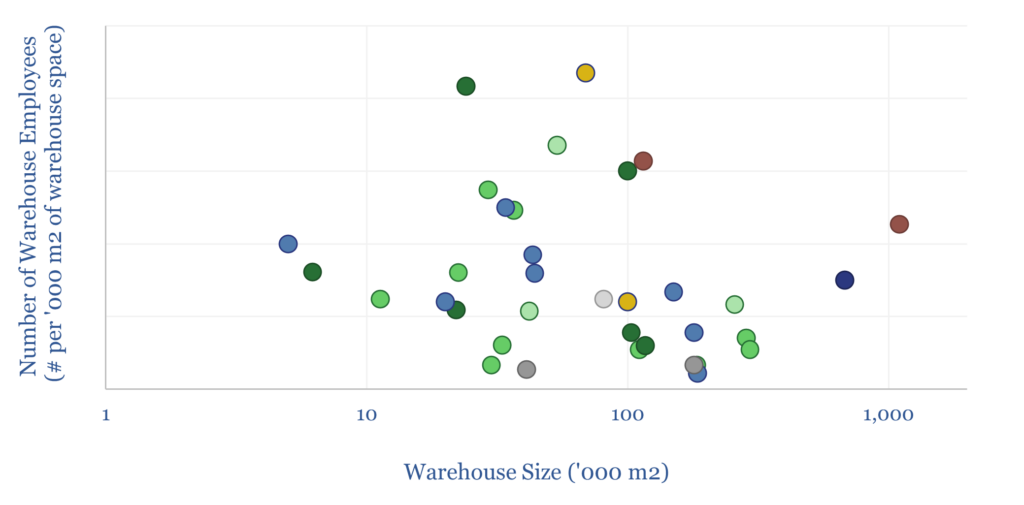
Labor comprises 40% of the total cost of warehousing, in our base case, but this number also varies. Some facilities have minimal labor requirements. Others have At the 90th percentile, some facilities have 20-ish employees per ‘000 m2, who may also handle some final assembly, logistics and transportation.
Please download the data-file to stress-test the economics of warehouses, and how storage costs vary as a function of capex, labor rates, electricity use, heat use, energy prices et al.