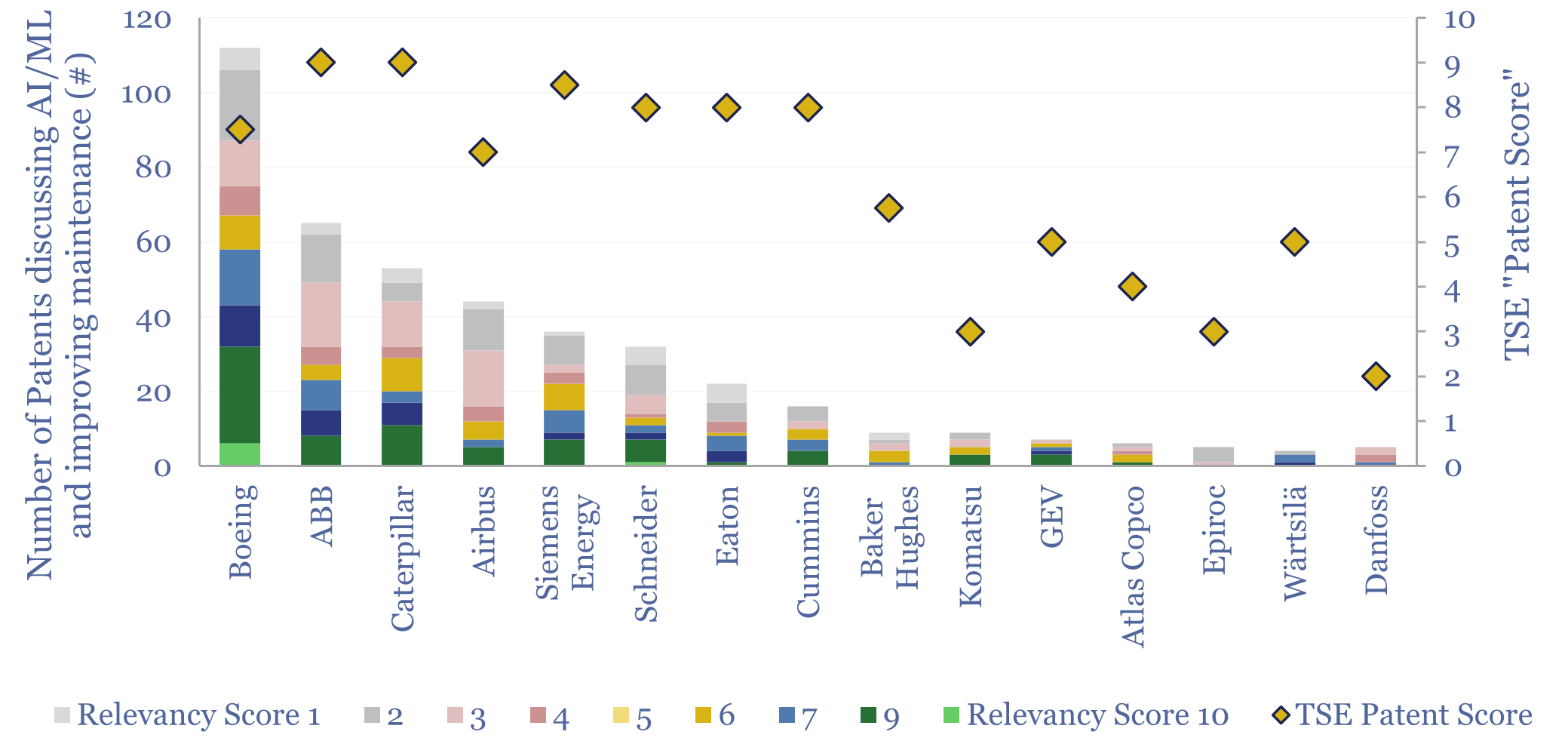
Leading capital goods companies using AI and machine learning to predict outages and optimize maintenance schedules across their product portfolios are summarized in this data-file. Using AI for predictive maintenance is an improvement on inexact prior schedules. AI also helps to improve energy efficiency during operation and the maintenance process itself.
Insufficient maintenance risks dangerous breakages and lost productivity. But excessive maintenance is itself costly and time-consuming. So which capital goods companies are using sensors and AI/ML to predict outages, optimize maintenance, and boost the competitive edge for their products?
To answer this question, we harnessed AI ourselves, to screen 475 patents from 15 leading capital goods companies, filed since 2021, then we reviewed the output and “scored” the likely value within these patents. The companies included ABB, Airbus, Atlas Copco, Baker Hughes, Boeing, Caterpillar, Cummins, Danfoss, Eaton, Epiroc, GE Vernova, Komatsu, Schneider, Siemens Energy and Wärtsilä.
Specifically, we found 475 patents from this peer group of companies, which mentioned “maintenance”, and “artificial intelligence” or “machine learning”. But that is only half the story. We also want to know which of these patents are specifically using AI/ML to predict outages or enhance maintenance, rather than just mentioning both sets of keywords unrelatedly.
Hence we used Claude to review each patent, identify 115 patents that were specifically using AI/ML to improve maintenance, and then summarize what these patents do, what industrial need they fill, whether they reduced downtime, saved energy, what sensor types they lean on, and to pull out any other case study data-points. This allowed us to review in 2-days what would previously have taken us 2-months.

After reviewing the output, together with the original patents, the ‘Overview’ tab of this spreadsheet covers our conclusions on each company, and how extensively they have started using AI/ML to predict outages, estimate remaining useful life (RUL) of machinery/components, and optimize maintenance cycles (aka predictive maintenance).
Commonly cited issues. Industrial assets generate Terabytes of data from thousands of sensors. Schneider notes that “the sheer volume of data can often overwhelm plant personnel”. Likewise, Cummins notes that modern diesel engines have “on the order of thirty sensors and fifteen actuators” and may calculate up to 20,000 parameters every second.
Many maintenance schedules today over-estimate degradation to err on the side of caution. But some failures also occur quite suddenly with little warning. Other times, an issue is noticed, but it is hard to localize. Hence AI/ML are well suited to handling vast quantities of data, learning patterns and improving predictive power.
Energy savings accompany improved monitoring. In one of the best patents/case studies across the entire sample, Schneider Electric uses AI to optimize the maintenance schedules for reverse osmosis plants, where fouling, scaling and suspended solids can elevate friction, hence. A worked example is given for a 22,000 m3/day osmosis plant. Simply optimizing the timing of four maintenance events per year saved 3.2% on the facility’s energy consumption. Atlas Copco patents also improve energy efficiency of compressors, along with monitoring them.
Caterpillar also had an excellent patent library for different classes of heavy machinery, backed up with hard data. For example, an excavator might usually achieve 576Tph of performance, which then declines by 2% every 100 hours, if the machine is not serviced after 3,000 hours.
Maintenance itself is also improved via AI. Patents from ABB and Airbus allow maintenance teams to query maintenance handbooks in natural language. Siemens uses machine vision to inspect gas turbine components.
Leading capital goods companies using AI and machine learning to predict outages and optimize maintenance schedules across their product portfolios are summarized in this data-file.