Will 2026’s disruption in the Strait of Hormuz leave a lasting aversion to chokepoints, and thus unleash a building boom for $5-25bn oil pipelines, in the Middle East, Canada and beyond? This 15-page report evaluates pipeline costs, resiliency benefits, and screens the supply chain on 25 past pipeline projects.
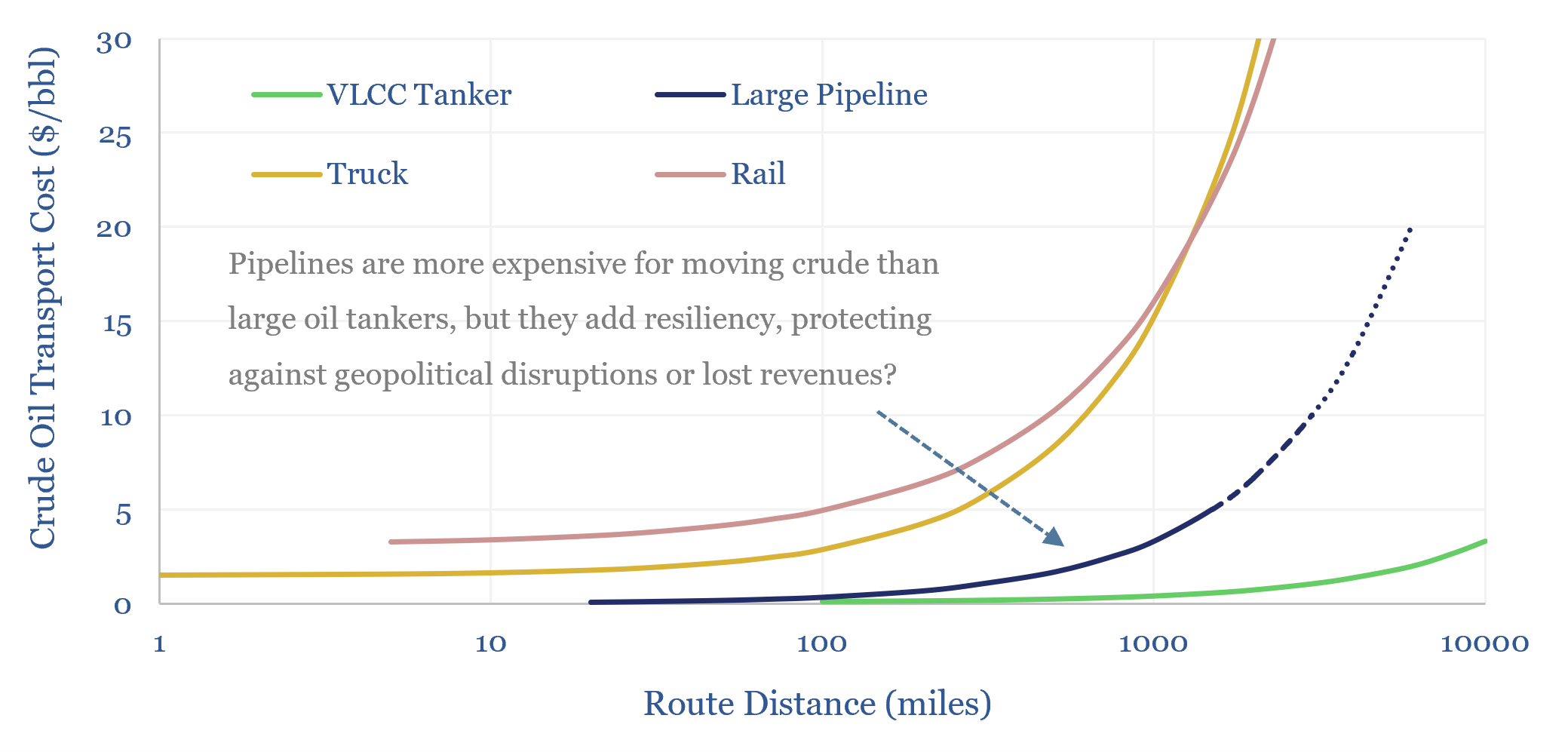
40Mbpd of crude and 20Mbpd of products moved by sea in 2025. Large oil tanker economics are usually lowest-cost for long distances, per page 2. But these tankers must also move through chokepoints.
Oil pipelines are 5-10x more costly, per kilometer, than oil tankers, based on our deep-dive into past pipeline projects and pipeline costs, on pages 3-4.
But oil pipelines can bypass chokepoints. And without pipelines, moving crude over land by truck or by rail is 5x more costly again, as shown on page 5.
Maybe large pipelines will increasingly be seen to be worth their $5-25bn construction costs, due to their resiliency value, as illustrated by the Strait of Hormuz disruption in 2026, discussed on page 6.
History already gives us several examples of long-distance pipelines that were built in the aftermath of prior crises and disruptions — most interestingly, Sumed — in order to improve resiliency, per pages 7-8.
Large new pipeline projects are thus under discussion, to bypass bottlenecks, and boost resiliency, in the Middle East, and also in Canada, per pages 8-9.
Who would benefit? We counted 40 contractors and subcontractors that have been involved in 25 major past pipeline projects, to inform who could win work in an upcoming pipeline boom, per pages 10-11. And relatedly, in LNG, per page 12.
It is particularly interesting to think how producers of pipeline steel might fare, relative to broader steel companies, amidst and/or after this year’s Hormuz disruptions.
We outline the steel requirements of large pipelines on page 13, an outlook for pipeline steel on page 14, and three specialist suppliers of wide-diameter pipeline steel on page 15.