Gallium Nitride (GaN) is a remarkable semiconductor. GaN forms a 2-Dimension Electron Gas (2DEG), with exceptional electron mobility, which supports high switching frequency, improved power quality, 50-70% lower losses and 50-70% smaller devices. It is thus a crucial enabler for large AI racks. This 13-page report reviews the technology, device costs, and future market drivers.
The key focus area for AI data-centers since 2024 has been getting power to the data-centers, which has motivated a lot of our deep-dive work into gas turbine supply-demand. But the key focus area for 2027+, to unlock more powerful chip-sets, is moving power within data-centers. Improved down-converters and SSCBs will almost certainly require GaN FETs. So what is GaN and why does it matter?
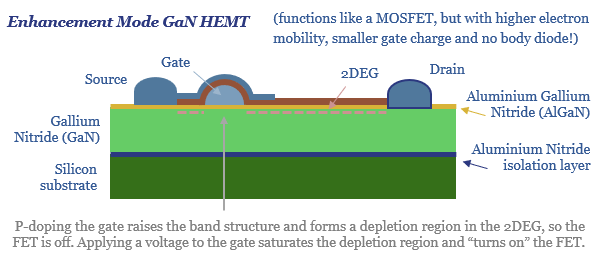
Something remarkable happens at the material interface between Gallium Nitride (GaN) and an overlying layer of Aluminium Gallium Nitride (AlGaN). A layer of mobile electrons accumulates at this interface. The properties and importance of this 2-Dimension Electron Gas (2DEG) in forming High Electron Mobility Transistors (HEMT) are explained on pages 2-4.
Why does this result in lower switching losses at higher frequency, and open up the potential for smaller devices? We work through a specific example, based on a simple buck-converter, on pages 5-6. Then we also review a dozen case studies, contrasting GaN devices against silicon devices on pages 7-8.
The latest costs of GaN, SiC and silicon MOSFETs, are tabulated on page 9. GaN FET costs are around 2x higher than silicon MOSFET costs. However, overall device costs may be smaller, if the faster-switching GaN FET allows for smaller passive components such as inductors and capacitors, per page 10.
How much upside is there for GaN discretes, and GaN-containing devices, amidst the rise of AI data centers? How does AI compare to other market drivers, such as wind/solar converters and EVs? And who benefits? Our answers to these questions are on pages 11-13.