Power Grids
-
Industrial energy and electricity consumption by sector?
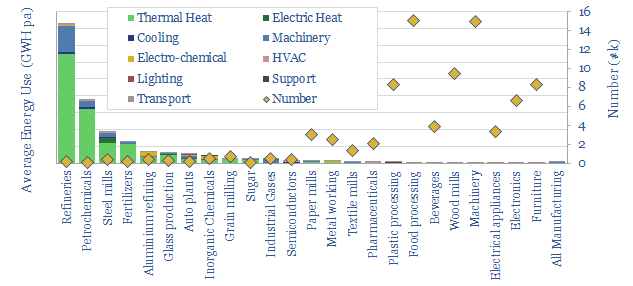
The average factory consumes 9GWH of energy per year, of which 5GWH is thermal heat and 4GWH is electricity. Of the electricity c50% is for rotating machinery, c10% for electric heat, c10% for process cooling, c7% for electrochemical processes, c10% for facility HVAC and c6% for lighting.
-
Power grids: tenet?
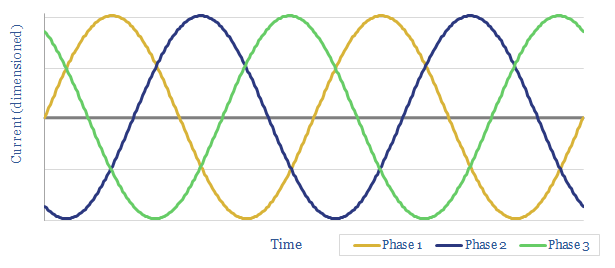
How do power grids work? How will they be re-shaped by renewables? This 20-page note outlines the underpinnings of electricity markets, from theoretical physics through to looming shortages of inertia and reactive power. There are challenges back-stopping renewables and this creates opportunities.
-
Inter-correlations between solar assets?
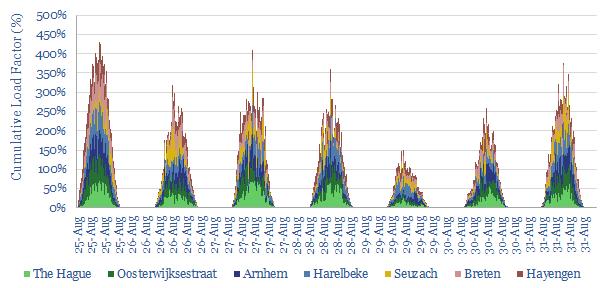
This data-file aggregates granular data from seven solar assets around Western Europe over a sample week. Absolute volatility is around 2-4% of nominal capacity every 15-minutes, while inter-correlations range from 60-90% depending on the distance between the different assets.
-
Transformers: rise of the beasts?
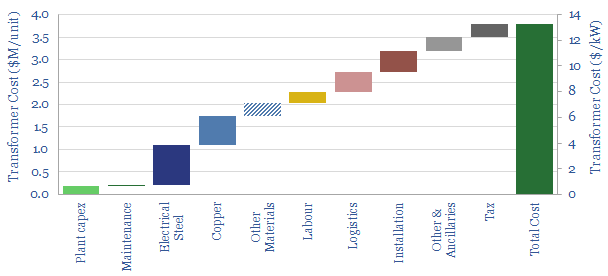
A transformer is needed to step the voltage up or down at every inter-connection point in the grid. Hence this 14-page note explores how renewables and EVs will expand future transformer markets. The main challenge is that the need for smaller, simpler units may exacerbate margin pressure in an already competitive industry. So who is…
-
Power plants: average capacity?
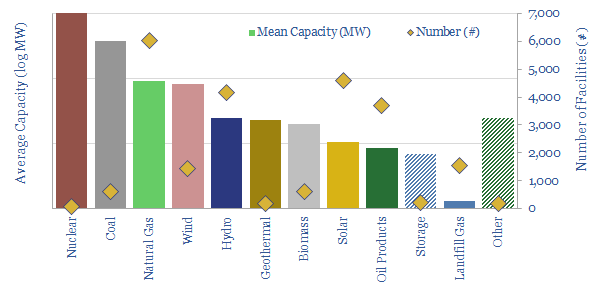
This data-file aggregates granular data into the average capacity of different types of power plants: wind, solar, nuclear, gas, hydro, coal, biomass, landfill gas and geothermal. Energy transition is going to increase the number of inter-connections to the grid by 10-100x.
-
Gas turbines: what market size in energy transition?
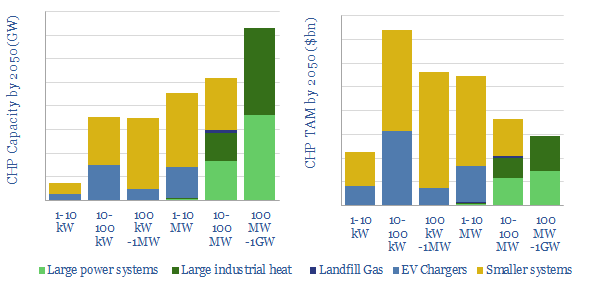
CHP systems are 20-30% lower-carbon than gas turbines, as they capture waste heat. They are also increasingly economical to backstop renewables. Amidst uncertain policies, the market size for US CHPs could vary by a factor of 100x. We nevertheless find 30 companies well-placed in a $9trn global market.
-
Power grids: hell is a hot, still summer’s day?
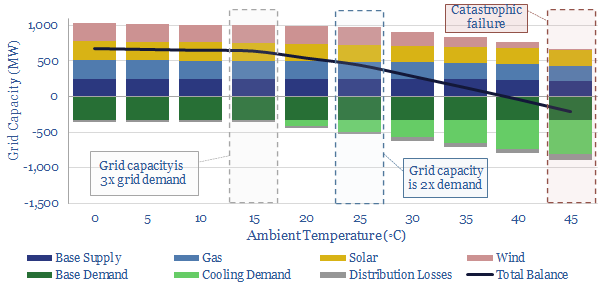
Ramping renewables to 50% of power grids is a growing aspiration in the energy transition. But in some markets, it may result in devastating blackouts during summer heatwaves, as power demand doubles exactly when wind, solar, gas, transmission losses and disruptions all deteriorate. This 15-page note assesses the implications.
-
Power generation: sensitivity to high-temperature heatwaves?
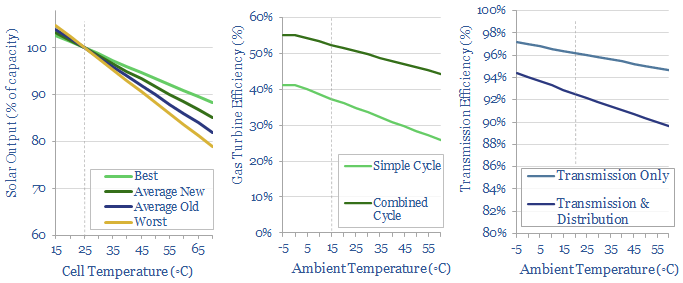
This data-file aims to provide a simple model for how generally well-covered grids can fail catastrophically during a heatwave. We have drawn on technical papers to quantify the deterioration of solar, gas, transmission and distribution losses, wind and other generation sources at higher temperatures.
-
Inter-correlations between offshore wind farms?
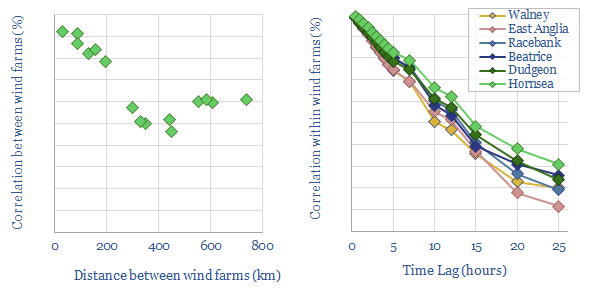
This data-file examines the correlations between different wind farms’ generation rates. The output from individual wind farms is 67% correlated on average, at any given point in time, and as high as 90% with a 100km x 100km area. Auto-correlation was also high, as windy/non-windy periods can last 2-10 days.
-
Power capacity of a typical home?
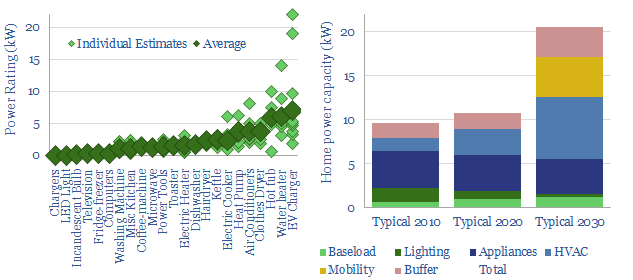
A typical home in the developed world currently has a 10kW maximum power capacity before tripping its circuit-breaker (although it varies). This could easily double in the energy transition, due to phasing back gas heating, gas cooking and the addition of home charging stations for electric vehicles.
Content by Category
- Batteries (96)
- Biofuels (44)
- Carbon Intensity (48)
- CCS (64)
- CO2 Removals (9)
- Coal (41)
- Commentary (65)
- Company Diligence (104)
- Data Models (922)
- Decarbonization (162)
- Demand (129)
- Digital (86)
- Downstream (47)
- Economic Model (221)
- Energy Efficiency (76)
- Hydrogen (63)
- Industry Data (308)
- LNG (56)
- Materials (86)
- Metals (88)
- Midstream (45)
- Natural Gas (161)
- Nature (76)
- Nuclear (28)
- Oil (176)
- Patents (39)
- Plastics (44)
- Power Grids (156)
- Renewables (153)
- Screen (137)
- Semiconductors (35)
- Shale (58)
- Solar (72)
- Supply-Demand (53)
- Vehicles (95)
- Video (24)
- Wind (47)
- Written Research (407)