Power Grids
-
Data-centers: electricity use and demand shifting?
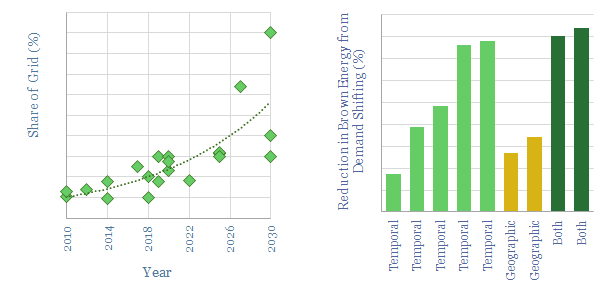
This data-file estimates data-centers’ electricity use and ability to demand shift. Large data centers how power demand in the range of 50-500MW. Around 40% of their electrical loads can demand shift, to help smooth out the volatility of renewables?
-
Cryogenic air separation: costs and energy economics?
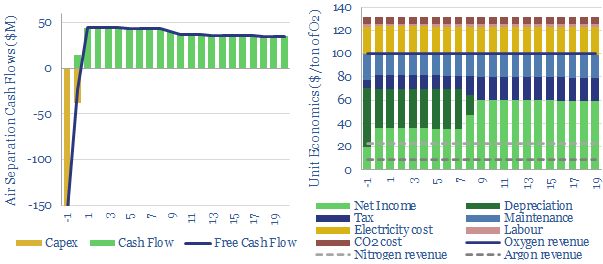
This data-file calculates the costs of cryogenic air separation units, which are important in the production of industrial gases, ammonia, metals, materials, medical applications and new energy technologies such as blue hydrogen. Good base cases are $100/ton oxygen, $20/ton nitrogen, $200/Tpa capex and 60kWh/ton of electricity (on an input air basis).
-
Shifting demand: can renewables reach 50% of grids?
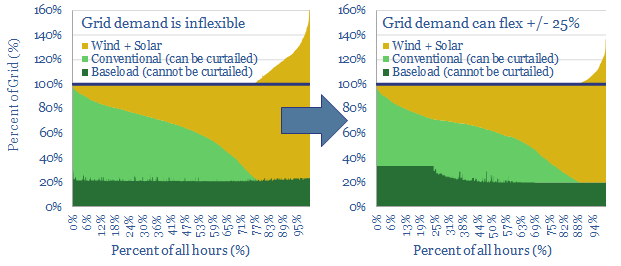
25% of the power grid could realistically become ‘flexible’, shifting its demand across days, even weeks. This is the lowest cost and most thermodynamically efficient route to fit more wind and solar into power grids. We are upgrading our renewables ceilings from 40% to 50%. This 22-page note outlines the opportunity.
-
Electric arc furnaces for lower-carbon steel production?
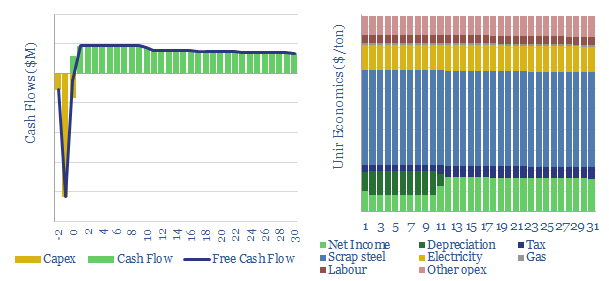
Electric arc furnaces generate enormous amounts of heat to recycle scrap steel, with 85% lower CO2 emissions than primary steel production. Our base case model yields a 15% IRR at $475/ton steel prices and a 10c/kWh power price. However, IRRs could be uplifted 2-6pp by integrating with renewables.
-
Prevailing wind: new opportunities in grid volatility?
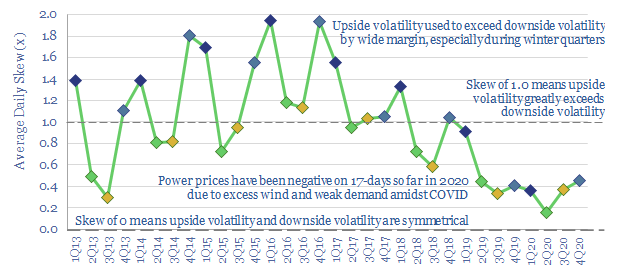
UK wind power has almost trebled since 2016. But its output is volatile, now varying between 0-50% of the total grid. Hence this 14-page note assesses the volatility, using granular, hour-by-hour data from 2020, to outline which backup opportunities are best-placed.
-
UK grid volatility as renewables gain share?
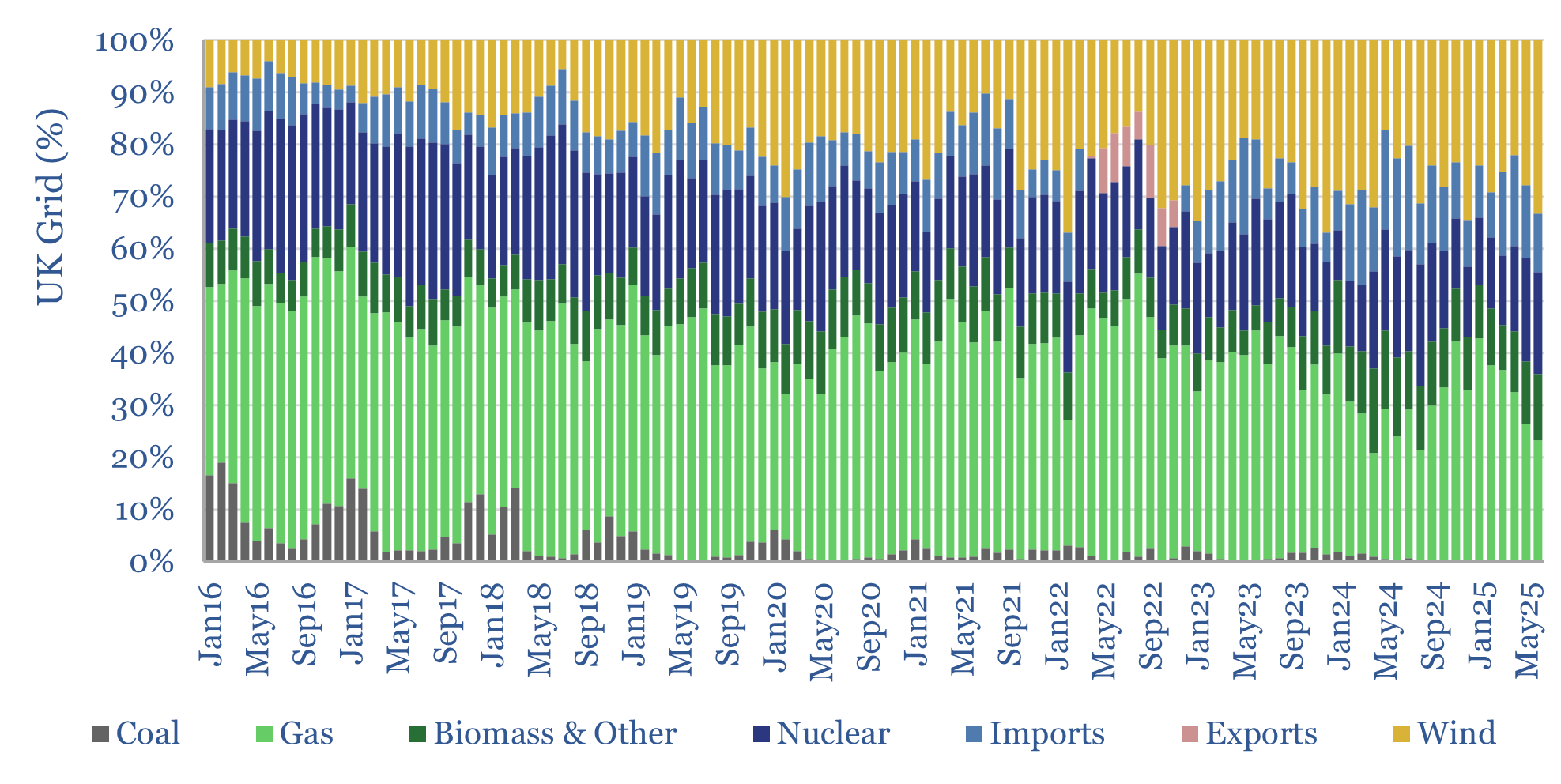
This data-file contains the output from some enormous data-pulls, evaluating UK grid power generation by source, its volatility, and the relationship to hourly traded power prices. We conclude the grid is growing more expensive and volatile, with the increasing share of wind.
-
Smart Energy: technology leaders?
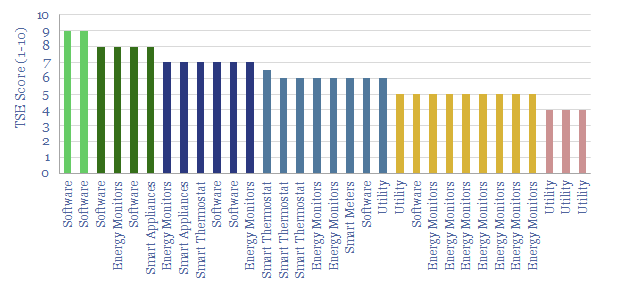
Smart meters and smart devices are capable of transmitting and receiving real-time consumption data and instructions. This data-file tracks 40 leading companies, mostly at the venture and growth stages. They help lower demand, smooth grid volatility and encourage appliance upgrades.
-
Turbo-charge gas turbines: the economics?
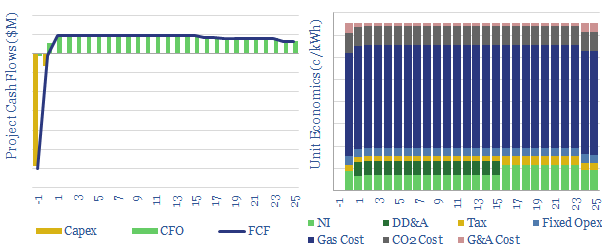
This data-file models the economics of turbo-charging gas turbines, which increases the mass flow of combustion air, to improve their power ratings by c10-20%. IRRs are solid. Turbo-charged gas turbines could thus gain greater share as grids become saturated with renewables
-
HVDC power transmission: the economics?
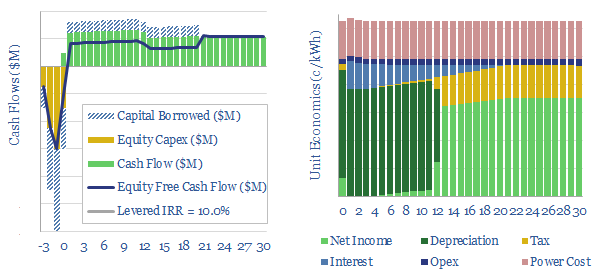
This model captures the economics of transporting electricity (e.g., wind and solar), over vast distances, using high voltage direct current power cables (HVDCs). Our base case shows a 3-10c/kWh transportation spread is required to earn a 10% levered IRR on 1,000-mile cable.
-
Exhaust gas recirculation in gas power: the economics?
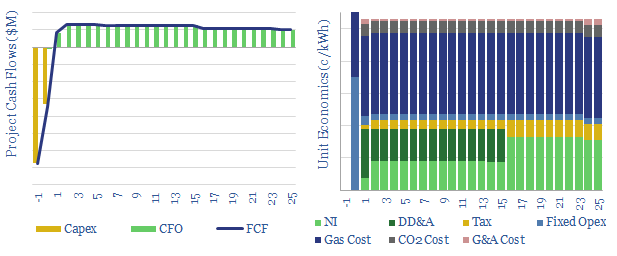
This data-file explores an alternative design for a combined cycle gas turbine, re-circulating exhaust gases after combustion, in order to facilitate CO2 capture. Costs and operating parameters are summarized from recent technical papers. Even with EGR, it will be challenging to decarbonize a gas turbine for less than $100/ton.
Content by Category
- Batteries (96)
- Biofuels (44)
- Carbon Intensity (48)
- CCS (64)
- CO2 Removals (9)
- Coal (41)
- Commentary (65)
- Company Diligence (104)
- Data Models (922)
- Decarbonization (162)
- Demand (129)
- Digital (86)
- Downstream (47)
- Economic Model (221)
- Energy Efficiency (76)
- Hydrogen (63)
- Industry Data (308)
- LNG (56)
- Materials (86)
- Metals (88)
- Midstream (45)
- Natural Gas (161)
- Nature (76)
- Nuclear (28)
- Oil (176)
- Patents (39)
- Plastics (44)
- Power Grids (156)
- Renewables (153)
- Screen (137)
- Semiconductors (35)
- Shale (58)
- Solar (72)
- Supply-Demand (53)
- Vehicles (95)
- Video (24)
- Wind (47)
- Written Research (407)