Power Grids
-
US electricity customers: sales, pricing, metering, load-shifting?
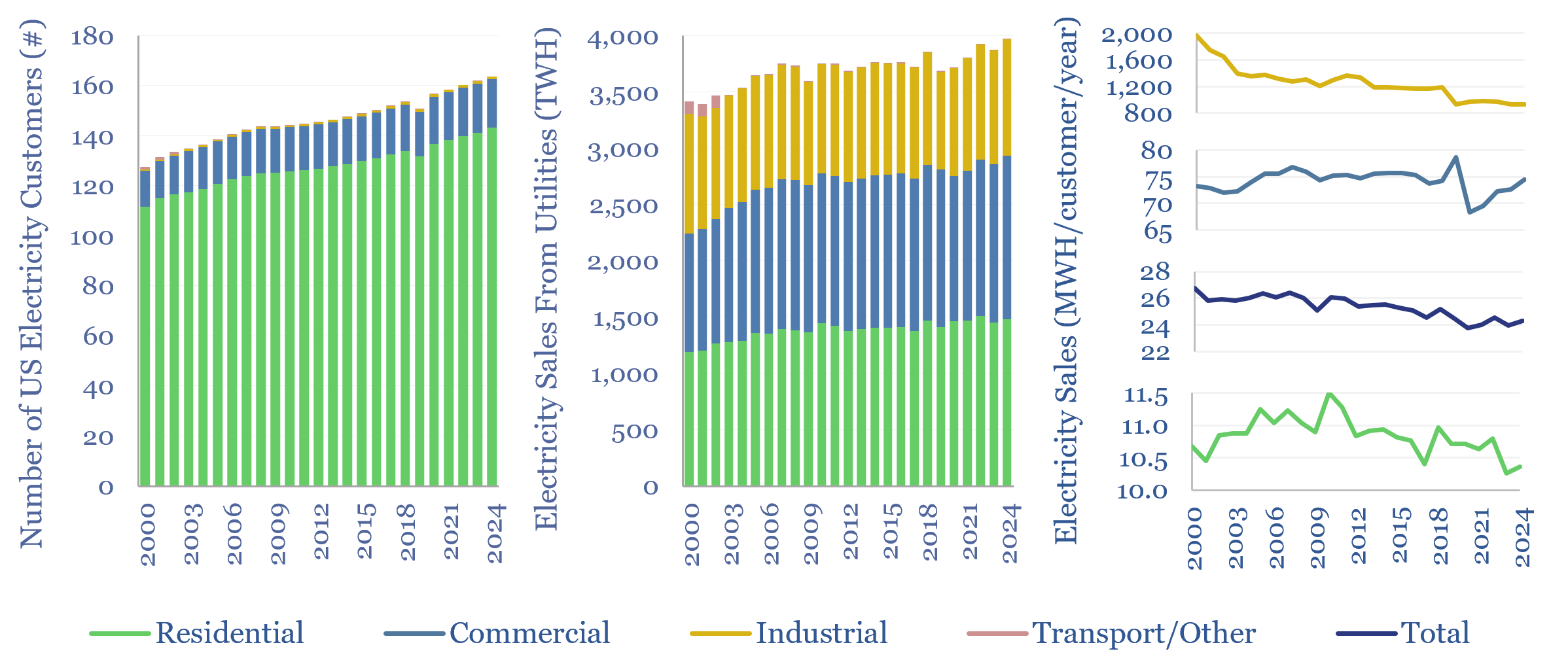
Characteristics of 164M US utility customers, consuming 4,000 TWH pa of electricity, are broken down in this data-file. The data help to explain the recent return to load growth in the US, but also show the pace of deployment of smart meters, demand response, load-shifting and real-time pricing tariffs, amongst residential, commercial and industrial customers.
-
Electric vehicle charging: the economics?
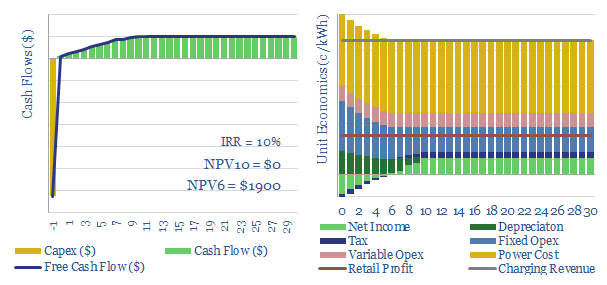
An electric vehicle charging station typically needs to charge 20-25 c/kWh, to earn a 10% return on its up-front capex costs, as it buys power for 10c/kWh and sells it on to electric vehicles with 10-50% utilization rates. Larger, fast-chargers seem most economic. Especially where retail revenues support the economics of EV-charging.
-
AI training energy: breaking the power laws?
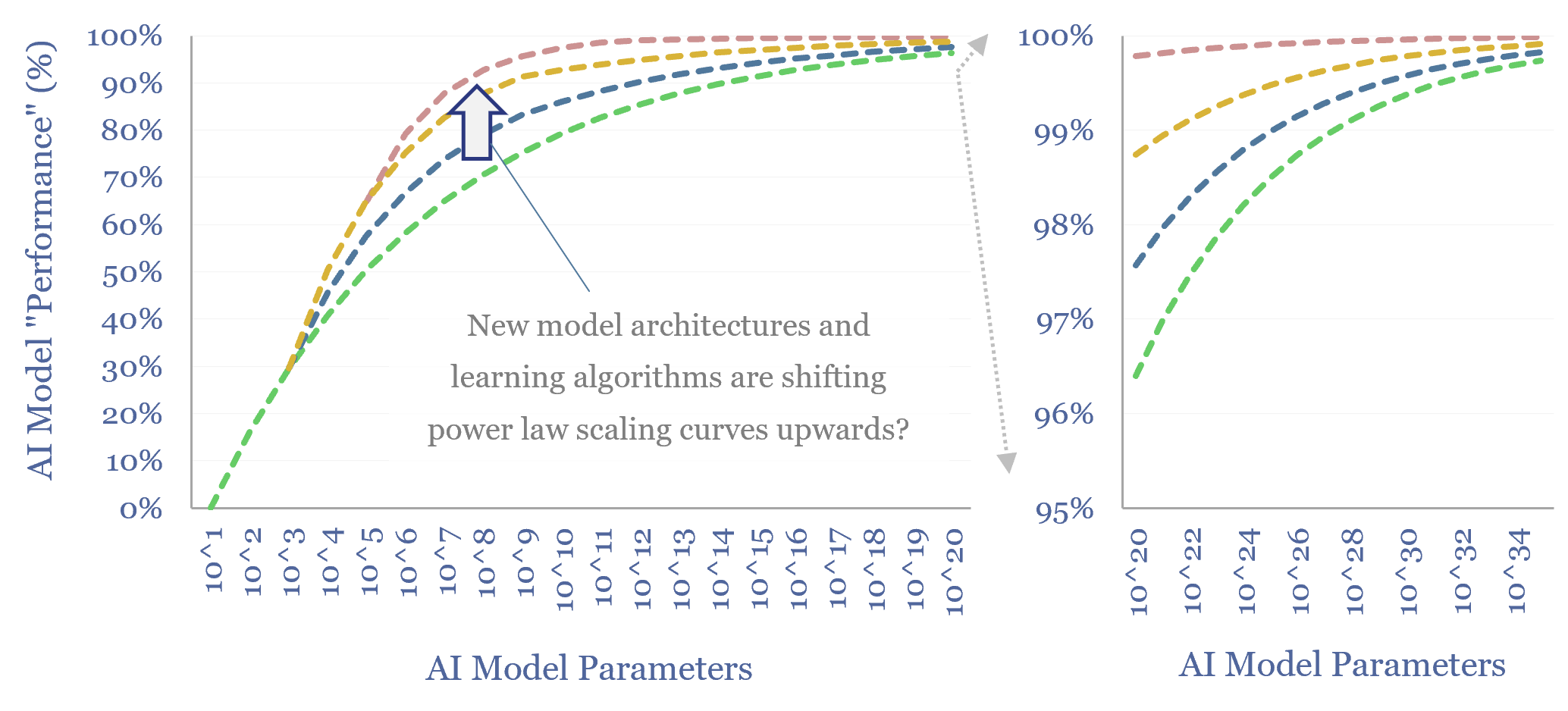
An argument for runaway energy use by AI is that performance follows a power law: incrementally better performance requires exponentially more model parameters, training data and compute. But this 13-page note finds evidence for greater efficiency gains, and considers whether AI scaling laws are set to slow down, meaning less energy consumption?
-
US load growth: electrical grounding?

What if US load growth disappoints from here, as the AI era progresses? We have previously published forecasts for +3% pa to 2030. Others are at 5-10% pa. Hence today’s 16-page report asks what assumptions are embedded in our outlook. There are six key risks. Our downside case is as low as +1% pa load…
-
Microgrids: plug-and-play?

Microgrids are accelerating due to perceived power grid bottlenecks and rising reliability requirements, especially at AI data-centers. Hence this 17-page report explores how microgrids work, what they cost, where they make economic sense, and finds microgrid opportunities, especially with an increasingly plug-and-play supply chain.
-
ELCCs: reliability of power sources?

ELCC denotes the Effective Load Carrying Capacity of power generation, illustrating how reliably that capacity will be available during times when grids are strained. ELCCs are highest for nuclear, gas generation and coal; lower for batteries, hydro and offshore wind; lowest for onshore wind and solar. ELCC by power source varies, however.
-
Microgrids: the economics?
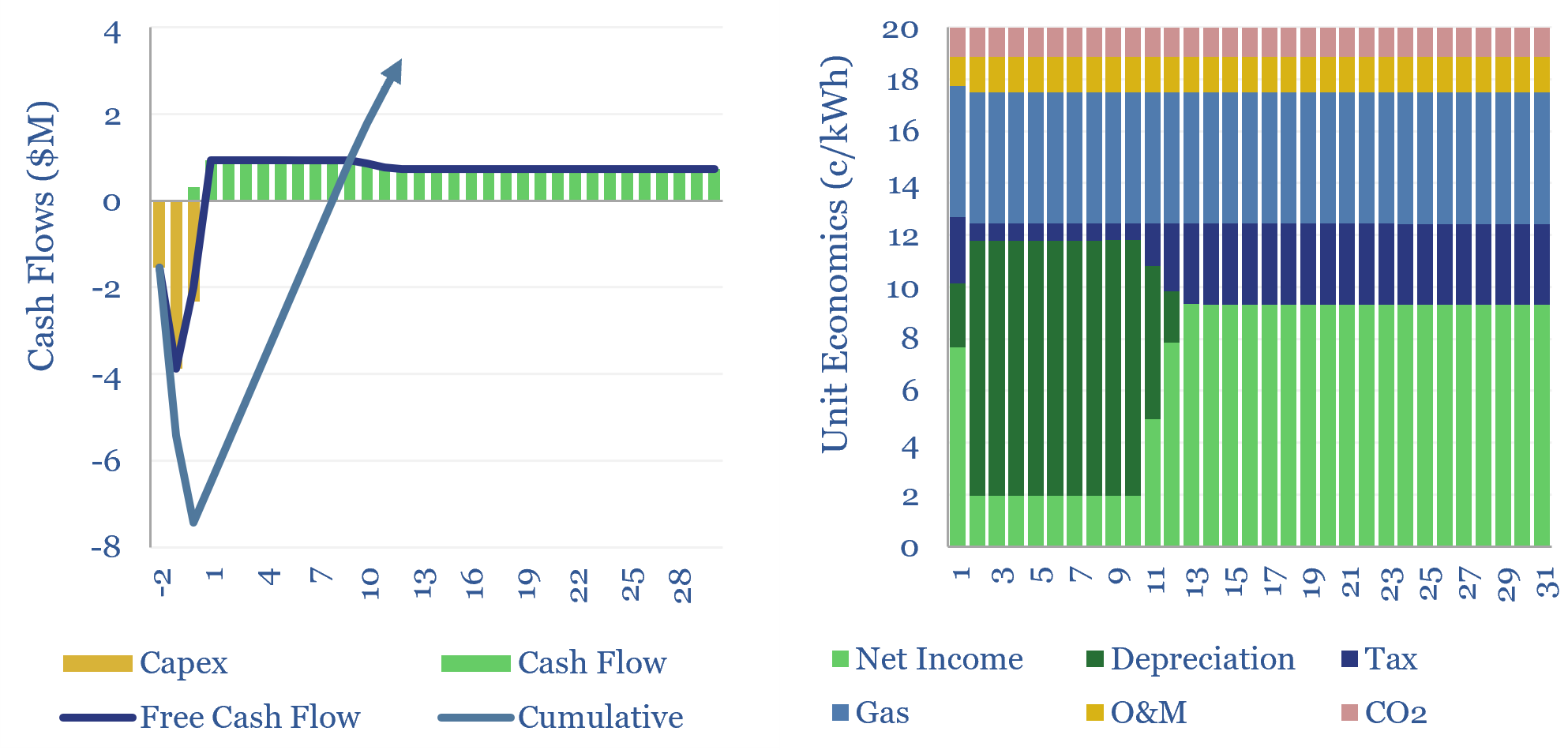
Microgrid economics are captured in this data-file. A 20c/kWh levelized cost of electricity is needed to generate a 10% IRR on a typical $5,000/kW system, sourced by solar, batteries and gas generation, plus controllers, switchgear and instrumentation.
-
Costs of demand response: Voltus case studies?

Demand response, aka load shifting, or virtual power plants, keep power grids in balance by curtailing non-essential loads, during times that would otherwise require ramping up peaker plants, or when grids simply do not have enough capacity overall. The costs of demand response are estimated at c$60/kW/year, across 25 case studies in this data-file, for…
-
Dunkelflaute: how big do the batteries need to be?

How big would the batteries need to be, to ride through the biggest dunkelflautes that occur each year, in renewable-heavy grids? This 8-page report has gathered data for Spain, the UK and California. 30 GWH of storage per GW of renewables would help ride through wind-driven dunkelflautes. But shutting thermal generation still seems unfeasible. Thus…
-
Renewable-heavy grids: total system costs?

Renewables can have similar LCOEs as conventional generation sources. Yet ramping renewables to c50% of a developed world power grid inflates total system costs by at least 50%. This is because renewables require back-ups, additional T&D and power electronics. This 16-page report aims to quantify the total system costs of renewable-heavy grids, and their implications.
Content by Category
- Batteries (96)
- Biofuels (44)
- Carbon Intensity (48)
- CCS (64)
- CO2 Removals (9)
- Coal (41)
- Commentary (65)
- Company Diligence (105)
- Data Models (924)
- Decarbonization (162)
- Demand (131)
- Digital (88)
- Downstream (47)
- Economic Model (221)
- Energy Efficiency (76)
- Hydrogen (63)
- Industry Data (308)
- LNG (56)
- Materials (86)
- Metals (88)
- Midstream (45)
- Natural Gas (161)
- Nature (76)
- Nuclear (28)
- Oil (176)
- Patents (39)
- Plastics (44)
- Power Grids (156)
- Renewables (153)
- Screen (138)
- Semiconductors (35)
- Shale (58)
- Solar (72)
- Supply-Demand (53)
- Vehicles (94)
- Video (24)
- Wind (47)
- Written Research (408)