Vehicles
-
Aerial Vehicles: Which Ones Fly?
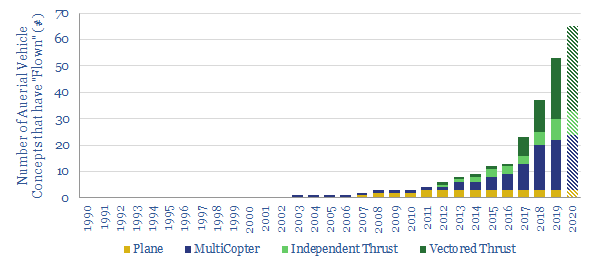
We have updated our database of over 100 companies, which have already flown c50 aerial vehicles (aka “flying cars”), to identify the leading contenders. We categorize each vehicle by fuel type, speed, range, fuel economy and credibility. The data strongly imply aerial vehicles taking off in the 2020s.
-
Hybrid horizons: industrial use of batteries?
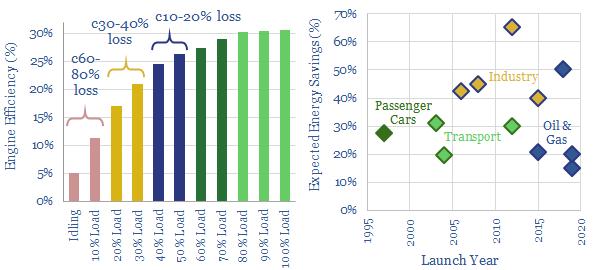
Gas and diesel engines can be 30-80% less efficient when idling, or running at low loads. This is the rationale for hybridizing engines with backup batteries. Industrial applications are increasing, achieving 30-65% efficiency gains, across multiple industries. In 2018-19, the biggest new horizon has been in oil and gas, including hybrid rigs, supply vessels, construction…
-
Drones & droids: deliver us from e-commerce
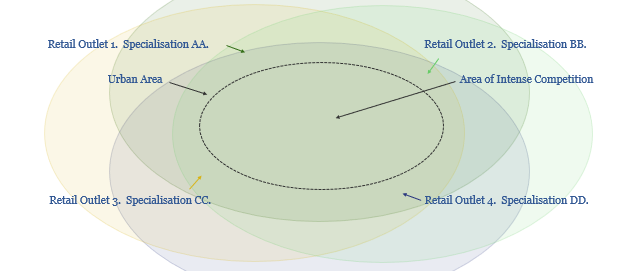
Small, autonomous, electric vehicles are emerging. They are game-changers: rapidly delivering online purchases to customers, creating vast new economic possibilities, but also driving the energy transition. Their ascent could eliminate 500MTpa of CO2, 3.5Mboed of fossil fuels and c$3trn pa of consumer spending across the OECD. The mechanism is a re-shaping of urban consumption habits,…
-
Value in Use: CO2 intensities of household items?
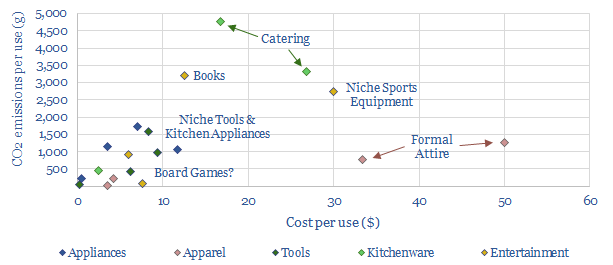
More extensive “sharing” will be enabled by drone delivery technologies and could save $1trn of costs and 100MTpa of CO2 emissions across the entire US. These numbers are illustrated by tabulating the data for 20 common household items, which we estimate are currently used just 20 times in their entire useful lives, thus costing $13…
-
Distribution Costs: Ships, Trucks, Trains and Delivery Vans?
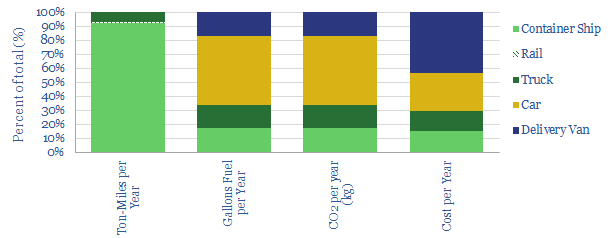
Distributing goods to the typical US consumer costs 1.5bbls of fuel, 600kg of CO2 and $1,000 per annum. The costs will increase 20-40% in the next decade, as the share of online retail doubles to c20%, hence new technologies are needed in last-mile delivery. This data-file provides a full breakdown of the numbers, across container-ships,…
-
2050 oil markets: opportunities in peak demand?
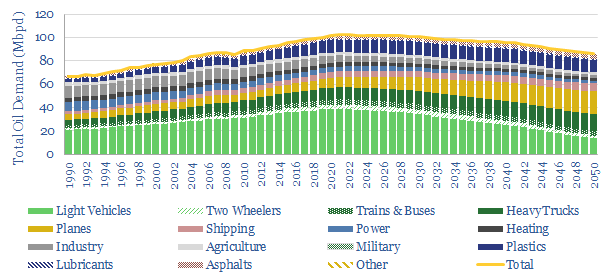
Seven technology themes can save 45Mbpd of long-term oil demand. They make the difference between 2050 oil consumption surpassing 130Mbpd and our own forecasts: for a plateau in the 2020s, then a gradual descent to 87Mbpd in 2050.
-
Drones attack military fuel economy?
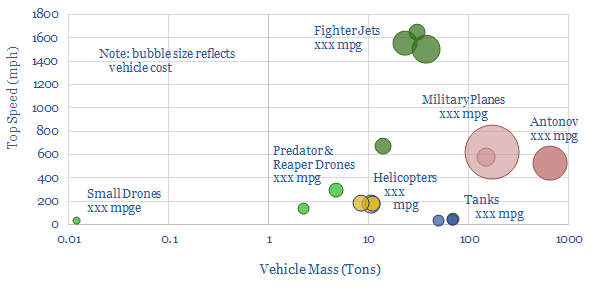
Swarms of drones are emerging as the most devastating military weapon of the 21st century. This was evidenced by the recent attack on Saudi oil infrastructure. But drones’ impact on 0.7Mbpd of global military oil demand could be even more devastating. This data-file quantifies their fuel economy at >1,000 mpge compared to today’s fighter jets,…
-
Container ships versus trucks and trains
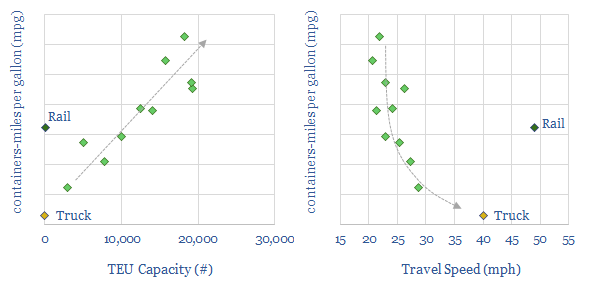
This data-file tabulates the impressive fuel economy of container vessels, as a function of their size and speed. The best examples are 2x more efficient than typical trains and 20x more efficient than typical trucks. Hence, even as the OECD consumes 4kg per person per day of goods shipped from overseas, these container ships account for c0.25%…
-
Drone Delivery: the Energy Economics
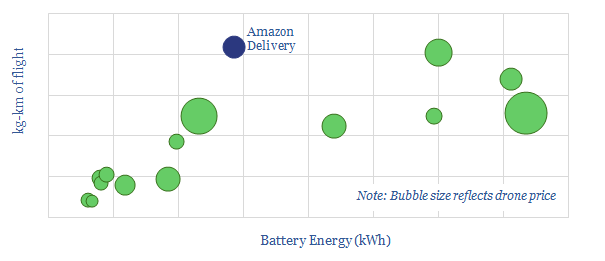
We have tabulated energy economics on 15 commercial drones and run the equations of flight on Amazon’s “Prime Air” solution. We conclude that drone delivery will use 90% less energy, 99% less cost and 90% lower carbon than is typical in current last-mile truck deliveries. Please download the model for all of the numbers.
-
Subsea Robots: the next generation?
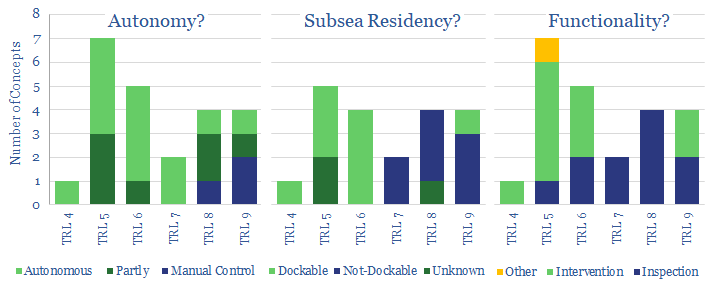
Over 20 next-generation subsea robotics concepts are presented. These electric solutions are increasingly autonomous, they reside subsea and can conduct more thorough inspection/intervention work. Inspection is 2-6x faster, and maintenance costs can be halved, yielding savings of $0.5-1/boe at a typical field. The data-file also summarizes the leading Majors and Service Companies in the space.
Content by Category
- Batteries (95)
- Biofuels (44)
- Carbon Intensity (48)
- CCS (64)
- CO2 Removals (9)
- Coal (41)
- Commentary (65)
- Company Diligence (104)
- Data Models (920)
- Decarbonization (162)
- Demand (129)
- Digital (86)
- Downstream (47)
- Economic Model (220)
- Energy Efficiency (76)
- Hydrogen (63)
- Industry Data (308)
- LNG (56)
- Materials (86)
- Metals (88)
- Midstream (45)
- Natural Gas (161)
- Nature (76)
- Nuclear (28)
- Oil (175)
- Patents (39)
- Plastics (44)
- Power Grids (155)
- Renewables (153)
- Screen (136)
- Semiconductors (35)
- Shale (58)
- Solar (72)
- Supply-Demand (53)
- Vehicles (95)
- Video (24)
- Wind (47)
- Written Research (405)