Vehicles
-
Explaining US gasoline?
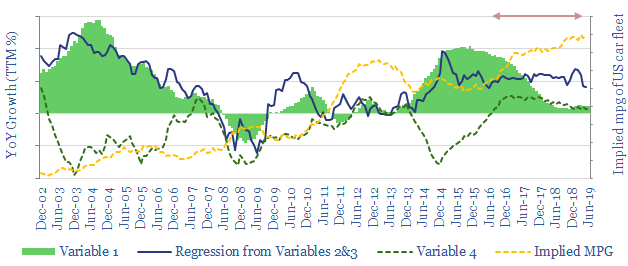
Gasoline demand is stalling in summer-2019, down -0.4% YoY vs a prior 15-year trend for 0.4% pa growth. The cause is urban Vehicle Miles Driven, which has slowed 1.4pp, defying historical correlations with GDP and gasoline prices. Possible structural explanations are explored. The full data-file contains monthly data on the drivers of gasoline, going back…
-
Power Trains? Electric, diesel or hydrogen
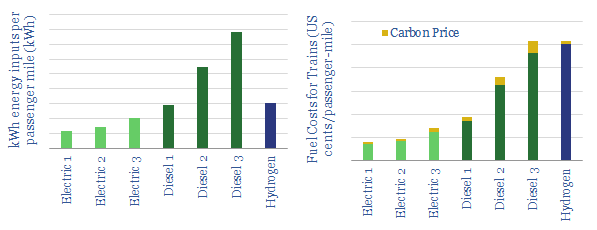
This data-file compares diesel trains, electric trains and hydrogen trains, according to their energy consumption, carbon emissions and fuel costs. The energy economics are best for electrifying rail-lines. Hydrogen costs must deflate 25-75% to be cost-competitive.
-
Electric cars slow the energy transition?
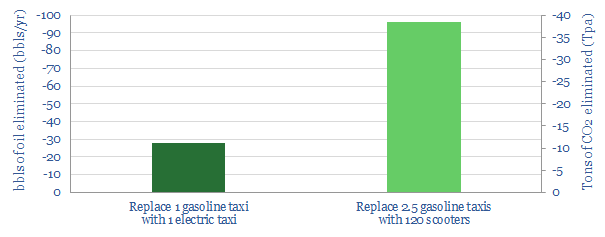
Electric Cars are being overtaken by new electric vehicles, which achieve c3x greater decarbonisation per unit of battery material. This is shown by comparing the relative impacts of deploying 400kg of battery materials into a single EV, versus a fleet of c120 electric scooters. It matters as battery materials are a limiting factor in the…
-
Scooter Wars?
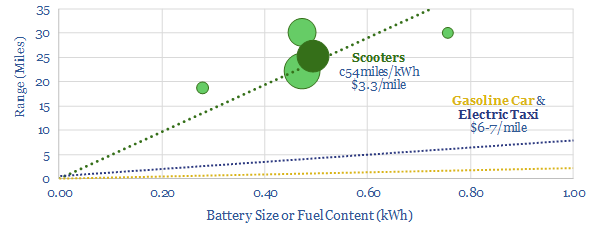
E-scooters can re-shape urban mobility, eliminating 2Mbpd of oil demand by 2030, competing amidst the ascent of “electric vehicles” and re-shaping urban economies. These implications follow from e-scooters having 25-50x higher energy efficiencies, higher convenience and c50% lower costs than gasoline vehicles, over short 1-2 mile journeys. Our 12-page note explores the consequences.
-
Energy Economics of e-Scooters
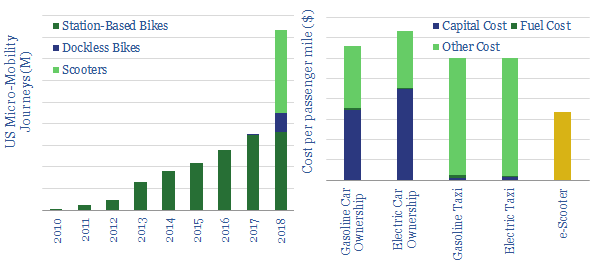
This workbook contains all our modelling on the energy economics of e-scooters; a transformational technology for urban mobility. Included are our projections of per-mile costs, energy-economics, battery charging times, new electricity demand and displacement of oil demand.
-
Hydrogen Cars: how economic?
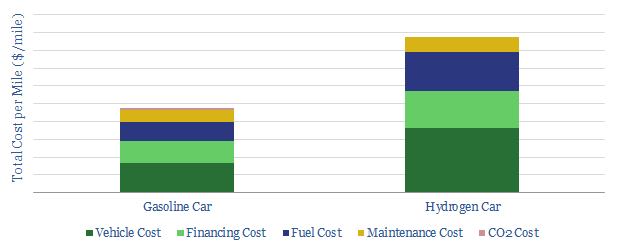
We model the relative economics of hydrogen cars, which are c85% costlier than US gasoline in our base case. In Europe, c20% cost-deflation could bring hydrogen cars close to competitiveness.
-
Aerial Vehicles: why flying cars fly
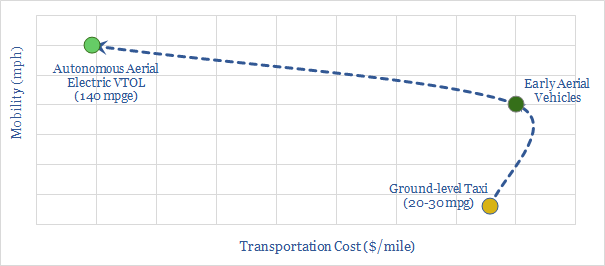
Aerial vehicles will do in the 2020s what electric vehicles did in the 2010s. They will go from a niche technology, to a global mega-trend that no forecaster can ignore. These conclusions stem from a deep-dive analysis into the technology, the fuel economies and the costs, all of which will be transformational.
-
Aerial Vehicles Re-Shape Transportation Costs?
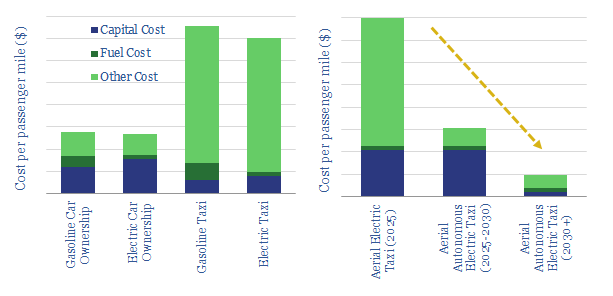
This model calculates costs per passenger-kilometer for transportation, based on input costs. Aerial vehicles could compete with taxis as early as 2025. By the 2030s, their costs can be c60% below car ownership.
-
Who’s Afraid of Aerial Vehicles?
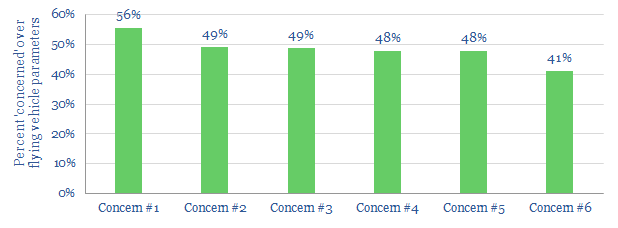
This data-file tabulates consumer attitudes towards aerial vehicles, based on the best perception study we have seen in the technical literature. It shows the influence of geography, income, age, gender, education levels and length of commute; along with top concerns.
-
Round Trip Battery Efficiencies
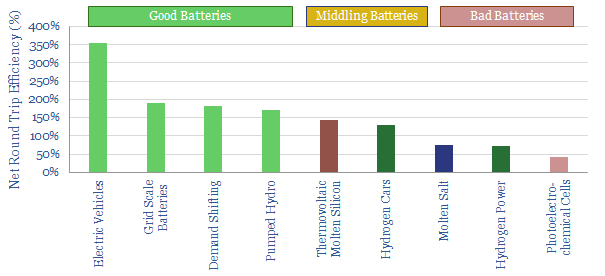
Different batteries have different round trip efficiencies. We see great potential, for example, in electrification of the vehicle fleet, which can achieve c3.5x efficiency gains. We see less potential, for example, backing up the grid with hydrogen, which reduces total system efficiency by c30%.
Content by Category
- Batteries (95)
- Biofuels (44)
- Carbon Intensity (48)
- CCS (64)
- CO2 Removals (9)
- Coal (41)
- Commentary (65)
- Company Diligence (104)
- Data Models (920)
- Decarbonization (162)
- Demand (129)
- Digital (86)
- Downstream (47)
- Economic Model (220)
- Energy Efficiency (76)
- Hydrogen (63)
- Industry Data (308)
- LNG (56)
- Materials (86)
- Metals (88)
- Midstream (45)
- Natural Gas (161)
- Nature (76)
- Nuclear (28)
- Oil (175)
- Patents (39)
- Plastics (44)
- Power Grids (155)
- Renewables (153)
- Screen (136)
- Semiconductors (35)
- Shale (58)
- Solar (72)
- Supply-Demand (53)
- Vehicles (95)
- Video (24)
- Wind (47)
- Written Research (405)