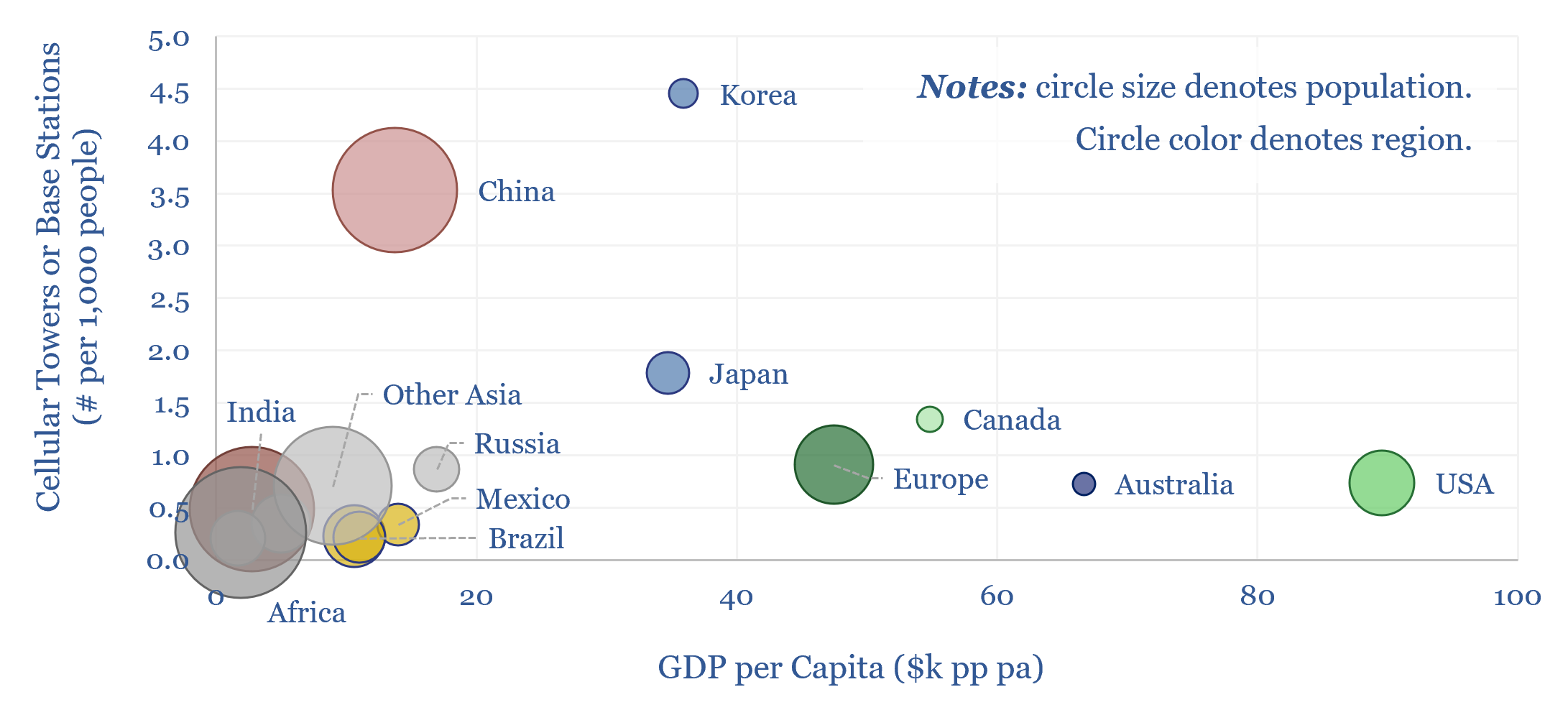
The global energy consumption of cellular networks is estimated at 250TWH pa in this data-file, by tabulating the deployment of 5G base stations, and other cellular towers, region-by-region. This matters as physical AI may require more cellular connections, across autonomous vehicles, drones and robotics.
Data are transmitted over the cellular network via radio waves. In an Active Antenna Unit, digital signals are first converted into radio-frequency signals, then up-converted to a specific radio frequency band (e.g., 3.5GHz), then amplified, then emitted at the antenna.
5G is the “Fifth Generation” of Mobile Network technology. 5G base stations use higher power, and higher frequency signals, across a broader spectrum than 4G, which are then beam-formed to individual users.
5G is MIMO, which stands for Multiple In Multiple Out, and enables hundreds of signals to be broadcast simultaneously, across hundreds of antenna units, often beaming data directionally towards specific users, which allows for more sharing of the same frequency bands.
Hence 5G is 10-20x faster than 4G, reaching 1-20Gbps (from 30-1,000Mbps), with latencies as low as 1ms (from 30-50ms), and an order of magnitude better performance in crowded areas.
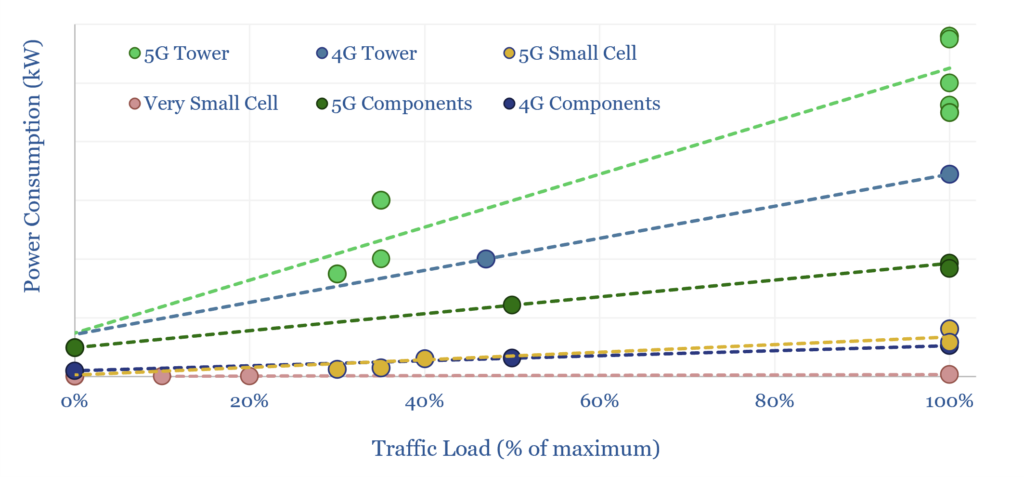
The power consumption of cellphone towers is estimated from prior studies and technical papers in this data-file, in kW, and varies with load and with network components (chart below).
We then multiply the average power consumption of each cellphone tower with the estimated number of cellphone towers in each region, across the US, Canada, Europe, Japan, Korea, Australia, LatAm, China, India, Other Asia and Africa.
The energy consumption of global cellular networks is thus estimated at 250TWH in 2026, which is 0.8% of global electricity demand, and has more than trebled since 2015.
Demand growth has been Jevonsian over the past decade. 5G is 10x more efficient than 4G, per unit of data that is transmitted, but this has been more than offset by an explosion of data transmission.
What energy consumption of cellular networks in the AI era?
Physical AI includes autonomous vehicles, specialized robotics concepts, humanoid robots, delivery drones, other drones. All of these are mobile. Hence will they require another billion+ cellular connections?
The key compute for autonomy is usually done in situ in all of these categories, and does not require conveying data over the cellular network. However, cell connections are used for fleet management.
Evolution not revolution? 75% of cars sold in 2025 already have embedded cellular connectivity, for real-time navigation and in-car entertainment. This is mostly 4G connectivity. But it shows that physical devices are already increasingly interconnected.
Another possibility is that autonomous vehicles and robots will periodically wish to upload huge data-sets, gathered from their real-world experience, back to data centers, for additional AI training, and to continually improve autonomous algorithms.
This might require a cellular network with much higher upload speeds than today. Or alternatively, it could simply lean on the WiFi network instead, when these vehicles and robots are ‘back at base’ or in an area with Wi-Fi/fiber connectivity.
The market for 5G hardware is also estimated in the data-file, at $50bn pa. Leading companies include Huawei, Ericsson, Nokia, ZTE, Cisco and Samsung. The underlying power amplifiers and radio units use GaN semiconductor.