Delivery drones are finally taking off? US pilot projects are achieving strong safety records, exciting consumers and raising the prospect of sub-$1 deliveries within 10-minutes. This 13-page report explores the future impacts of delivery drones in energy, materials and capital goods.
Drone delivery is a topic we have been following excitedly since 2019. It just “seems cool”, that a drone flying at 100kmph, could deliver any small cargo right to your back yard or rooftop, from anywhere within a 1-15km radius, within 1-10 minutes.
A second benefit for delivery drones is avoiding the inefficiency of delivering small packages weighing <10kg in a car (2 tons) or delivery van or truck (5-10 tons), which uses 90-95% less energy, per page 2.
Use of drones in niche contexts, such as military uses or power line inspection was accelerating when we revisited the topic in 2024. But generalized deployment of urban delivery drones seemed harder, slower to emerge, due to stringent safety controls.
That is now changing, after reviewing industry progress. Specifically, we reviewed milestones from Zipline, Amazon Prime Air and Google Wing, on pages 2-5.
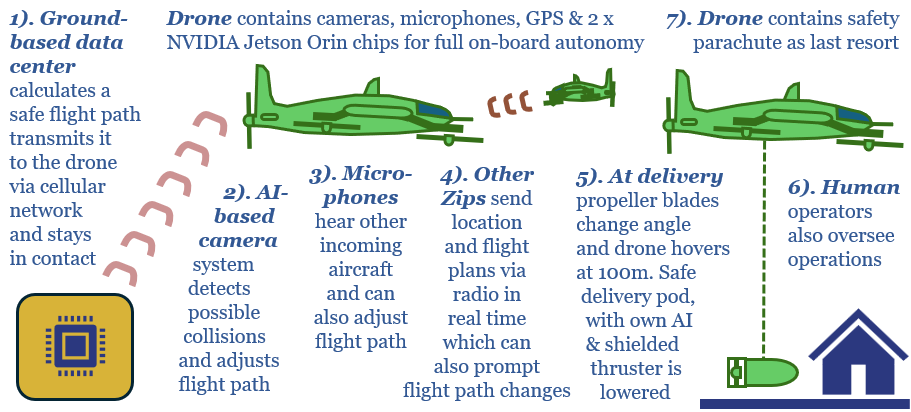
In particular, we can understand how strong safety records are being achieved, using low-cost sensors and AI chips, based on reviewing Zipline’s patents.
So here we have another example where AI and autonomous technology looks likely to upend several economic categories. And one where the compute is in the physical device, more so than in data centers.
Hence this prompted us to re-examine the cost of drone deliveries. There is a pathway where costs can fall below $1 per delivery, as argued on pages 6-8.
A cost of $1 per delivery for drones is 80-95% less than the $5-20 courier fees that are typically charged on small deliveries today. So what does this mean?
We estimate the ultimate market size for delivery drones, the number of units that could get built per year, and where that spend would go, across 20 materials and capital goods categories, on pages 8-10.
Energy market impacts might seem to reduce oil demand by around 2% in developed world economies. But overall, we think hydrocarbon demand may rise when considering rebound effects and demographic changes, as argued on pages 11-12.