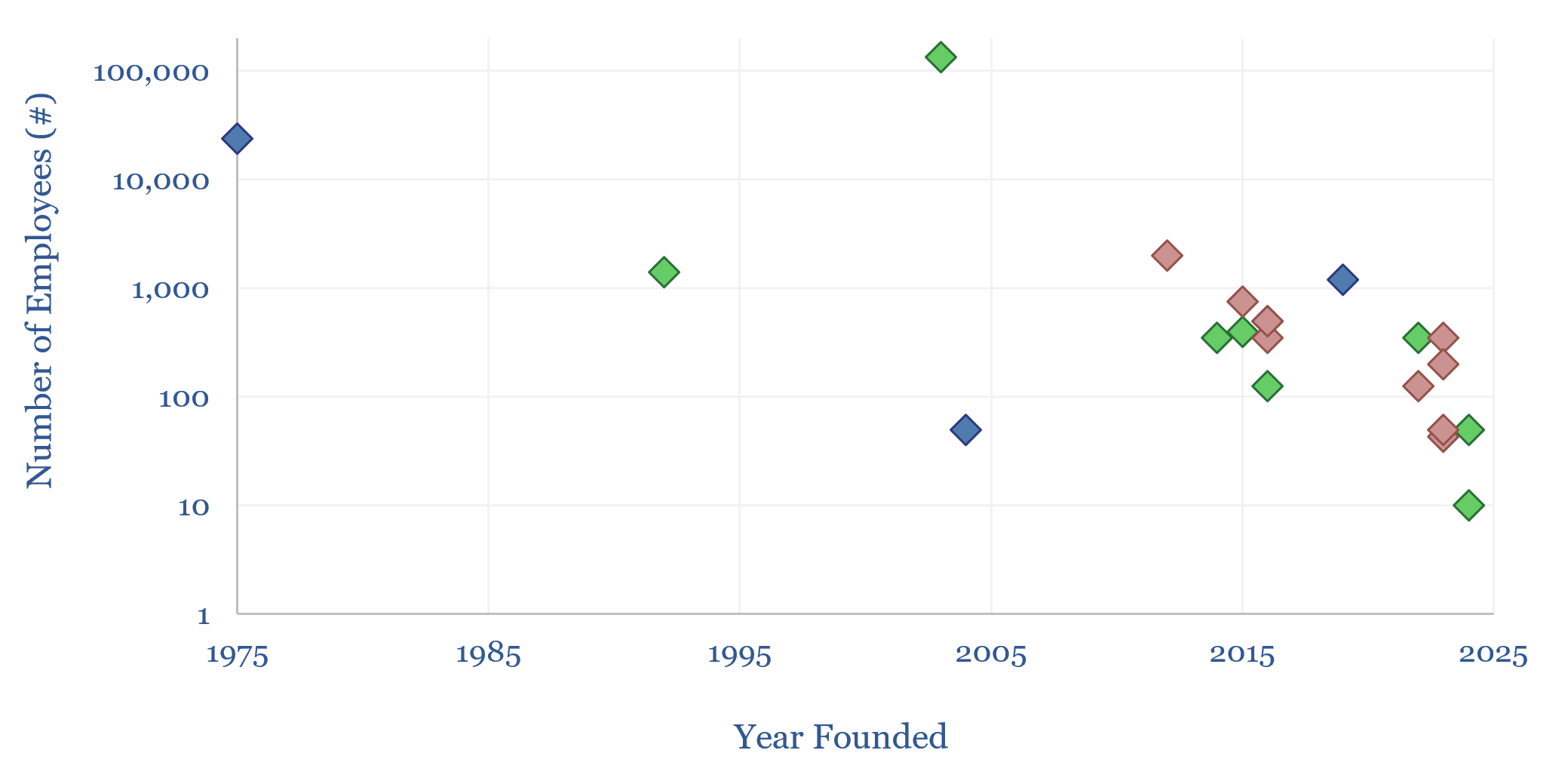
We have reviewed 20 humanoid robot concepts and robotics companies. The average example costs $80k, weighs 60kg, carries 17kg, with 40 degrees of freedom, moves at 6kmph, uses up to 500W of power, of which 10% is for 640 TOPs of onboard compute, while a 1.3kWh battery gives 3+ hours of endurance. Details for each humanoid robot concept and robotics company are in the data-file.
The great debate over humanoid robots is whether they are needed. It is hard enough to build an autonomous vehicle with 2 degrees of freedom, but humanoid robot concepts have 20-80 degrees of freedom. Hence is it easier to build highly specialized but simpler robots for specific use cases? (examples here and here). And if you want to cool down a space, you should get a simple air conditioning machine, not a complex humanoid to come and fan you.
But could we nevertheless see large deployments of complex, generalist robots, shaped like humans, before 2030?
Suggested use cases for humanoid robots in this data-file include cleaning, tidying, laundry, washing dishes, bringing items to people in a house, security, inspections, DiY, hotel-work, warehouse work, manufacturing work (especially in auto-plants).“They’ll serve you cocktails, babysit your kids, walk your dog, mow your lawn, get the groceries—whatever you can think of, it will do”, says Elon Musk.
Tesla also argues that the AI learnings from its self-driving auto program are directly relevant to bots. Tesla has a near-term target of delivering 1M robots, which will be manufactured on the former Model S and Model X auto lines in Fremont, California. A longer-term target is to produce 10M bots per year, at a Gigafactory in Texas, which is under construction.
Other companies in the data-file have reached multi-billion dollar valuations, and are producing or targeting production rates of 10,000 – 100,000 units per year before 2030. 9 are Chinese. 8 are American. 3 are European. 3 are public. All are reviewed in the data-file.
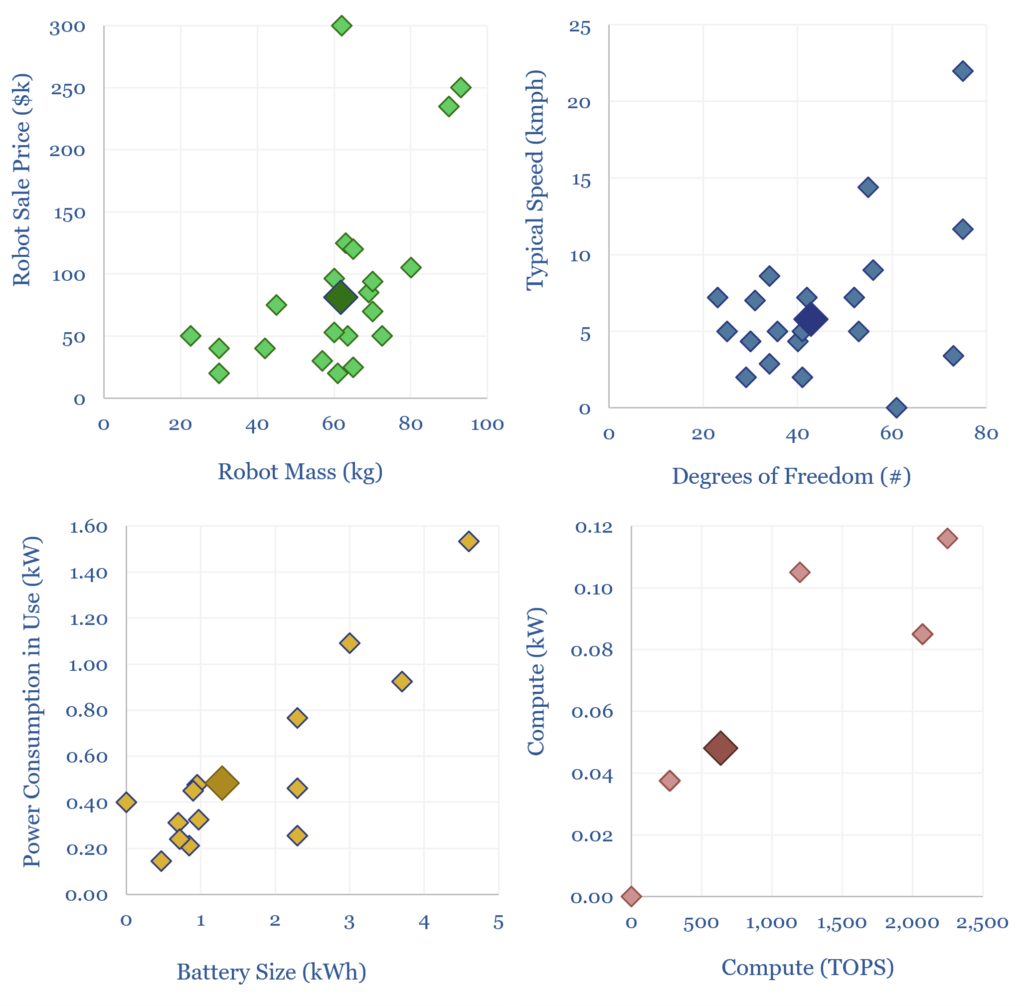
We also reviewed 20 humanoid robot concepts. The average example costs $80k, weighs 60kg, carries 17kg, with 40 degrees of freedom, moves at 6kmph, uses 500W of power, of which 10% is for 640 TOPs of onboard compute, and a 1.3kWh battery gives 3+ hours of endurance.
Larger robots have a higher payload (30% correlation) but also cost more (55%), use more power (60%) and thus require larger batteries (52%). Cross-plots are shown below.
Cameras are used in every robot, with 2-8 camera units, and an average of 3 cameras. Two-thirds of the robots also have LiDAR for depth perception, although famously, Tesla’s products do not. Another key localization technology is inertial navigation. While complex robot hands rely on feedback from pressure sensors.
The most common compute/control was via the NVIDIA Jetson Orin chip-set (50%), followed by the more recent and 7.5x more powerful NVIDIA Jetson Thor chip-set (40%). Some other examples did not contain local AI chips or are controlled from the cloud.
The more advanced robots in our screen have 2.5kWh batteries. So if humanoid production ramps to 100M per year, i.e., the same as auto production, this could require 250GWH pa of batteries, or 11% upside on the current global battery market, which we have not yet de-risked.
Materials demand for humanoid robots could reach 3MTpa of polymer/composite and 0.6 MTpa of copper, if the world produces 100M humanoids x 60kg per humanoid x 10% copper content and 50% polymer content, following a typical electronic device’s bill of materials.
Perhaps the upside is higher again. FigureAI estimates that ultimately there will be demand for 3 billion robots for corporate labor, 2 billion for home assist and 1 billion for caring for the elderly. Although we still need to see more real-world adoption, before we can de-risk this upside.