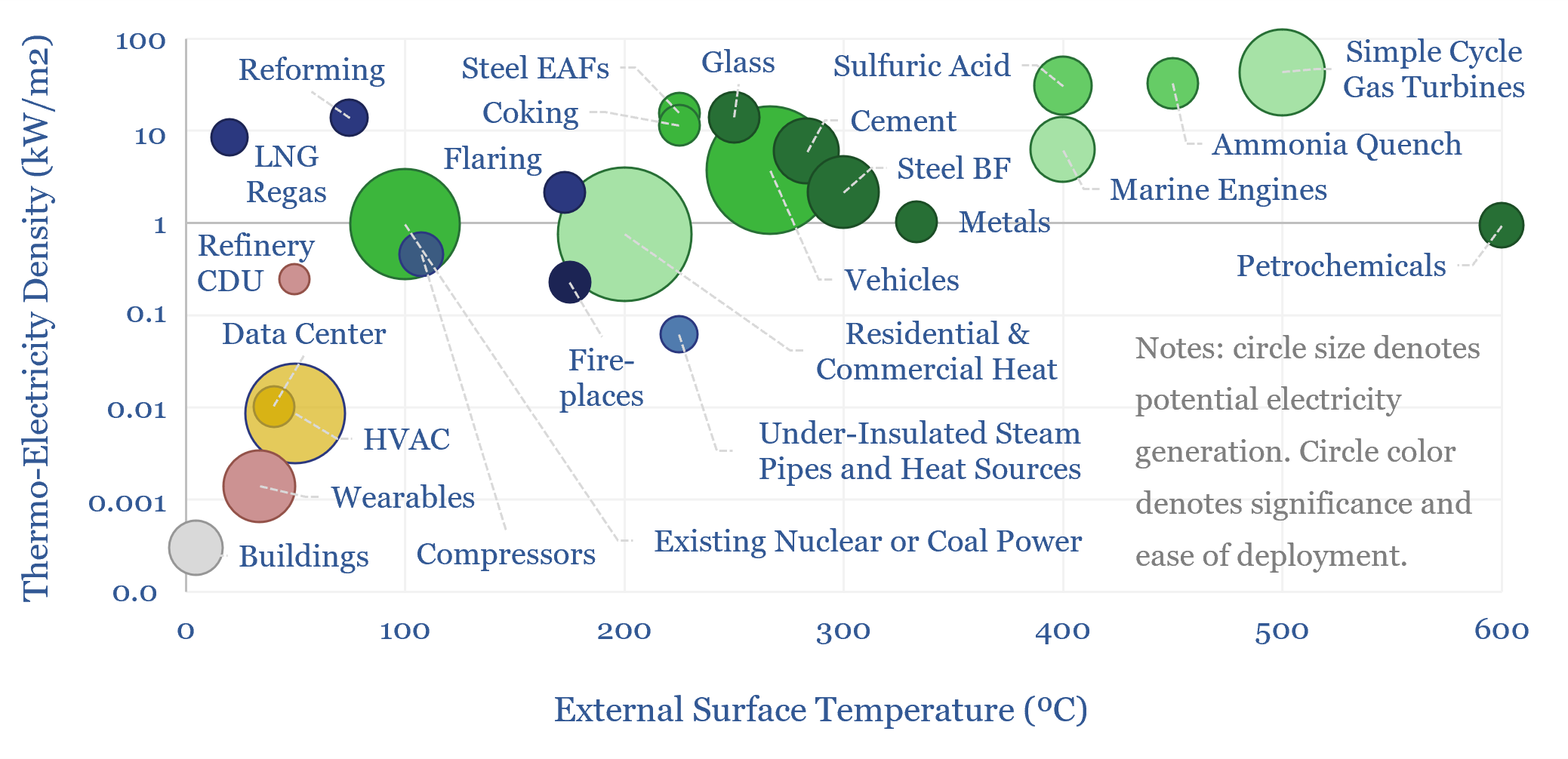
Next-generation thermoelectrics, if discovered by AI, could be a world-changer, converting heat to electricity at 10-50% efficiency, costing $500/kWe. 10,000 TWH of incremental electricity could be generated, worth $500-1,000bn pa. This 17-page report outlines our ‘top ten’ use cases for thermoelectrics.
Thermoelectrics (TE) are a remarkable class of solid-state materials, which output a direct electrical current, as they conduct heat from a source to a sink. The challenge is that today’s TEs have low efficiency and material properties, per pages 2-3.
Yet AI is now being used to trawl through multi-trillion candidate state spaces, including high entropy alloys, perovskites and metal organic frameworks, and proactively predict materials that might satisfy weird and wonderful criteria.
Hence what if novel thermoelectric materials can be discovered, which have higher efficiencies (ZT = 3-10), high stability, low costs, and can be deployed across the global energy system?
We have assessed 25+ possible applications for next-generation thermoelectrics. Hence this 17-page report sets out our top ten use cases for thermoelectrics, which could have the most world-changing potential.
Total incremental electricity potential from TEs is seen exceeding 5,000 TWH, simply from today’s pre-existing waste heat categories, which is more than today’s entire solar, wind, hydro or nuclear output, and worth $250-500bn pa (see pages 4-7).
500 TWH of this electricity, from the best industrial heat categories, could have an LCOE of 1c/kWh, especially in ammonia, steel, glass-making and cement.
Simple-cycle gas turbines could more readily recover waste heat, displacing an entire year of gas turbine additions (page 8).
Another 5,000 TWH of electricity generation could be achieved by enabling new forms of power generation to be scaled up, especially in nuclear and solar.
Novel nuclear reactor designs, which avoid the 10-20 miles of piping in conventional nuclear plants, and thus halve nuclear costs, could be opened up, enabling nuclear growth (pages 9-10).
In solar, there is a way to generate another 2-3pp efficiency per module, supporting solar growth (page 11).
In grids, effectively every home that is heated by natural gas can self-generate baseload behind the meter, at timings that dovetail with solar generation, which transforms the grid (pages 12-13).
In vehicles, attaching TEs to exhaust pipes could recuperate 1-4kW of electricity, to power the onboard compute for autonomous driving, and save 3Mbpd of oil (pages 14-15).
In medicine, always-on sensors, consuming mW, but powered only by the heat of the human body, could feed AIs that predict/prevent medical emergencies (page 16).
Other examples include deep space-faring, beyond the reaches of our solar system (page 17).
Hence we conclude that novel thermoelectrics could be one of the biggest world-changers in material science. Thermoelectrics are well worth incubating and tracking.