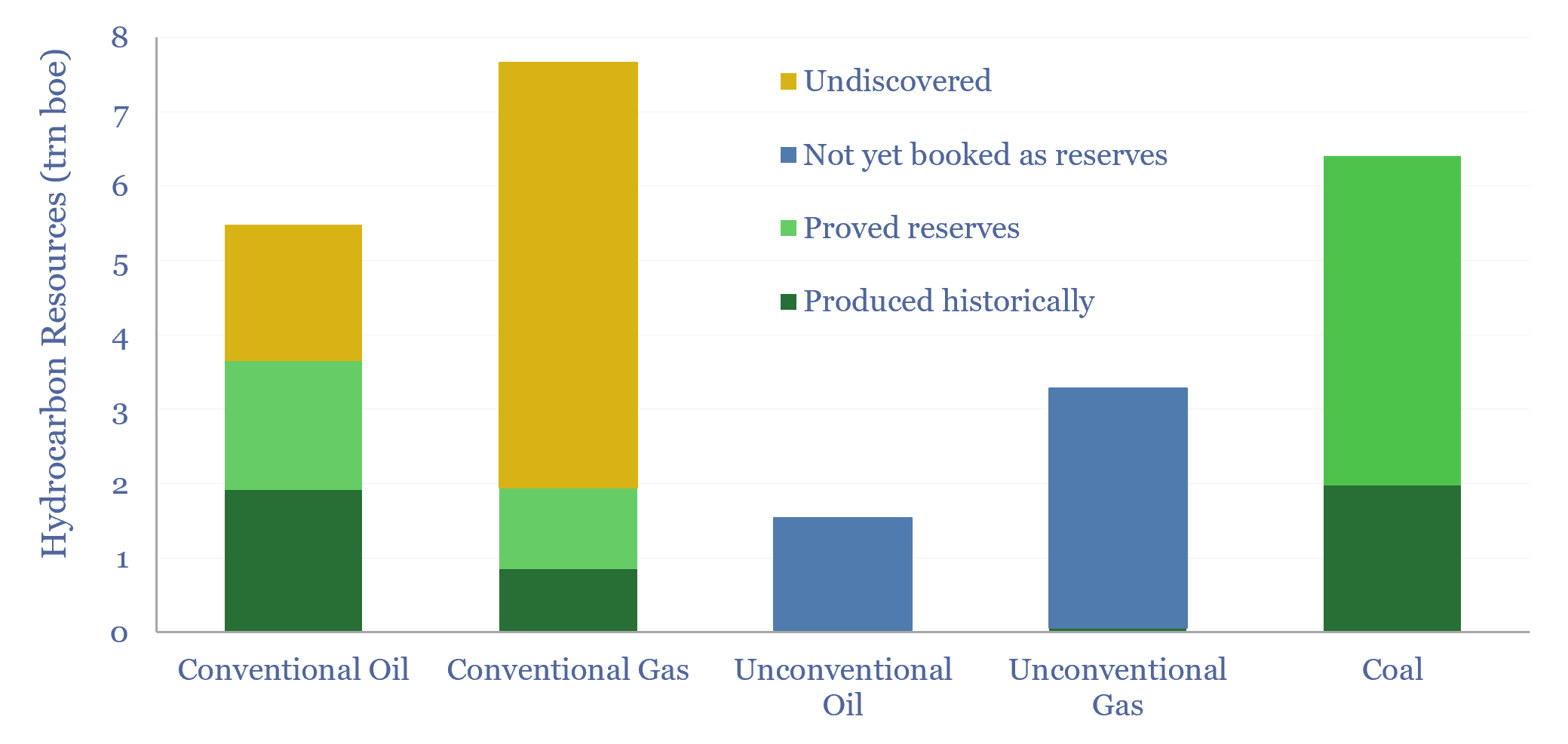
Global hydrocarbon resources and global coal resources — in-place resources and economically recoverable resources — are estimated from first principles in this data-file. We see the world’s remaining economically recoverable reserves of oil and gas being 4x larger than remaining economically recoverable reserves of coal.
Proved reserves of oil, gas and coal are available, by country, from sources such as the Energy Institute. This remains the most widely cited source for quantifying energy resources.
However, proved reserves only capture known resource accumulations. They do not capture undiscovered resources. And since these numbers have not been updated since 2020, they likely also fail to reflect unconventional resources.
Hence our goal in this data-file is to approximate how much oil, gas and coal has accumulated in the Earth, across all geological history, using a series of simplifying assumptions, which are justified by technical papers and economic models.
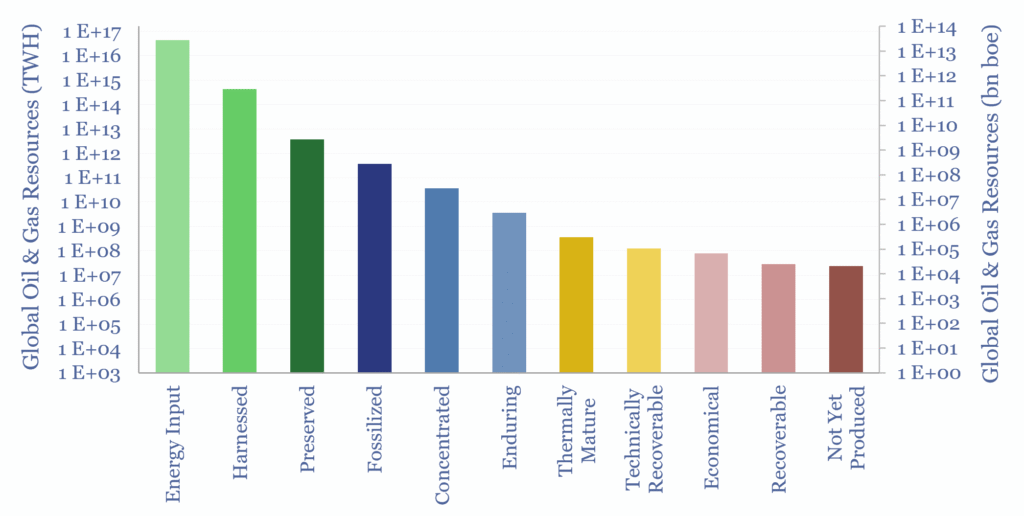
For oil and gas, we estimate that 10 ^ 17 TWH of sunlight has fallen on ancient shallow seas, over the past 750M years, since blue-green algae and plankton first evolved. But it takes 350M kWh of sunlight to yield 1kWh of oil and gas resource in-place. We estimate 25% of oil and gas resources in place should be economically recoverable (bridge below).
For coal, we estimate that 10 ^ 15 TWH of sunlight has fallen on ancient swamp forests, over the past 400M years, since vascular plants became widespread in the Devonian. It only takes 3M kWh of sunlight striking a peat swamp to produce 1kWh of coal resource in-place. So a vast 30 trn tons of coal exist of Earth. But most of this is over 1km underground, thus it cannot be mined economically, and less than 5% of that coal should be economically recoverable.
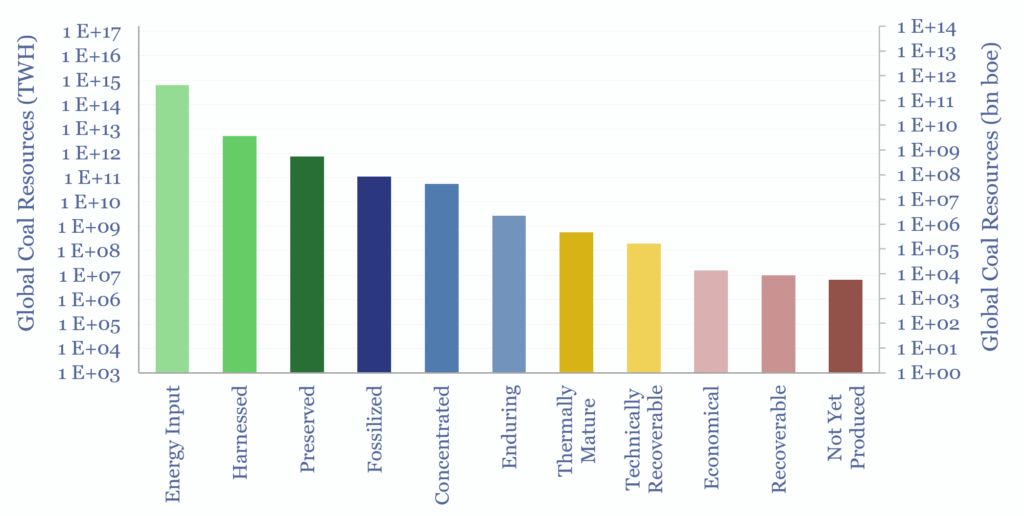
Overall, this means we see the economically recoverable remaining reserves of oil and gas being 4x more extensive than the remaining economically recoverable remaining reserves of coal, at 15 bn boe and 4 bn boe respectively.
This translates into c100-years of coal, 150-years of oil and 400-years of gas, per our 15-page report here, and justifies an energy transition away from coal and towards solar and gas in the long term energy mix.
Numbers in this model of global hydrocarbon resources ever formed are based on technical papers and other input assumptions, explained in our 15-page report, and can be stress-tested in the data-file. Numbers are given in TWH, in bn boe, in TCF for gas and in bn tons for coal.