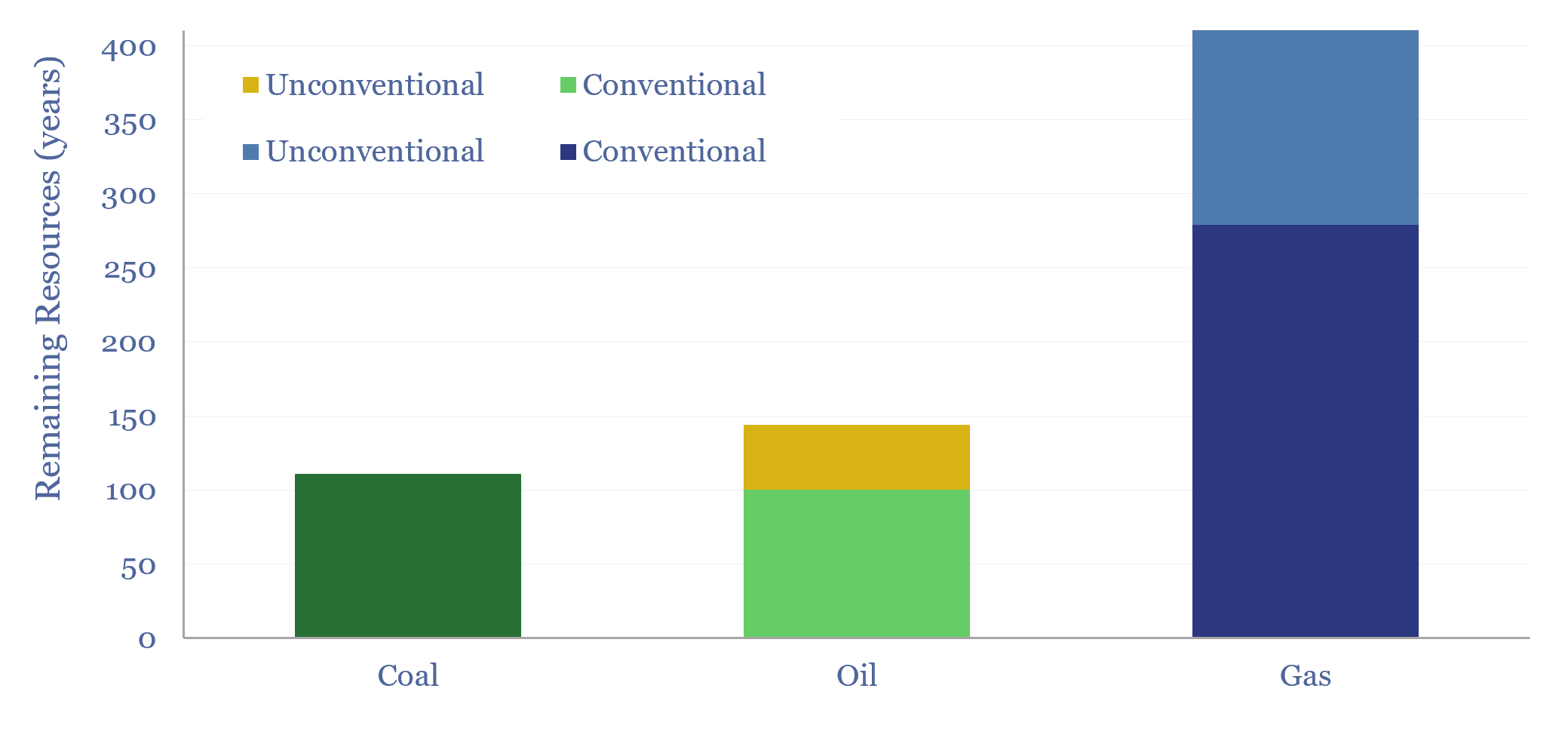
We have quantified global hydrocarbon resources, from first principles, in this 15-page report. We estimate how much oil, gas and coal ever formed across the total history of the world. And more importantly, we estimate how much is left. Our numbers support an energy transition from coal to gas.
The future global energy mix will most likely tilt towards whichever resources are most abundant and economical. This also tells us where to look for long-run opportunities.
Hence we have already estimated total global resources of wind and solar. But what are our best estimates for the world’s total remaining recoverable resources of oil, gas and coal?
“Proved reserves” of oil, gas and coal are reported by statistical agencies, such as the Energy Institute, and imply c50-years of oil and gas remain, while 140-years of coal remains.
But these numbers only include known oil and gas reservoirs. They do not reflect undiscovered oil and gas fields. They do not fully capture shale. And we think the coal numbers are over-estimated (see pages 2-3).
Hence our goal in this 15-page report is to estimate total global resources of oil, gas and coal from first principles, looking across geological time, and bridging from incoming sunlight, to organic material deposited, to resources in-place, to economically recoverable resources, using numbers from technical papers (pages 4-11).
It is impossible to reach precise numbers via this methodology, but we have compared our estimates with other bottom up quantifications of global shale resources (on page 7), or other estimates of total global coal resources in place, confirming we are in the right ballpark (on page 10).
It is also interesting to have the bridges in this report. For example, we think 350M kWh of sunlight had to fall on ancient shallow seas in order to form just 1kWh of oil/gas in-place, while only 3M kWh of sunlight needed to fall on a peat swamp per kWh of coal.
Hence more coal resources did form on Planet Earth than oil resources or gas resources. However we also find that a much greater share of coal resources have been lost to erosion across geological history.
Moreover, a much smaller share of coal resources will be economically recoverable, as 80% is buried below 1km of depth, and economics become very challenging for deep coal mining (pages 12-13).
Overall our analysis suggests around 100-years of remaining reserves of coal, and just 40-years of remaining reserves in China. This tallies with China resorting to deeper and more costly coal projects (see pages 14-15). This is our main reason for forecasting a decline in global coal production.
Remaining global gas reserves are estimated at 400-years. This is two-thirds of all remaining hydrocarbons and points to upside in global gas production and in global LNG.
Across all remaining global hydrocarbon resources, 30% are unconventional and 40% are undiscovered conventional resources. This points to upside in oil and gas supply chains, especially in seismic exploration.