The global seismic industry is worth $10bn pa. But an additional $10bn pa of value could be unlocked by AI. This 19-page report finds promising progress with AI in seismic, uplifting the value of seismic hardware and multi-client libraries. But the theme is still in early innings. Who benefits?
Potential value-creation from improved seismic imaging is illustrated on pages 2-3, by reviewing the 12bn boe of resources discovered off Guyana in the past decade, or even in a mature basin, the 25bn boe still to be found off Norway.
Yet Energy Majors are still only spending $1.3/boe on exploration capex, a 30-year low. Could this re-accelerate due to a re-prioritization of resource security after two recurring energy shocks, maturation of some shale basins, or the use of AI to improve the risk-reward of seismic?
The global seismic and geophysics industry is currently worth c$10bn pa. Offshore seismic survey costs are $10,000/km2. Hence to understand how this industry is evolving, we reviewed 500 patents and their growing use of AI, per pages 4-6.
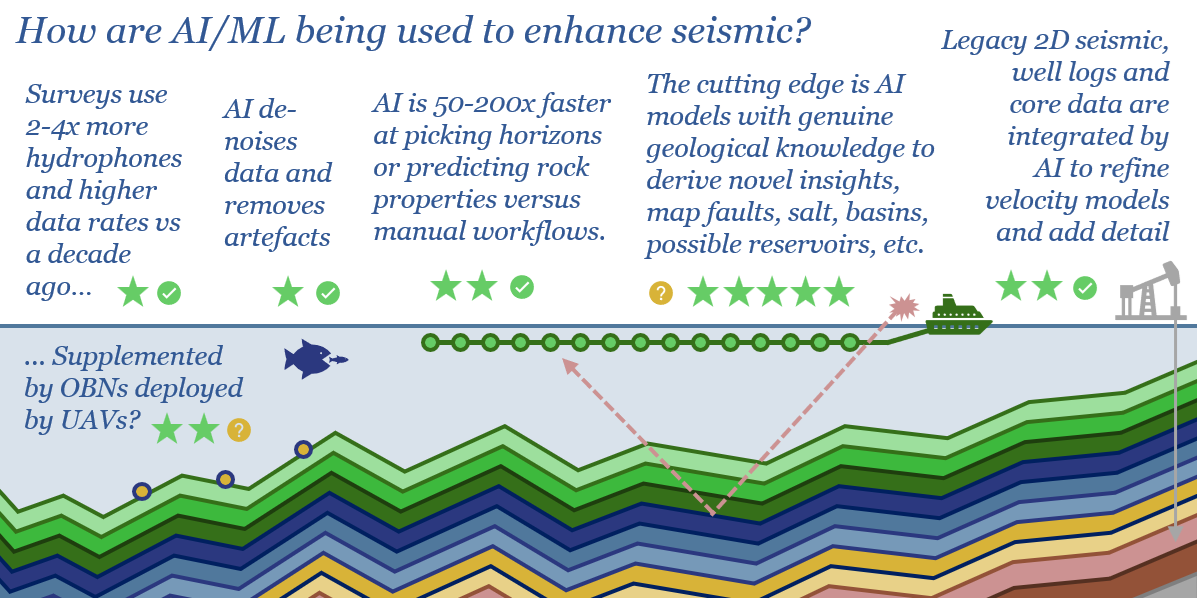
How is AI being used to create more value from seismic survey data? Successful AI deployments really only accelerated in the past decade — to de-noise data, classify horizons, or predict rock properties, 50-200x faster than previously.
The most interesting case studies we have seen, and the broader promise of using AI in seismic, across patents, technical papers and company disclosures are summarized on pages 7-11.
Economic implications. We estimate that using AI to enhance the quality of seismic imaging could add $10bn pa of value across the offshore energy industry. The numbers, implications for oil markets, for gas markets, and who benefits, are discussed on pages 12-14.
We also screened the $10b pa seismic industry. Our key conclusion on 14 companies, and their own journeys towards embracing AI, are summarized on pages 15-19.