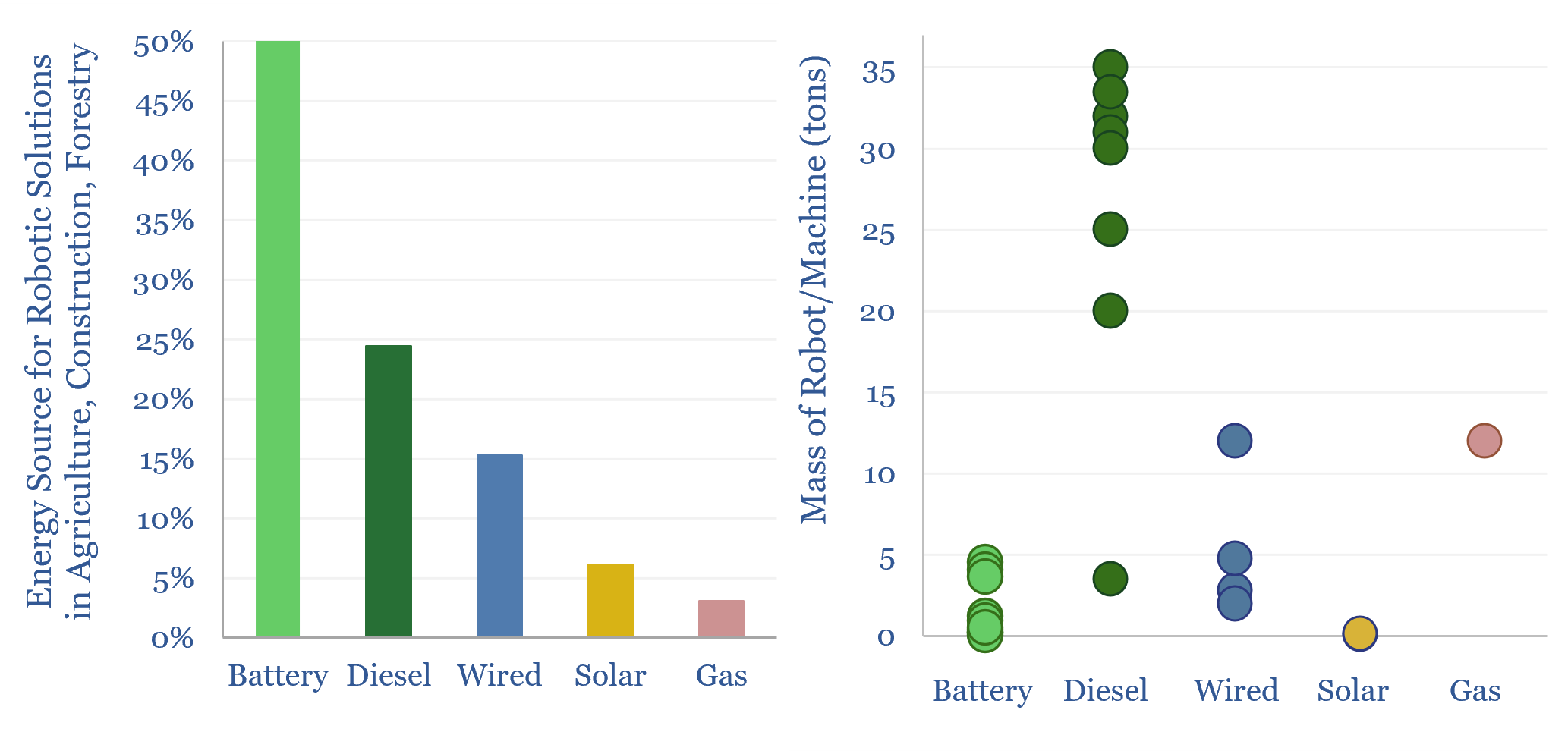
Mobile robotics companies are screened in this data-file, finding transformational impacts in construction, agriculture, forestry and solar installation. The average robot operates 50% faster and at 50% lower cost than manual methods. 50% of the robots are battery powered, 25% are diesel, and 15% are wired. Interesting companies are in the data-file.
Mobile robotics are being unlocked by AI. So how will this re-shape industries such as construction, agriculture, forestry, solar module installation, asset inspection and logistics? To answer this question, we have screened 30 robotics companies in this data-file. Note we have separately screened autonomous vehicles or mining trucks.
The average company sees its robots performing tasks that were previously undertaken by humans, often in labor-constrained industries, 50% faster, at 50% lower cost, and improving labor productivity by 3.5x.
The energy source chosen for these robotics concepts is c50% batteries, 25% diesel, 15% wired electricity, c5% direct solar powering. The average battery-powered system weighs 300kg, and as much as 5 tons.
Diesel is chosen, however, for large machines, which are often pre-existing forms of construction equipment — e.g., from companies like Caterpillar — which is then fitted with additional sensors so it can be run autonomously.
Time-critical decisions are typically handled by onboard compute, while data is also fed to the cloud to provide visibility on the machine’s activities, and for coordination/scheduling of many machines.
In agriculture, various robotic solutions can autonomously plough, furrow, sow, weed and harvest. This can be transformative. For example, a near-perfect laser-based weeding system from Carbon Robotics avoids the use of herbicides, and in turn, can increase yields by 5-50%. Another weeding system, from Aigen, is interesting because it is directly energized by a solar module, kicking in when the sun is shining and gracefully idling when it isn’t. The generation profile of solar may be well-suited to seasonal and non-constant demand profiles in agriculture, as robotics advance.
In construction, robots open up the prospect for building most of the skeleton of a home in about 1-2 days, using autonomous robots to plan/mark exact locations, autonomous excavators, autonomous wall printers/brick layers, then autonomous plasterers/painters. Companies doing each of these tasks are noted in the data-file. Rather than causing severe labor shortages, we wonder if AI enables a golden era for infrastructure-building, as a multiplier on human productivity.
In solar installation, which is now around half of a solar project’s total installed costs, at $400/kW, we are also seeing autonomous systems that can mark the locations of piles, install piles, then mount modules onto piles, and thus potentially halve many of these installation-related cost lines.
90% of the robotics companies in our data-file are relatively early-stage, venture-backed companies. Most were founded in the past decade and 30% were founded after 2020, due to continuously deflating costs of electronics and compute.