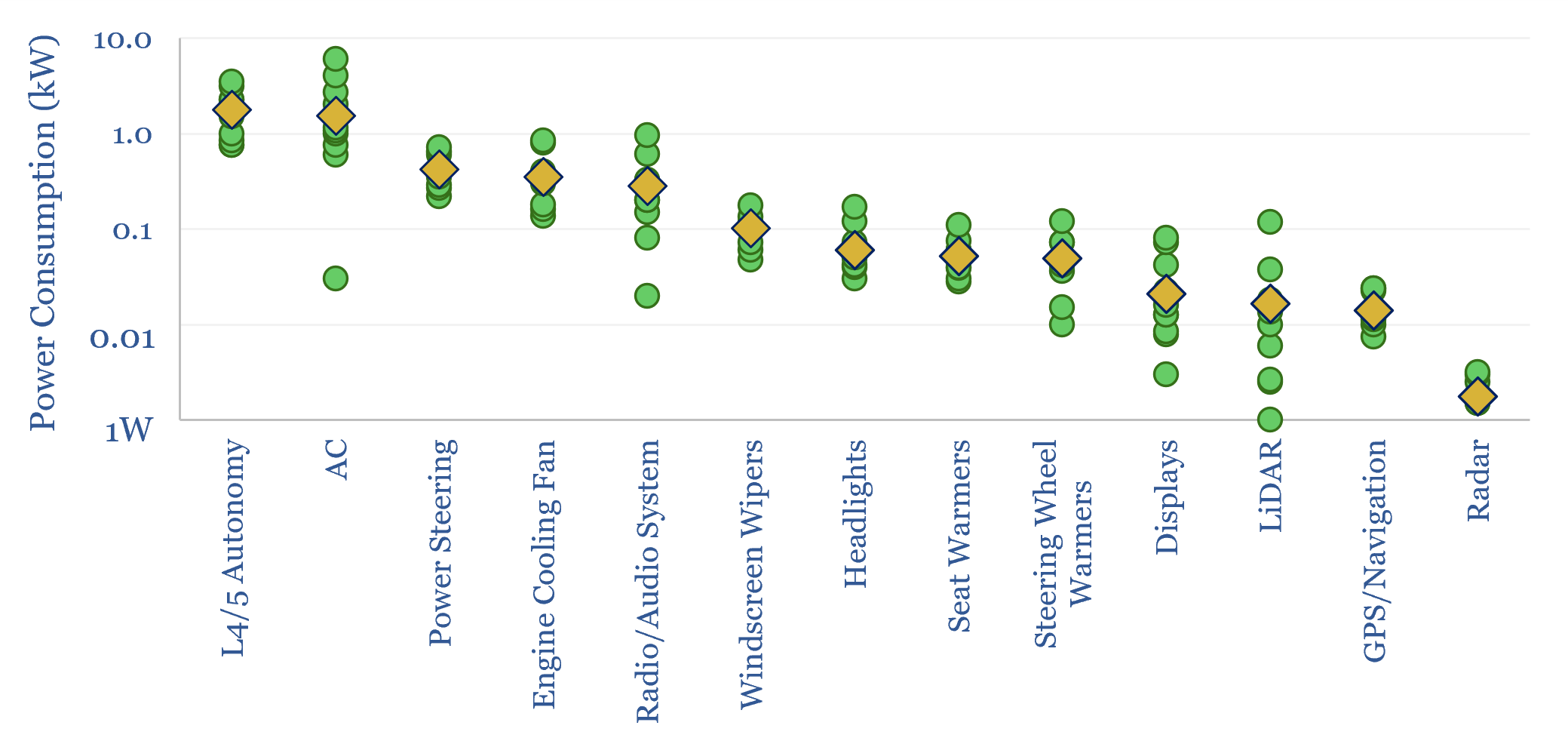
Electrical loads in vehicles typically average 1kW, in order to power HVAC, computers, engine cooling, steering, sensors and entertainment. This equates to 500TWH of electricity demand globally within ICEs, even before considering electrification. Fully autonomous vehicles would likely consume another 1-3kW again for on-board AI chips.
The global vehicle fleet stands at 1.8bn units and rises to 2.6bn by 2050, of which we estimate 1.5bn will be combustion-based and 1.2bn will be electric, in our global vehicle demand models.
However, the electrical loads in vehicles are often overlooked. If a typical car is consuming 1kW of power, on average, while it is driving, then the electricity consumption in cars is on the order of 500TWH pa, adding 1.5% on top of 32,500 TWH pa of global grid-connected electricity demand.
Major contributors to the electrical loads of vehicles are estimated in the chart above and include air conditioning, power-steering, on-board computing, engine cooling, entertainment systems, headlights, windscreen wipers, electrical warmers in seats or the steering wheel, Wi-Fi, and small sensors such as LiDAR and GPS.
HVAC is the largest load in a vehicle today. On average, an AC system might consume 1.5kW. This includes 600-1,500W while the vehicle is driving on a warm day, but the power to the AC compressor can spike to 3-7.5kW, depending on the vehicle, for initial cool-down, for example, after the vehicle has been parked in the sun.
Typically the electricity in a combustion vehicle would come from an alternator, which adds to the mechanical load on the engine. Generating each kW of electricity requires burning 0.13 gallons of fuel per hour, denting fuel economy by 7%.
There is world-changing potential for deploying level 4/5 autonomous vehicles. As of 2025-26, the on-board compute necessary to support full autonomy has been estimated in the range of 0.75 – 3.5kW, with 2kW comprising a good mid-point estimate.
The compute is almost entirely located within AI chips on-board in the vehicle, in order to enable real-time decision-making, whereas the time latency for communicating with the cloud is too long to handle critical vehicle decisions, especially if the vehicle is driving in an area outside of reliable cell coverage.
Adding 1-3kW of compute load for vehicle autonomy could thus dent fuel economy by 7-20% in a conventional ICE, and absorb another 15-30% of the power in the electricity consumption of electric vehicles, which tend to consume 0.15-0.2kWh per km.
An intriguing option to power the increased loads for full vehicle autonomy would be to attach thermoelectric materials to the 1.5m2 surface of an ICE’s exhaust pipes, which run at 150-540ºC, and thus could enable the recovery of 1-4kW of electricity from the vehicle’s waste heat. We see exciting opportunities for next-generation thermoelectrics.
This data-file estimates the electrical loads in vehicles, by category, by tabulating several data-points within each category, from company disclosures, technical papers and online discussion forums.