
Iron ore is the sixth most produced commodity in the world, at 2.7GTpa. This data file breaks down global iron ore production by company over time. Since 2019, average realizations for the largest producers have risen at 1.6% pa, while production costs have risen at 5% pa. What outlook from here?
Global iron ore production is estimated at 2.7GTpa, largely from the Pilbara in Australia (1GTpa), Minas Gerais in Brazil (0.4GTpa), and also domestically in China and India (0.3GTpa each).
Iron ore is 60% iron by mass, on a global average basis, and largely exported in bulk tankers, to smelters in China, which dominates global steel production.
This makes iron ore and steel the sixth and seventh most produced commodities in the world, behind food (10GTpa), coal (9GTpa), oil (5GTpa), cement (4GTpa), gas (3GTpa) and similar to wood (2GTpa).
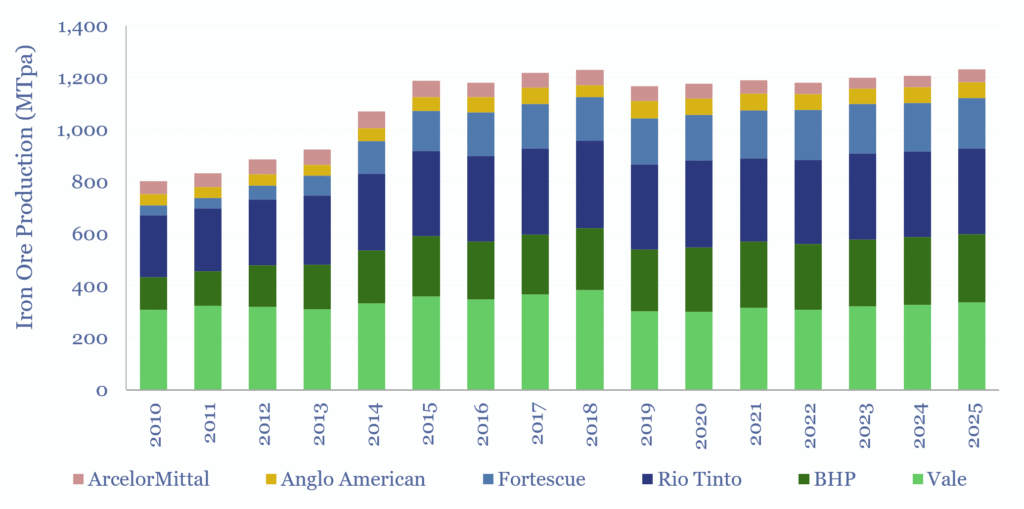
As a breakdown of global iron ore production by company, 1.4GTpa of iron ore production can be attributed to ten producers captured in this data-file, of which the largest are Vale (340MTpa, and the largest in the world), followed by Rio Tinto, BHP, Fortescue and Anglo American.
Tightening margins. Across the peer group of leading iron ore producers, revenues averaged $90/ton in 2025, the lowest since 2019, cash costs averaged $40/ton, rising at a 5% pa CAGR since 2019, and unit costs on a pure opex basis have also been rising to $20/ton.
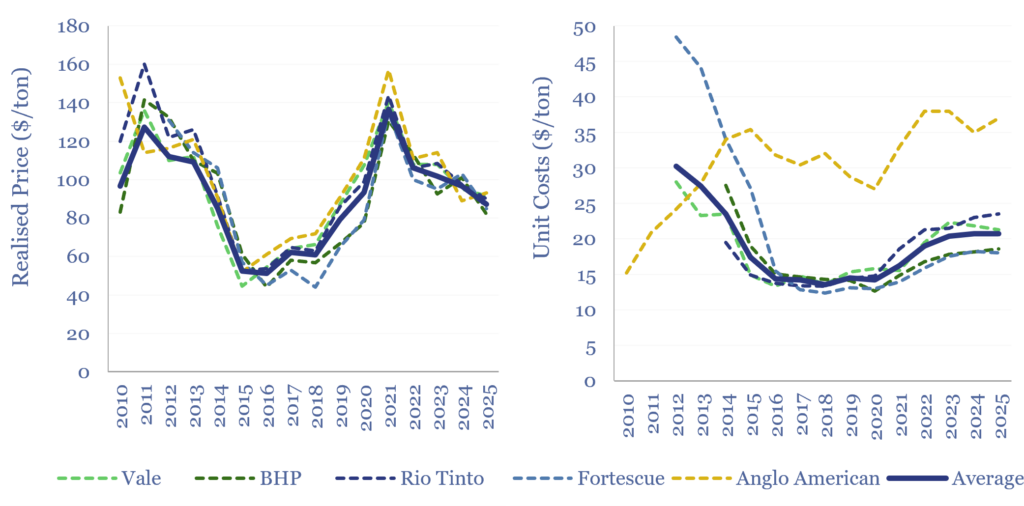
The inability to pass on higher costs through higher prices may suggest a shift in the global economy, being less driven by growth from heavy industrial activity, and more towards electrical/AI deployments. It may also indicate the start of structurally rising recovery of steel from scrap.
Energy consumption for iron ore mining is 50kWh/ton, which can be broken down in our overview of mine processes, assuming a 65% ore grade. For perspective, we assume 70kWh/ton in our coal mining model, of which 40kWh/ton is diesel for machinery and 30kWh/ton is electricity, mainly for comminution.
Processing is the energy-intensive part, as a blast furnace uses 100x more energy, at 5,400 kWh/ton, and even EAF uses 1,000kWh/ton for scrap-recycling.