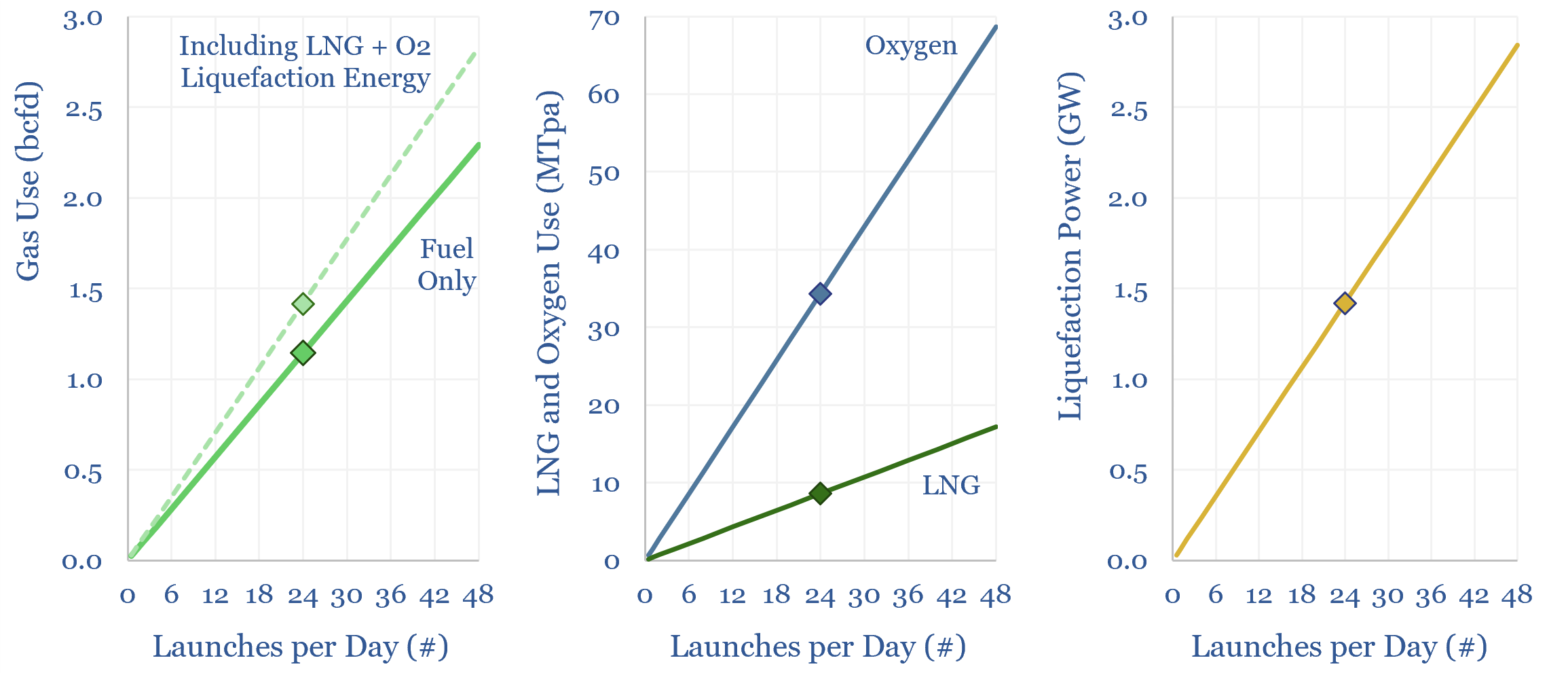
How much energy would be required to support ongoing launches of Starship spacecrafts into Low Earth Orbit? And what capital equipment would be needed to liquefy this LNG fuel and oxygen propellant? This data-file calculates hourly launches would require 1.4bcfd of gas, 9MTpa of LNG liquefaction, 34MTpa of oxygen ASUs, 1.4GW of compression power and $20bn of investment?
A Starship spacecraft with a Super-Heavy booster from SpaceX would have a dry mass of 375 tons, and contain 4,900 tons of fuel, to deliver up to 100-200 tons of payload into Low Earth Orbit. Effectively, a rocket is a giant toothpaste tube of fuel, which also stands out in our overview of rocket fuels.
A Starship launch is envisaged to take place every hour, to support more spacefaring, data centers in space or simply faster travel on Earth (as unlike passenger jets, a rocket could travel anywhere within about an hour). Hourly launches might seem like a lot, but for comparison, a flight takes off from Heathrow airport every 45-seconds, during busy periods.
Hence how much energy and what capital goods investments would be needed to support hourly launches of a Starship spacecraft with a Super-Heavy booster. How much would the fuel cost? This data-file contains a simple calculator, drawing from our other models.
1.2bcfd of natural gas would be required directly as rocket fuel to support hourly Starship launches, adding 1% to total US gas consumption, or possibly as much as 1.4bcfd if all the liquefaction equipment was energized by gas as well.
9MTpa of gas liquefaction capacity would be needed via a large, dedicated LNG liquefaction plant, costing $8-10bn, which is 2% upside on the total global LNG market.
34MTpa of oxygen must be separated from air and liquefied in a dedicated air separation plant, as an oxidant for LNG rocket fuel, also costing $8-10bn pa, which is almost 1% upside on the global industrial gas market.
The energy needed for liquefaction of gas and air depends on the liquefaction solution. Historically, compressors have been directly driven by gas turbines, but we are also seeing increasing adoption of electrically driven compressors.
1.4GW of compression energy would be needed for the gas and oxygen plants, which could either be met by 1.4GW of gas turbines, a hybrid solution incorporating solar, or round-the-clock solar (although this would not allow full launch capacity in the winter).
Overall $20bn of energy and infrastructure capex would likely be needed to support hourly Starship launches. It is fascinating that the lion’s share of this capex would go to companies in the increasingly consolidated LNG and industrial gas equipment value chain.
Numbers behind our SpaceX Starship energy and capital goods estimates are built up in this data-file. The cost of fuel and propellant thus ends up at about $5/kg launched into LEO, which is a small fraction of total launch costs. Our numbers draw from more detailed models that are linked above.