Could industrial heat pumps accelerate, especially due to excess renewables, thereby stoking load growth, and displacing natural gas? This 14-page report finds the economics are more challenging than expected. Heat pumps fare best in specific contexts. Load growth mainly hinges on AI.
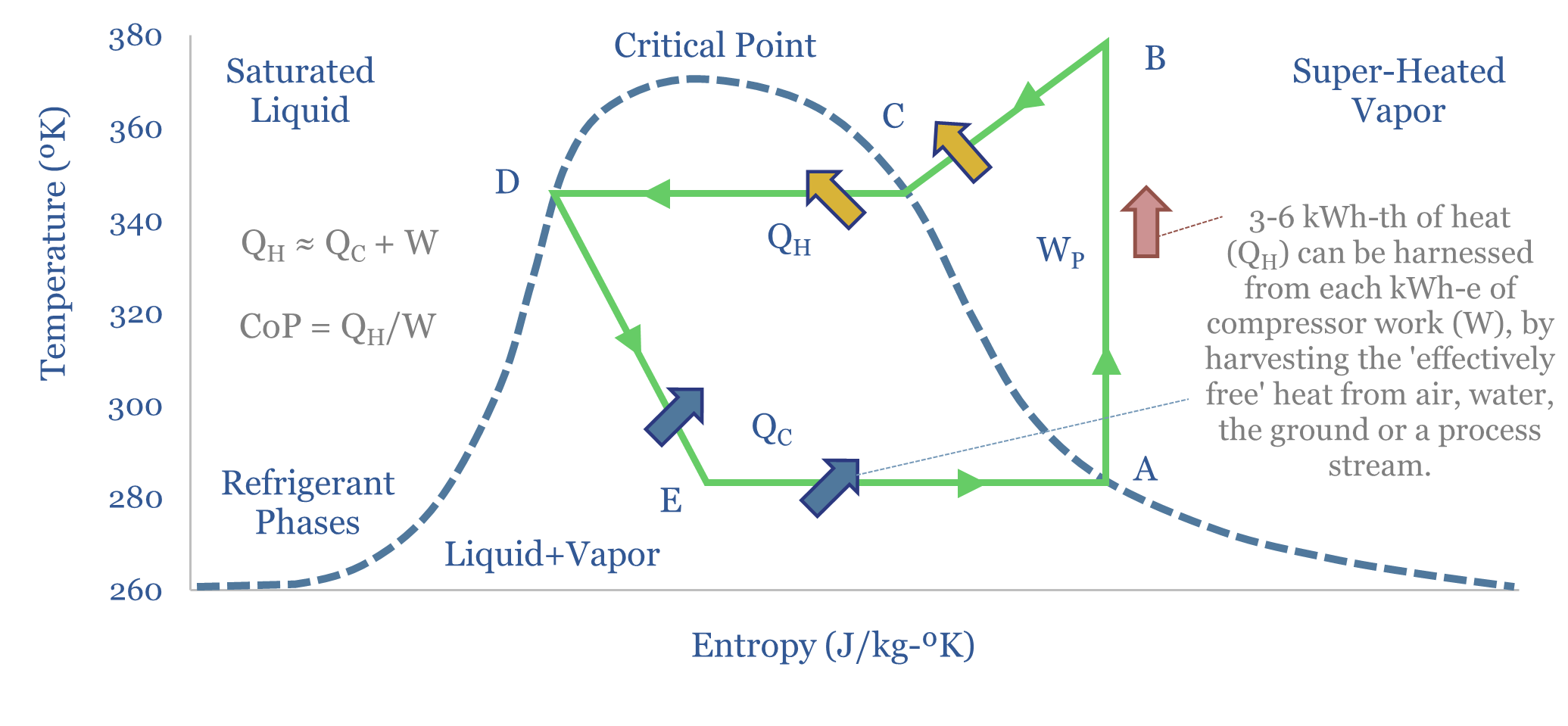
Heat pumps perform the thermodynamic alchemy of transforming small amounts of electrical energy into larger amounts of heat energy. Their functioning, and ‘Coefficients of Performance’ are explained from first principles on pages 2-3.
This tells us where we should expect to see heat pumps deployed across the global energy system, and could the faster electrification of heat contribute to US load growth, and/or to displacing natural gas, per pages 4-6?
To understand the economics of larger and/or industrial heat pumps, we started by tabulating 15 case studies, which show how larger heat pumps have actually been deployed. Conclusions are on pages 7-8.
The economics of industrial heat pumps are compared and contrasted with gas-heating, on a ‘levelized cost of heat’ basis, by region, by context, pp 9-10.
A scenario where a heat pump hybridizes an industrial facility, running at low utilization, to absorb nearly free, excess renewable electricity, on a time-of-use tariff, is explored on page 11.
The conclusions from our modeling are that the economics do not yet support a generalized acceleration of heat pumps, but they can make sense in some niches, as discussed on pages 12-13.
It is important for us to keep stress-testing our long-term energy forecasts, to see how much of the c20% of global primary energy that is currently used for low-grade heat, mainly via gas, could electrify via commercial-industrial heat pumps. Our latest global gas demand model and global electricity demand model are revisited on page 14.