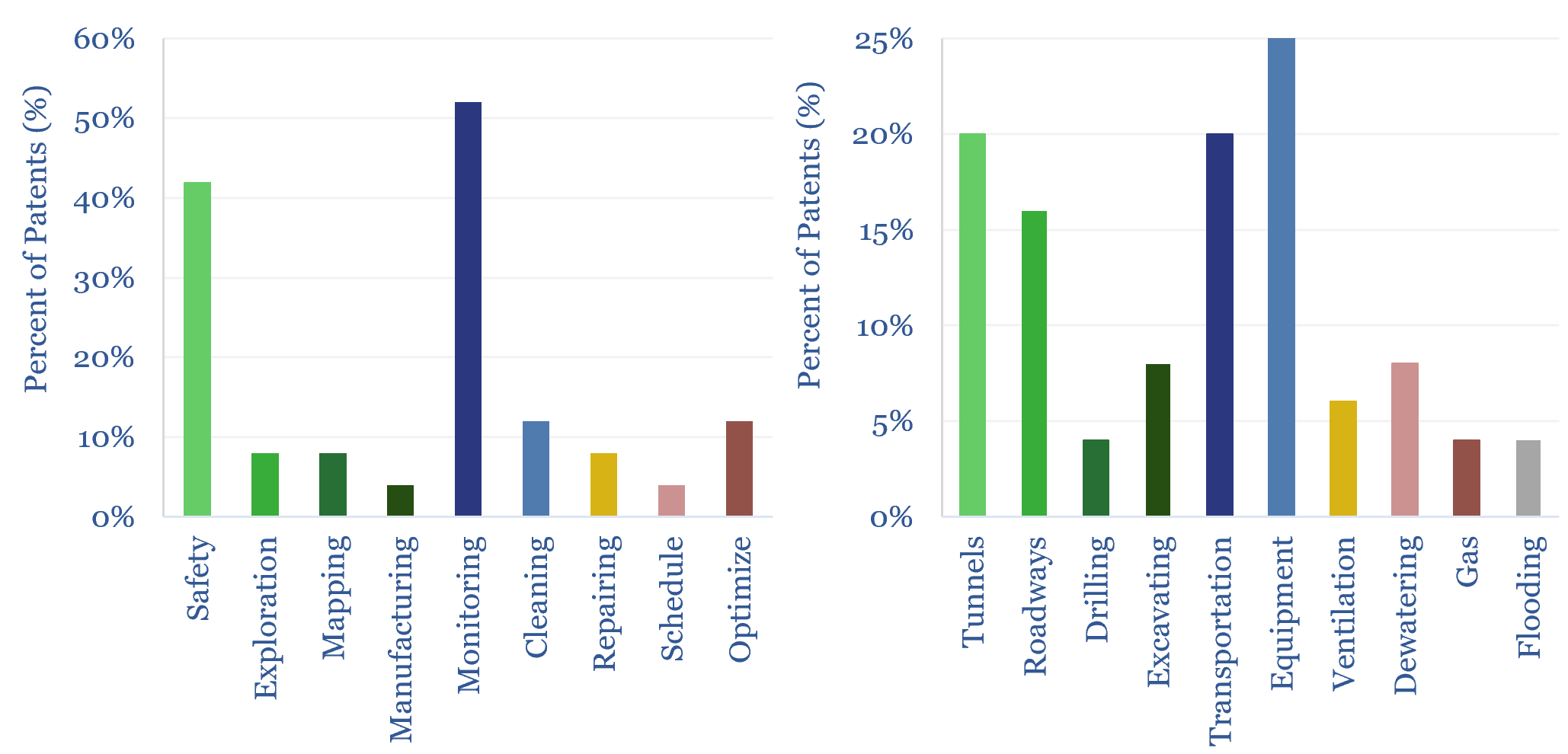
This data-file tracks the progress in deploying AI in the coal industry, and deploying robots in the coal industry, based on the evidence from patents filed in 2025 and early 2026. AI is increasingly under study, but mainly for safety and monitoring applications, and often specifically to combat resource depletion, which is discussed in c30% of the patents.
All commodities are in an ongoing battle between resource maturation and technology gains. This battle is particularly important for coal. Global coal production, at almost 9GTpa, comprises 30% of global useful energy supply-demand. And it is the maturation of coal, especially in China, that we expect to propel global gas demand higher and absorb an upcoming wave of global LNG supplies.
Hence how are AI and robotics being deployed across the coal industry? To answer this question, we searched for AI and robotics patents, filed by the coal industry, in 2025, and then reviewed a representative sample of 25 of these patents. Our notes are in this data-file.
Coal depletion is occurring. 28% of the patents in our sample explicitly mentioned depletion. This includes ever-deeper mines, with higher costs, more complex gas, water and structural issues. And a shift towards Western mining regions with more deformed stratigraphies. 60% of China’s coal resources are now in soft, low-permeability and high-gas seams.
One Chinese patent states “Shallow and easily mined coal resources are gradually decreasing, while the development of coal resources in deep and complex geological conditions is becoming more difficult”. Other comments are tabulated in the data-file.
100% of the patents in our data-file came from the Chinese coal mining industry. More than anywhere else, China is aiming to combat resource depletion, deflate costs, and improve safety by deploying AI (which, by design, was a discussion topic in 100% of the patents we reviewed) and robotics (50% of the patents).
Overall our sense from the patents is that AI and robotics deployments are under development in China’s coal industry, but the quality and quantity of patents left us with the impression that costs will likely be going sideways, or still even mildly upwards.
Most of the patents are focused on improving real-time monitoring. It is repeatedly highlighted that manual inspections are time-consuming, lack real-time visibility and lack predictive accuracy. Hence about half of the patents aimed to deploy sensors and algorithms instead. Interestingly, about 25% of the patents specifically focused on LiDAR for precise localization and mapping.
Improving worker safety was the second greatest focus area. This includes areas such as predicting gas risks, predicting possible mine collapses or predicting sudden equipment failures.
Transportation was the greatest individual focus area. This might include predictive maintenance on conveyers, while a more cutting-edge kind of application involved autonomous robots to detect damage and repair underground tunnels and robots.
Fully autonomous mining, which is a kind of sci-fi vision, deploying specialized autonomous robots, that would truly be a game changer for costs, seems to be still a long way away. The topics discussed in the patents seem to be a great enough challenge for now. Full details are in the data-file.