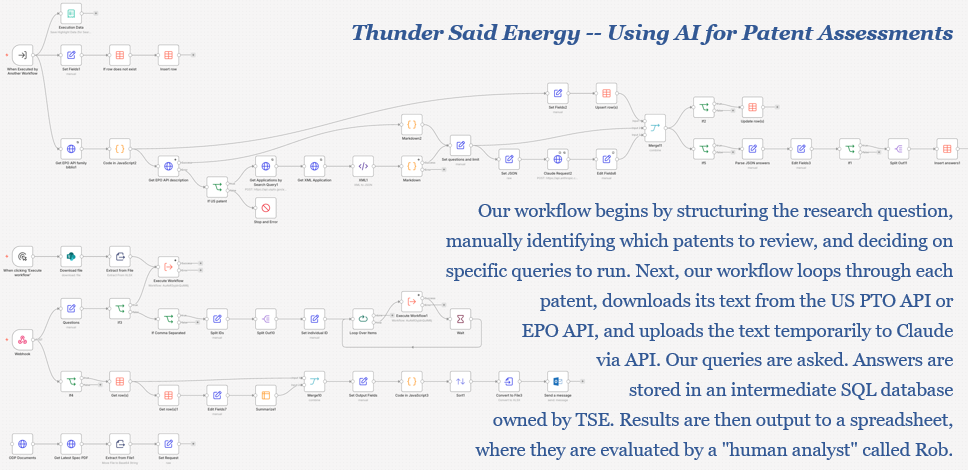
We have developed a new methodology to cover 4x more ground, and create novel data-sets, by using AI to enhance our analysis of patents. So how will this help us appraise energy technologies? This 11-page report covers our approach, data usage rights, energy use, and some of our favorite examples so far.
Our goal as analysts is to present interesting and actionable ideas to our clients, about energy technologies, which they can trust, and which are substantiated by data, often from patents.
Patents are public documents, where companies specifically disclose challenges not found in glossy marketing materials, followed by concrete details for how they are overcoming these challenges.
Hence we have conducted over 100 ‘TSE patent assessments’ to date, to understand whether we can de-risk new technologies. Our framework was initially developed by reviewing patents from Theranos, to see if we could ‘spot a fraud from its patents’. Micro conclusions from our patent analysis also inform our 50 macro energy/material supply-demand models, as recapped on page 2.
Usage rights and other legalities are particularly important as part of this endeavor. We respect all copyrights, all terms of use, especially from Espacenet, and do not engage in “web scraping”, per pages 3-4.
But a patent is like the human genome. 98% is junk DNA and only 2% encodes useful information. Hence we have recently started using AI to filter out junk, cover more ground and draw out more useful/relevant information.
Isn’t this cheating? Excel models make a good analogy. No one thinks that building an Excel model is cheating compared to using a calculator. You can build more sophisticated and useful models in Excel than with a calculator. As long as you remember that Excel is a tool, to help draw out conclusions. Where analysts go wrong with Excel is in building a big, complicated Excel model, which frankly nobody understands, then publishing research conclusions whose sole justification is that “my model says so”. “Why does it say so?” “I built an Excel model.”
Hence we will absolutely never be using AI to “write our research for us”. Steve Jobs once described a computer as “bicycle for the mind”, allowing 4x more ground to be covered per unit of energy or time. For us, AI is another type of bicycle.
This 11-page report outlines the specific details for how we are using AI to assess patents. Specific case studies and examples are given on pages 6-11. Estimates around the energy consumption of our AI usage are discussed on page 12.
Our case studies of using AI range from reviewing specific companies’ patent libraries (covering 3-4x more patents than in prior patent screens), screening different companies within the capital goods industry, informing our views of US electricity demand, finding obscure data-points into seismic imaging, and understanding new energy technologies such as high entropy materials.