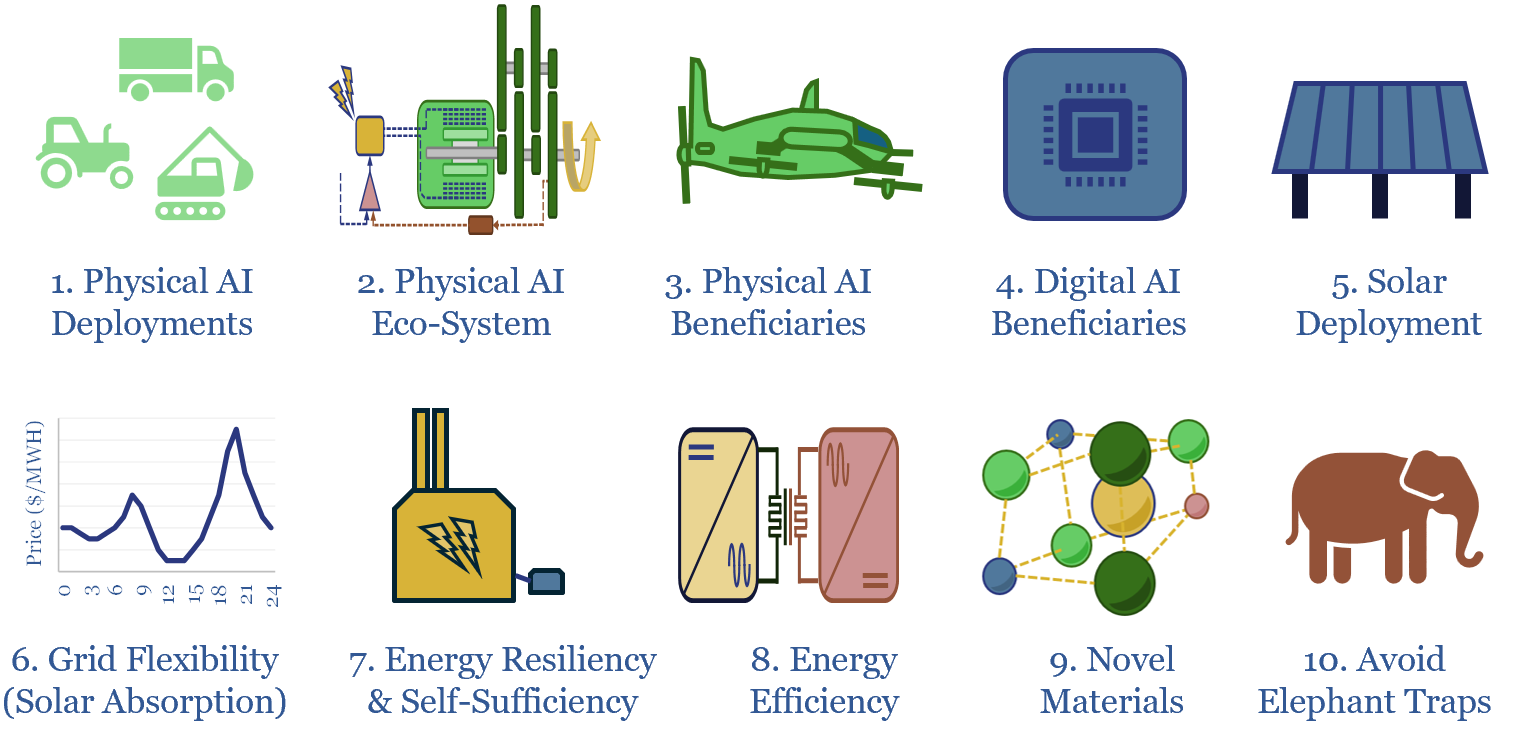
The global energy and industrial landscape is undergoing an AI energy transition. We have also recently published our top ten themes for 2H26. Hence what would be the top ten investment themes for 2026-30, amidst these new technologies, policies and opportunities? This article sets out the types of businesses that might excite us most, with links to supporting research.
#1 Physical AI deployments. Physical AI now excites us more than mere AI data center construction, which we fear could be in a speculative boom-bust cycle. Physical AI develops novel robotics concepts, for use in energy, mining, agriculture, construction and logistics. Possibly to automate tasks that are overly dull, dirty, distant and dangerous for humans. This is possible because of the simultaneous maturation of AI, autonomy, microelectronics, MEMs, batteries and solar. Examples in our research often increase productivity 1.5-10x and have 1-year paybacks when deployed. Our top overview into Physical AI is linked below. To bring the theme to life, consider reading our fascinating case study into AI-enabled robots at waste recovery facilities.
#2 The Physical AI Eco-System? This theme covers businesses that develop improved sensors, motors, microelectronics, power electronics, capacitors, copper, lithium, in order to enable the scale-up of physical AI. However, a key to unlocking value here is to have genuine technology moats (e.g. MOCVD), rather than getting caught up in a ‘race to the bottom’ (e.g., LiDAR, image sensors).
#3 Physical AI beneficiaries? Business models are emerging and becoming possible, specifically because of the step-change in AI-enabled autonomy, especially autonomous mobility. Note this theme is different from #1, as it does not involve companies deploying AI themselves, simply riding structural trends AI/autonomy. For example, consider what commercial opportunities spring up if we can deliver any small good (<4kg), anywhere within a city, within 10-minutes, for a cost of <$1, per our deep-dive into delivery drones?
#4 Digital-AI beneficiaries? Businesses in energy and industrials that can benefit from the increasing ability to create value with data. Every industry can offer up candidates in this category, including greater instrumentation and monitoring, digital twins. For example, 35% more power can be flowed through the existing transmission network at minimal incremental cost through DLR. An additional 100bn boe lies undiscovered in pre-existing seismic imagery. Utilities can minimize gas losses in the distribution network. The average digital twin lifts output 7%, cuts cost -16% and energy use by -20%.
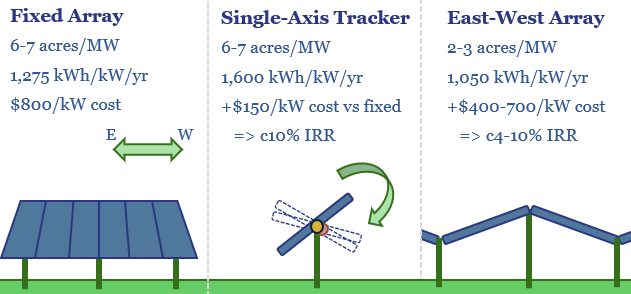
#5 Solar Deployment. This theme covers businesses that provide solar installation services, or improve the solar installation process. There is sufficient solar energy to power human civilization 200x over. Utility-scale costs today are 4-10c/kWh. They will halve again in the next decade as efficiency doubles. A key challenge has been China’s tendency to build overcapacity. But now installation, at $400/kW, comprises half the cost of a utility-scale solar project. Construction specialists, specialized regional developers or technology providers can likely unlock value.
#6 Grid flexibility (aka solar absorption). This theme covers businesses that shift grid loads away from times of strain (high costs) to times of surplus (low costs). This will increasingly be rewarded financially, by utilities, and encouraged by policymakers in the name of resource self-sufficiency and resiliency (see below), as grid interconnect times have doubled in the last decade, while the curtailment of global wind+solar rose also doubled from 4% in 2021 to 8% in 2025. Examples which are well worth understanding include using AI smart controllers, load-shifting heat pumps, battery-swap systems, and flexible data centers.
#7 Energy self-sufficiency and resiliency? This theme covers businesses that develop hydrocarbons, power projects and infrastructure projects, especially in regions whose attitudes are shifting in the face of competitive/adversarial pressures, which are possibly even overtaking ‘Net Zero’ goals in importance. There are 150-years of oil resources and 400-years of gas resources likely recoverable on Earth, of which 40% are undiscovered conventional resources and 30% are unconventional resources. Also included in this theme is developing LNG infrastructure and cyber-security.
#8 Energy efficiency. This theme covers businesses that improve the efficiency with which energy is consumed, especially in ‘energy short’ regions, such as Europe and Asia. Only 45% of primary energy is captured as useful energy today, although this has been improving at 0.8% per year. Many industrial value chains use 2-5x more energy than thermodynamic minimum, while today’s best chips still use 100M times more energy than the minimum energy of compute. Recent examples in our research might include electric ships, laser photonics and increasingly efficient appliances.
#9 Novel Materials. This theme covers businesses that develop novel catalysts and performance materials. AI is transformative for material discovery, quickly cataloguing materials that would previously have taken 800-years, or predicting the properties of novel materials from multi-million member state spaces. Thermoelectrics, high-entropy alloys and metal organic frameworks can be particularly transformative; for heat valorization, catalysis and industrial separation processes.
#10 Avoid Elephant Traps. As our final category, this theme is our final catch-all for businesses whose technologies are (close to) ready, thermodynamically justified, can be substantiated with economics, and safeguarded with high-quality moats, such as via patent filings. It historically takes 15-years to move a physical/chemical process technology from lab-stage to real-world. Policymakers set the laws of the land but not the laws or physics or economics, as proven time after time (see our case study of the Synthetic Fuels Corporation). Hence we will continue our patent screening, including using AI itself.